
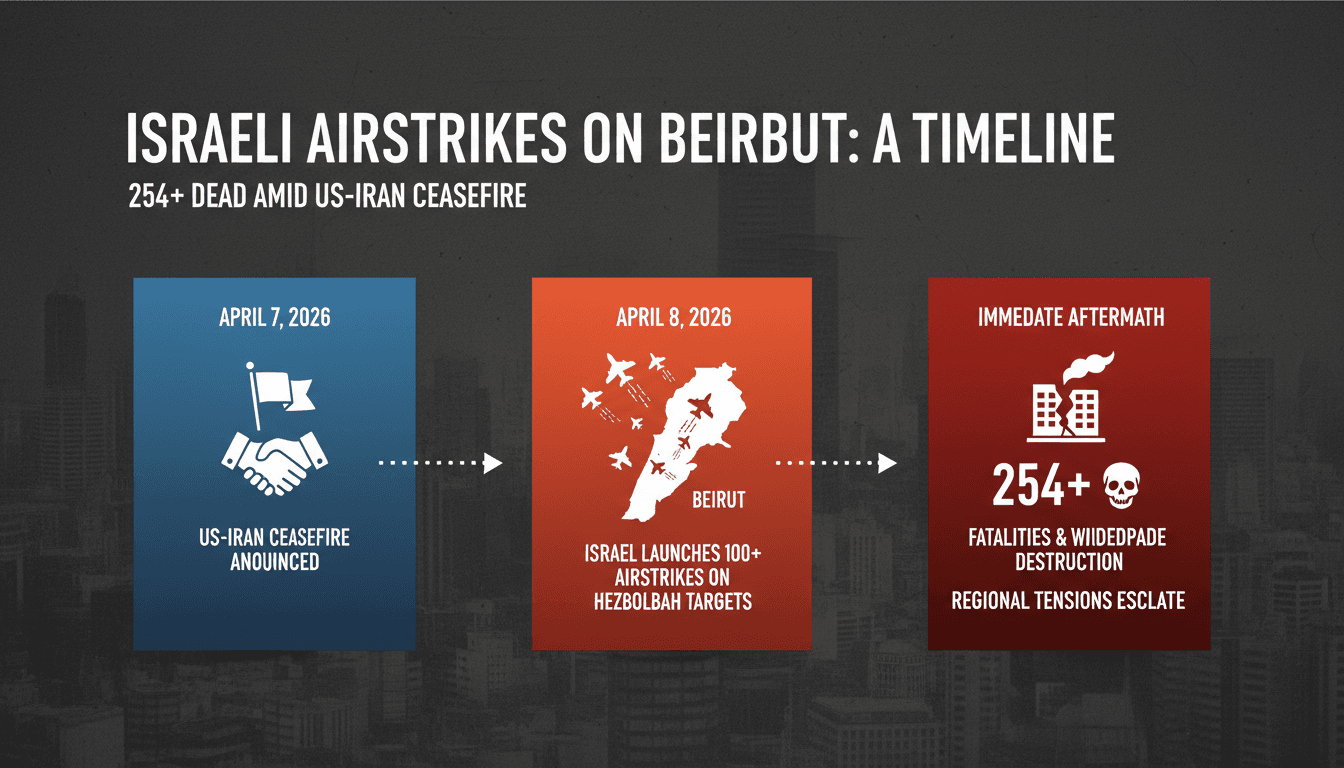
Israeli Airstrikes on Beirut Result in 254 Deaths Amid US-Iran Ceasefire
Here's what it means for you.
The escalation in Lebanon could impact global markets and international relations, affecting your investments and travel plans.
Why it matters
The airstrikes represent a significant escalation in the ongoing conflict, threatening regional stability and international economic interests.
What happened (in 30 seconds)
- On April 8, 2026, Israel launched over 100 airstrikes across Lebanon, primarily targeting Hezbollah sites.
- The strikes resulted in at least 254 deaths and over 1,165 injuries, marking the deadliest day of the conflict.
- This occurred shortly after a US-Iran ceasefire announcement, with Israel asserting the truce did not apply to Hezbollah.
The context you actually need
- The 2026 Lebanon–Israel conflict began on March 2, 2026, when Hezbollah attacked Israel in support of Iran amid a broader US-Iran war.
- Israel's military strategy aims to dismantle Hezbollah's infrastructure and establish a buffer zone, displacing over 1.2 million Lebanese citizens.
- The international community is closely monitoring the situation, with potential implications for global oil prices and Middle Eastern geopolitics.
What's really happening
The airstrikes on April 8, 2026, represent a critical juncture in the ongoing Lebanon-Israel conflict, which has escalated dramatically since March 2026. Following Hezbollah's initial attacks on Israel, the Israeli Defense Forces (IDF) executed a large-scale military response aimed at crippling Hezbollah's operational capabilities. The strikes targeted over 100 sites, including command centers and missile installations, within a rapid 10-minute window, resulting in widespread destruction in densely populated areas of Beirut and beyond.
This military action occurred just hours after a US-Iran ceasefire was announced, which Israel interpreted as not extending to Hezbollah. Israeli Prime Minister Benjamin Netanyahu and other officials justified the strikes by emphasizing the ongoing threat posed by Hezbollah, which they view as a proxy for Iranian aggression in the region. The immediate aftermath saw chaos in Beirut, with hospitals overwhelmed and rescue operations hampered by the scale of destruction.
The human cost was staggering, with 254 confirmed deaths and more than 1,165 injuries reported by the Lebanese Civil Defence. The strikes have drawn international condemnation, with Lebanese Prime Minister Nawaf Salam labeling them a "war crime." Hezbollah's swift retaliation, including rocket fire into northern Israel, indicates that the cycle of violence is likely to continue, further complicating the already volatile situation.
The broader implications of this conflict extend beyond Lebanon and Israel. The strikes have heightened tensions across the Middle East, prompting fears of a wider regional conflict. The UAE, home to a significant Lebanese expatriate community, expressed profound shock and grief, reflecting the interconnectedness of regional politics and its impact on global markets. As the situation develops, international stakeholders are closely monitoring the potential for escalation, which could disrupt oil supplies and affect global economic stability.
Who feels it first (and how)
- Lebanese civilians: Directly affected by the airstrikes, facing loss of life and property.
- Hezbollah militants: Engaged in retaliatory actions, escalating the conflict further.
- Regional governments: Particularly in the UAE, facing economic and diplomatic repercussions.
- International investors: Monitoring market volatility and geopolitical risks linked to Middle Eastern tensions.
What to watch next
- International diplomatic responses: Watch for statements from the UN and major powers regarding peace efforts and potential sanctions.
- Market reactions: Keep an eye on oil prices and stock market fluctuations as tensions escalate.
- Hezbollah's military actions: Monitor for further retaliatory strikes or escalations that could draw in other regional players.
The airstrikes resulted in significant civilian casualties and destruction in Lebanon.
The conflict will escalate further, with potential for broader regional involvement.
The long-term implications for US-Iran relations and their impact on global markets.
Frequently Asked Questions
- Why it matters?
- The airstrikes represent a significant escalation in the ongoing conflict, threatening regional stability and international economic interests.
- What happened (in 30 seconds)?
- On April 8, 2026, Israel launched over 100 airstrikes across Lebanon, primarily targeting Hezbollah sites. The strikes resulted in at least 254 deaths and over 1,165 injuries, marking the deadliest day of the conflict. This occurred shortly after a US-Iran ceasefire announcement, with Israel asserting the truce did not apply to Hezbollah.
- What's really happening?
- The airstrikes on April 8, 2026, represent a critical juncture in the ongoing Lebanon-Israel conflict, which has escalated dramatically since March 2026. Following Hezbollah's initial attacks on Israel, the Israeli Defense Forces (IDF) executed a large-scale military response aimed at crippling Hezbollah's operational capabilities. The strikes targeted over 100 sites, including command centers and missile installations, within a rapid 10-minute window, resulting in widespread destruction in dens
- Who feels it first (and how)?
- Lebanese civilians: Directly affected by the airstrikes, facing loss of life and property. Hezbollah militants: Engaged in retaliatory actions, escalating the conflict further. Regional governments: Particularly in the UAE, facing economic and diplomatic repercussions. International investors: Monitoring market volatility and geopolitical risks linked to Middle Eastern tensions.
- What to watch next?
- International diplomatic responses: Watch for statements from the UN and major powers regarding peace efforts and potential sanctions. Market reactions: Keep an eye on oil prices and stock market fluctuations as tensions escalate. Hezbollah's military actions: Monitor for further retaliatory strikes or escalations that could draw in other regional players.
Global news coverage with extensive reporting on Middle Eastern conflicts and geopolitics.
"Al Jazeera is a Qatar-based broadcaster known for wide regional coverage and alternative perspectives."
— A47 Editor
Scale of Beirut destruction revealed after wave of Israeli strikes
The recent wave of Israeli airstrikes on Beirut has resulted in extensive destruction, with reports indicating at least 182 fatalities and significant civilian casualties. The strikes have particularly targeted central areas of the city, reducing hom...
Comprehensive coverage of Middle Eastern and global issues.
"Al Jazeera is a prominent voice from the Global South, especially the Middle East, with an emphasis on underreported stories."
— A47 Editor
Scale of Beirut destruction revealed after wave of Israeli strikes
The recent wave of Israeli airstrikes on Beirut has resulted in extensive destruction, with reports indicating at least 182 fatalities and significant civilian casualties. The strikes have particularly targeted central areas of the city, reducing hom...
24/7 international news from a French perspective in multiple languages.
"France 24 is viewed as a globally focused outlet with balanced coverage and a European perspective."
— A47 Editor
Rescuers search for survivors in Lebanese capital amid new Israeli strikes
Rescuers are actively searching for survivors in Beirut following a series of devastating Israeli airstrikes that have resulted in over 200 fatalities. The strikes have caused significant destruction across the city, prompting Lebanon to declare a na...
24/7 international news from a French perspective in multiple languages.
"France 24 is viewed as a globally focused outlet with balanced coverage and a European perspective."
— A47 Editor
#Lebanon: Scenes of destruction day after ‘terrifying’ Israeli #strikes
Lebanon has declared a national day of mourning following a devastating series of Israeli airstrikes that resulted in over 250 fatalities, marking one of the deadliest days in the ongoing conflict. The strikes particularly targeted central Beirut, le...