
KelpDAO exploit leads to Aave liquidity crisis and $6 billion TVL drop
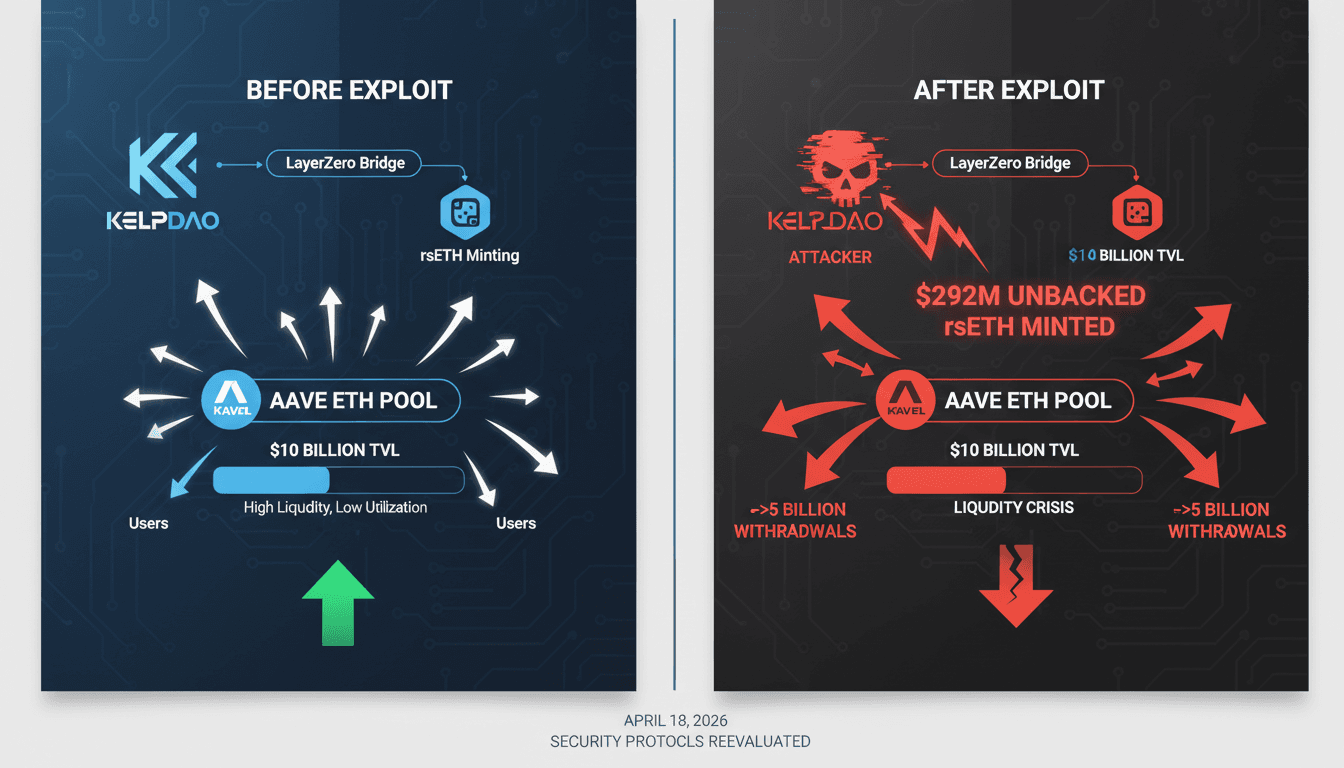
Here's what it means for you.
If you’re involved in decentralized finance (DeFi), this exploit could impact your liquidity options and asset values.
Why it matters
This incident highlights vulnerabilities in cross-chain protocols and their cascading effects on major DeFi platforms.
What happened (in 30 seconds)
- On April 18, 2026, an attacker exploited KelpDAO's LayerZero bridge, minting 116,500 unbacked rsETH tokens valued at $292 million.
- Aave's ETH pool utilization surged to 100%, leading to massive withdrawals exceeding $5 billion and a $6 billion drop in total value locked (TVL).
- KelpDAO and LayerZero paused operations, while Aave froze rsETH markets to mitigate bad debt, which reached approximately $177–200 million.
The context you actually need
- KelpDAO is a liquid restaking protocol that issues rsETH backed by EigenLayer restaked ETH, utilizing LayerZero's cross-chain capabilities.
- The exploit targeted a flaw in the bridge's message verification, allowing the minting of unbacked tokens without reserves.
- Following the exploit, Aave's TVL dropped by 21.6%, reflecting broader market instability and a bearish sentiment towards Ethereum.
What's really happening
The KelpDAO exploit is a stark reminder of the fragility inherent in decentralized finance systems, particularly those leveraging cross-chain bridges. The attacker exploited a vulnerability in LayerZero's bridge, which utilized a 1-of-1 Decentralized Verifier Network (DVN) configuration. This setup allowed the attacker to forge cross-chain messages, minting 116,500 rsETH tokens without any backing.
Once minted, these tokens were quickly deposited into Aave's lending pools on both Ethereum and Arbitrum. The attacker borrowed approximately 82,000 WETH and wstETH, leading to a staggering $177–200 million in bad debt. This sudden influx of unbacked assets caused Aave's ETH pool utilization to spike to 100%, triggering a liquidity crisis.
In response, Aave froze the rsETH markets, effectively removing borrowing power and prompting a wave of withdrawals from liquidity providers. Whales, or large holders of ETH, withdrew over $5 billion, further exacerbating the liquidity crunch and leading to a $6 billion drop in Aave's total value locked (TVL).
The aftermath saw a significant decline in AAVE token prices, with a drop of 18–20% as market participants reacted to the unfolding crisis. Other protocols, including Yearn and Maple, also withdrew liquidity, indicating a broader contagion effect across the DeFi landscape.
KelpDAO paused its contracts, and LayerZero initiated a root cause analysis to address the vulnerabilities exploited. Notably, Justin Sun, a prominent figure in the crypto space, even proposed negotiations with the hacker, highlighting the desperate measures being considered to recover lost funds and restore confidence in the ecosystem.
Who feels it first (and how)
- DeFi investors: Those holding AAVE or rsETH are directly impacted by the drop in asset values and liquidity constraints.
- Liquidity providers: Participants in Aave and similar platforms face increased risk and potential losses due to the liquidity crisis.
- Developers and protocols: Other DeFi projects may experience a loss of trust, leading to reduced participation and investment in their platforms.
- UAE crypto participants: Local investors may see indirect effects through the depreciation of AAVE tokens and constrained lending liquidity.
What to watch next
- Aave's recovery strategies: Monitor how Aave plans to mitigate the bad debt and restore liquidity in its pools, as this will influence market confidence.
- LayerZero's response: The effectiveness of LayerZero's root cause analysis and subsequent updates will be crucial in preventing future exploits.
- Market sentiment indicators: Keep an eye on DeFi total value locked (TVL) trends and Ethereum price movements, as these will signal broader market health.
The exploit resulted in a significant liquidity crisis for Aave, with a TVL drop of $6 billion.
Other DeFi protocols will face increased scrutiny and may implement stricter security measures in response to this incident.
The long-term impact on Ethereum's market position and investor confidence remains uncertain as the ecosystem adjusts to the fallout.
Frequently Asked Questions
- Why it matters?
- This incident highlights vulnerabilities in cross-chain protocols and their cascading effects on major DeFi platforms.
- What happened (in 30 seconds)?
- On April 18, 2026, an attacker exploited KelpDAO's LayerZero bridge, minting 116,500 unbacked rsETH tokens valued at $292 million. Aave's ETH pool utilization surged to 100%, leading to massive withdrawals exceeding $5 billion and a $6 billion drop in total value locked (TVL). KelpDAO and LayerZero paused operations, while Aave froze rsETH markets to mitigate bad debt, which reached approximately $177–200 million.
- What's really happening?
- The KelpDAO exploit is a stark reminder of the fragility inherent in decentralized finance systems, particularly those leveraging cross-chain bridges. The attacker exploited a vulnerability in LayerZero's bridge, which utilized a 1-of-1 Decentralized Verifier Network (DVN) configuration. This setup allowed the attacker to forge cross-chain messages, minting 116,500 rsETH tokens without any backing. Once minted, these tokens were quickly deposited into Aave's lending pools on both Ethereum and
- Who feels it first (and how)?
- DeFi investors: Those holding AAVE or rsETH are directly impacted by the drop in asset values and liquidity constraints. Liquidity providers: Participants in Aave and similar platforms face increased risk and potential losses due to the liquidity crisis. Developers and protocols: Other DeFi projects may experience a loss of trust, leading to reduced participation and investment in their platforms. UAE crypto participants: Local investors may see indirect effects through the depreciation of
- What to watch next?
- Aave's recovery strategies: Monitor how Aave plans to mitigate the bad debt and restore liquidity in its pools, as this will influence market confidence. LayerZero's response: The effectiveness of LayerZero's root cause analysis and subsequent updates will be crucial in preventing future exploits. Market sentiment indicators: Keep an eye on DeFi total value locked (TVL) trends and Ethereum price movements, as these will signal broader market health.
Research, news, and analysis on blockchain startups, DeFi, and regulations.
"Crypto Briefing provides research, news, and analysis on blockchain startups, DeFi, and crypto regulations with investor-focused coverage."
— A47 Editor
KelpDAO exploit causes AAVE ETH pool to utilization
The KelpDAO exploit has caused significant disruption in the decentralized finance (DeFi) sector, leading to a utilization crisis in the AAVE ETH pool. This incident has resulted in an estimated $280 million loss, raising alarms about the security vu...
Curated tech headlines including AI stories.
"Influential aggregator surfacing the day’s top tech/AI links."
— A47 Editor
An attacker targeting Kelp DAO's LayerZero-powered cross-chain bridge, appears to have drained ~$292M worth of rsETH before Kelp paused all rsETH contracts (Zack Abrams/The Block)
An attacker has exploited Kelp DAO's LayerZero-powered cross-chain bridge, draining approximately $292 million worth of rsETH before Kelp paused all rsETH contracts. The incident occurred on Saturday, leading to significant financial losses for the p...
Covers blockchain, cryptocurrency news, project analysis, and market insights.
"Cointelegraph is a leading crypto-focused media outlet known for timely news, analysis, and educational content related to blockchain and digital assets."
— A47 Editor
Kelp restaking platform exploited, $293M drained in attack
The Kelp restaking platform has been exploited, resulting in a significant loss of approximately $293 million. This attack has triggered a