
Class Action Lawsuit Filed Against Circle Internet Financial Over Drift Protocol Exploit
Here's what it means for you.
If you’re involved in decentralized finance (DeFi), this lawsuit could redefine the responsibilities of stablecoin issuers and impact your investments.
Why it matters
This case tests the legal boundaries of liability for stablecoin providers in the rapidly evolving DeFi landscape.
What happened (in 30 seconds)
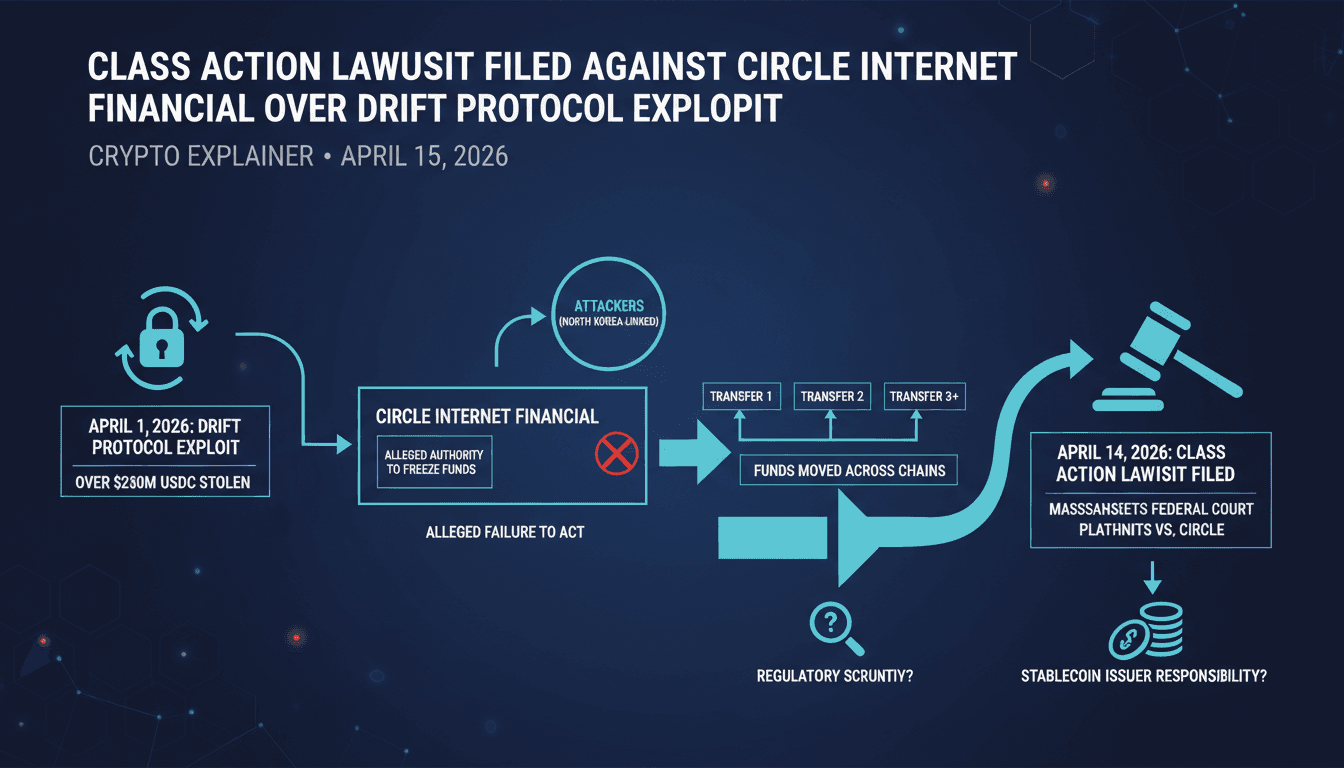
- On April 1, 2026, Drift Protocol was exploited, resulting in the theft of $280–286 million in funds.
- Circle Internet Financial, the issuer of USDC, was notified but did not freeze over $230 million in stolen assets.
- On April 14, 2026, a class action lawsuit was filed against Circle, claiming negligence in their response to the exploit.
The context you actually need
- Drift Protocol is a decentralized exchange on Solana that specializes in perpetual futures trading and had recently removed a timelock safeguard.
- Attackers, linked to North Korea's Lazarus Group, executed a sophisticated social engineering operation to gain control of the protocol and drain funds rapidly.
- Circle's defense hinges on regulatory constraints, stating that asset freezes require legal authorization, raising questions about the responsibilities of stablecoin issuers in DeFi breaches.
What's really happening
The Drift Protocol exploit represents a significant event in the DeFi space, highlighting vulnerabilities that can be exploited by sophisticated attackers. The attackers, reportedly linked to North Korea's Lazarus Group, executed a six-month social engineering campaign to gain control over the protocol. By securing pre-signed administrative transactions and deploying fake collateral, they were able to drain funds in a matter of minutes.
Circle Internet Financial, the issuer of USDC, was notified of the exploit but did not take action to freeze the stolen assets. Their inaction has sparked a class action lawsuit, which raises critical questions about the responsibilities of stablecoin issuers in the event of a breach. Circle's leadership has stated that freezing assets requires legal authorization from law enforcement or courts, which they argue protects them from unilateral actions that could have broader implications.
This lawsuit is significant because it could set a precedent for how stablecoin issuers are held accountable in the future. If the court finds Circle liable for negligence, it may lead to stricter regulations and expectations for stablecoin providers regarding their response to security breaches. This could also impact investor confidence in DeFi platforms, as users may demand more robust protections and assurances from stablecoin issuers.
The aftermath of the exploit has already seen Drift Protocol pivoting from USDC to USDT, securing up to $150 million in recovery support from Tether. However, the protocol's total value locked has plummeted from $550 million to under $250 million, and the value of its DRIFT token has fallen over 40%. This decline reflects the broader market's reaction to the exploit and the uncertainty surrounding the responsibilities of stablecoin issuers.
As the lawsuit progresses, the industry is closely watching how it will influence the regulatory landscape for DeFi and stablecoins. The outcome could reshape the operational frameworks of these entities, potentially leading to more stringent compliance measures and a reevaluation of risk management practices.
Who feels it first (and how)
- Investors in Drift Protocol: They face significant financial losses and uncertainty about the future of their investments.
- Stablecoin issuers: Companies like Circle may face increased scrutiny and regulatory pressure, impacting their operational strategies.
- DeFi platforms: Other decentralized exchanges may need to reassess their security measures and response protocols to avoid similar situations.
What to watch next
- Legal developments: Monitor the progress of the class action lawsuit against Circle, as its outcome could set a precedent for future cases.
- Regulatory changes: Watch for potential regulatory responses from authorities regarding stablecoin issuer responsibilities in the wake of this exploit.
- Market reactions: Observe how the DeFi market adjusts to the fallout from the exploit, particularly in terms of investor confidence and platform security measures.
The Drift Protocol exploit resulted in the theft of $280–286 million, with over $230 million in USDC not frozen by Circle.
The lawsuit will prompt discussions about the legal responsibilities of stablecoin issuers in DeFi.
The long-term impact on investor confidence in DeFi platforms and stablecoins remains uncertain.
Frequently Asked Questions
- Why it matters?
- This case tests the legal boundaries of liability for stablecoin providers in the rapidly evolving DeFi landscape.
- What happened (in 30 seconds)?
- On April 1, 2026, Drift Protocol was exploited, resulting in the theft of $280–286 million in funds. Circle Internet Financial, the issuer of USDC, was notified but did not freeze over $230 million in stolen assets. On April 14, 2026, a class action lawsuit was filed against Circle, claiming negligence in their response to the exploit.
- What's really happening?
- The Drift Protocol exploit represents a significant event in the DeFi space, highlighting vulnerabilities that can be exploited by sophisticated attackers. The attackers, reportedly linked to North Korea's Lazarus Group, executed a six-month social engineering campaign to gain control over the protocol. By securing pre-signed administrative transactions and deploying fake collateral, they were able to drain funds in a matter of minutes. Circle Internet Financial, the issuer of USDC, was notifi
- Who feels it first (and how)?
- Investors in Drift Protocol: They face significant financial losses and uncertainty about the future of their investments. Stablecoin issuers: Companies like Circle may face increased scrutiny and regulatory pressure, impacting their operational strategies. DeFi platforms: Other decentralized exchanges may need to reassess their security measures and response protocols to avoid similar situations.
- What to watch next?
- Legal developments: Monitor the progress of the class action lawsuit against Circle, as its outcome could set a precedent for future cases. Regulatory changes: Watch for potential regulatory responses from authorities regarding stablecoin issuer responsibilities in the wake of this exploit. Market reactions: Observe how the DeFi market adjusts to the fallout from the exploit, particularly in terms of investor confidence and platform security measures.
Covers Bitcoin plus altcoin news, market updates, and educational resources.
"Bitcoin.com provides news, market data, and guides focused on Bitcoin and the wider crypto industry."
— A47 Editor
Circle Faces Lawsuit After Drift Exploit Over Claims It Took No Action to Freeze the Funds
Circle is facing a lawsuit in Massachusetts following the $280 million hack of the Drift Protocol, which occurred on April 1, 2026. Plaintiffs allege that Circle failed to take timely action to freeze the stolen funds, raising serious concerns about ...
News and analysis on Bitcoin, altcoins, and blockchain innovation.
"Bitcoinist delivers news and analysis on Bitcoin, altcoins, and blockchain innovation with a focus on market trends and industry updates."
— A47 Editor
Crypto Shockwave: Circle Sued As $280 Million Drift Hack Unravels
Circle is facing a class action lawsuit in Massachusetts following a $280 million hack of the Drift Protocol, attributed to North Korean hackers. Plaintiffs allege that Circle failed to take timely action to freeze the stolen funds, raising questions...
Real-time updates, analysis, and reports on the blockchain and cryptocurrency sectors.
"Crypto News delivers real-time updates, analysis, and reports on the blockchain and cryptocurrency sectors."
— A47 Editor
Circle faces lawsuit as $230M in stolen USDC moved across chains after Drift breach
Circle is facing a class action lawsuit in Massachusetts over its alleged failure to freeze approximately $280 million in stolen USDC following the Drift Protocol hack that occurred on April 1, 2026. The lawsuit, initiated by investor Joshua McCollum...
Bitcoin news, technical analysis, and forecasts across crypto markets.
"NewsBTC covers Bitcoin news, technical analysis, and forecasts across crypto markets and major blockchain projects."
— A47 Editor
Circle (CRCL) Sued Over $280M Drift Protocol Hack—What Plaintiffs Claim
Circle (CRCL) is facing a lawsuit in Massachusetts related to the $280 million hack of the Drift Protocol that occurred on April 1, 2026. The plaintiffs, represented by the law firm Gibbs Mura, allege that Circle failed to act to freeze the stolen fu...
Research, news, and analysis on blockchain startups, DeFi, and regulations.
"Crypto Briefing provides research, news, and analysis on blockchain startups, DeFi, and crypto regulations with investor-focused coverage."
— A47 Editor
Circle faces lawsuit over Drift Protocol hack, Solana under $40 April 15
Circle is facing a lawsuit following the hack of the Drift Protocol, which resulted in significant financial losses and raised concerns about security measures within decentralized finance (DeFi). The incident has negatively impacted market confidenc...