
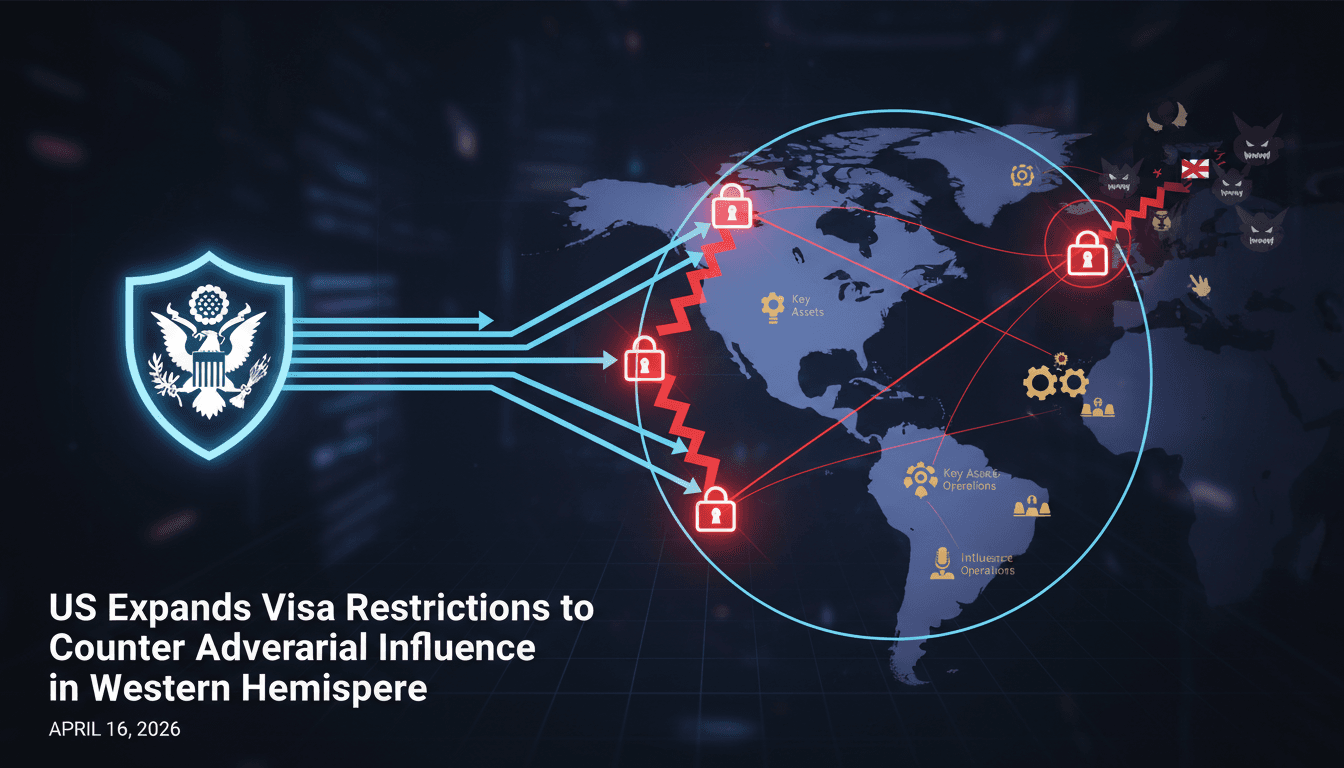
US Expands Visa Restrictions to Counter Adversarial Influence in Western Hemisphere
Here's what it means for you.
If you work in international relations or trade, this policy could reshape your engagement strategies in the Western Hemisphere.
Why it matters
This expansion of visa restrictions signals a heightened U.S. commitment to countering foreign influence in a geopolitically sensitive region.
What happened (in 30 seconds)
- On April 16, 2026, the U.S. Department of State announced an expansion of its visa restriction policy targeting nationals from the Western Hemisphere.
- The policy affects 26 individuals engaged in activities undermining U.S. interests, barring them and their families from entering the U.S.
- This move builds on previous restrictions aimed at individuals collaborating with adversarial powers like China and Russia.
The context you actually need
- The policy is rooted in existing legislation, specifically Section 212(a)(3)(C) of the Immigration and Nationality Act, which allows for visa restrictions based on national security concerns.
- It reflects a broader strategy under the Trump administration to limit foreign influence in Latin America and the Caribbean, particularly from nations like China and Russia.
- Previous restrictions have targeted specific groups, including Central American nationals and Cuban officials, indicating a focused approach to countering adversarial actions.
What's really happening
The U.S. Department of State's recent announcement marks a significant escalation in its efforts to safeguard national interests in the Western Hemisphere. By expanding visa restrictions to include a broader range of nationals, the U.S. aims to deter foreign influence that could destabilize regional security and undermine American economic interests.
This policy is not merely a reaction to isolated incidents but part of a strategic framework designed to counteract the growing presence of adversarial powers in Latin America. The targeted individuals are accused of engaging in activities that facilitate foreign control over critical assets, thereby posing a direct threat to U.S. interests. The inclusion of immediate family members in the restrictions amplifies the impact, creating a more comprehensive deterrent against those considering actions that could harm U.S. interests.
The expansion builds on previous measures taken against specific groups, such as Central American nationals collaborating with the Chinese Communist Party and Cuban officials involved in forced labor schemes. This continuity suggests a systematic approach to identifying and restricting individuals who pose a risk to U.S. sovereignty and security.
The implications of this policy extend beyond the immediate visa restrictions. It sends a clear message to both allies and adversaries about the U.S. commitment to maintaining influence in the region. By actively denying entry to individuals perceived as threats, the U.S. aims to reinforce its geopolitical standing and deter further encroachment by adversarial nations.
Moreover, the policy aligns with President Trump's broader National Security Strategy, which emphasizes the need to counteract foreign influence in vital hemispheric assets. As geopolitical competition intensifies, particularly with nations like China and Russia seeking to expand their foothold in Latin America, the U.S. is positioning itself as a defender of regional stability and economic integrity.
In summary, this visa restriction policy is a calculated move to protect U.S. interests in a rapidly changing geopolitical landscape. It reflects a proactive stance against foreign influence and underscores the importance of maintaining control over key assets in the Western Hemisphere.
Who feels it first (and how)
- Government officials in the Western Hemisphere may face increased scrutiny and pressure from the U.S.
- Business leaders engaged in trade or investment in affected countries could experience disruptions or changes in partnership dynamics.
- Immigrants and expatriates from the targeted nations may find their mobility restricted, impacting their ability to travel for work or family reasons.
What to watch next
- Reactions from Western Hemisphere governments: How will other nations respond to these restrictions? Their diplomatic strategies could shift significantly.
- Impact on U.S.-Latin America trade relations: Watch for any changes in trade agreements or economic partnerships as a result of heightened tensions.
- Future visa policy expansions: Monitor whether additional individuals or countries are added to the restriction list, indicating a broader trend in U.S. immigration policy.
The U.S. has imposed visa restrictions on 26 individuals from the Western Hemisphere.
Other nations in the region may reassess their relationships with the U.S. in light of these restrictions.
The long-term economic impact on U.S.-Latin America relations remains to be seen.
Frequently Asked Questions
- Why it matters?
- This expansion of visa restrictions signals a heightened U.S. commitment to countering foreign influence in a geopolitically sensitive region.
- What happened (in 30 seconds)?
- On April 16, 2026, the U.S. Department of State announced an expansion of its visa restriction policy targeting nationals from the Western Hemisphere. The policy affects 26 individuals engaged in activities undermining U.S. interests, barring them and their families from entering the U.S. This move builds on previous restrictions aimed at individuals collaborating with adversarial powers like China and Russia.
- What's really happening?
- The U.S. Department of State's recent announcement marks a significant escalation in its efforts to safeguard national interests in the Western Hemisphere. By expanding visa restrictions to include a broader range of nationals, the U.S. aims to deter foreign influence that could destabilize regional security and undermine American economic interests. This policy is not merely a reaction to isolated incidents but part of a strategic framework designed to counteract the growing presence of adver
- Who feels it first (and how)?
- Government officials in the Western Hemisphere may face increased scrutiny and pressure from the U.S. Business leaders engaged in trade or investment in affected countries could experience disruptions or changes in partnership dynamics. Immigrants and expatriates from the targeted nations may find their mobility restricted, impacting their ability to travel for work or family reasons.
- What to watch next?
- Reactions from Western Hemisphere governments: How will other nations respond to these restrictions? Their diplomatic strategies could shift significantly. Impact on U.S.-Latin America trade relations: Watch for any changes in trade agreements or economic partnerships as a result of heightened tensions. Future visa policy expansions: Monitor whether additional individuals or countries are added to the restriction list, indicating a broader trend in U.S. immigration policy.
Conservative-leaning coverage of current events.
"Fox News is a highly influential conservative news outlet known for right-leaning political commentary and coverage."
— A47 Editor
Trump admin announces expansion of visa restriction policy in Western Hemisphere
The State Department has announced the imposition of visa restrictions on 26 individuals as part of an expanded policy aimed at targeting those acting on behalf of U.S. adversaries in the Western Hemisphere. This move reflects the Trump administratio...
Global news coverage with extensive reporting on Middle Eastern conflicts and geopolitics.
"Al Jazeera is a Qatar-based broadcaster known for wide regional coverage and alternative perspectives."
— A47 Editor
US State Department restricts visas for those who ‘support adversaries’
The US State Department has announced visa restrictions targeting individuals who allegedly support adversaries of the United States, with actions taken against 26 people across the hemisphere. This move is part of the Trump administration's broader ...
Comprehensive coverage of Middle Eastern and global issues.
"Al Jazeera is a prominent voice from the Global South, especially the Middle East, with an emphasis on underreported stories."
— A47 Editor
US State Department restricts visas for those who ‘support adversaries’
The US State Department has announced visa restrictions targeting individuals who allegedly support adversaries of the United States, with the Trump administration identifying 26 people across the hemisphere as part of this initiative.
Arabic-language coverage of international news and geopolitics.
"RT Arabic is a Russian state-funded outlet often criticized for promoting Kremlin-aligned narratives."
— A47 Editor
واشنطن تفرض قيودا على تأشيرات 26 فردا بتهمة تقويض المصالح الأمريكية في نصف الكرة الغربي
The U.S. Department of State has announced an expansion of its visa restrictions policy, imposing sanctions on 26 individuals from countries in the Western Hemisphere, citing their actions as undermining American interests.
Macro commentary, policy analysis, growth/inflation themes, and global outlooks.
"Contextual macro coverage that complements day-to-day market headlines."
— A47 Editor
US State Department expands visa restriction policy in Western Hemisphere
The US State Department has announced an expansion of its visa restriction policy within the Western Hemisphere, aiming to address various immigration issues. This policy change reflects ongoing efforts to manage and regulate immigration flows in the...