
Amazon Delays Launch of Leo Satellite Internet Network to Mid-2026
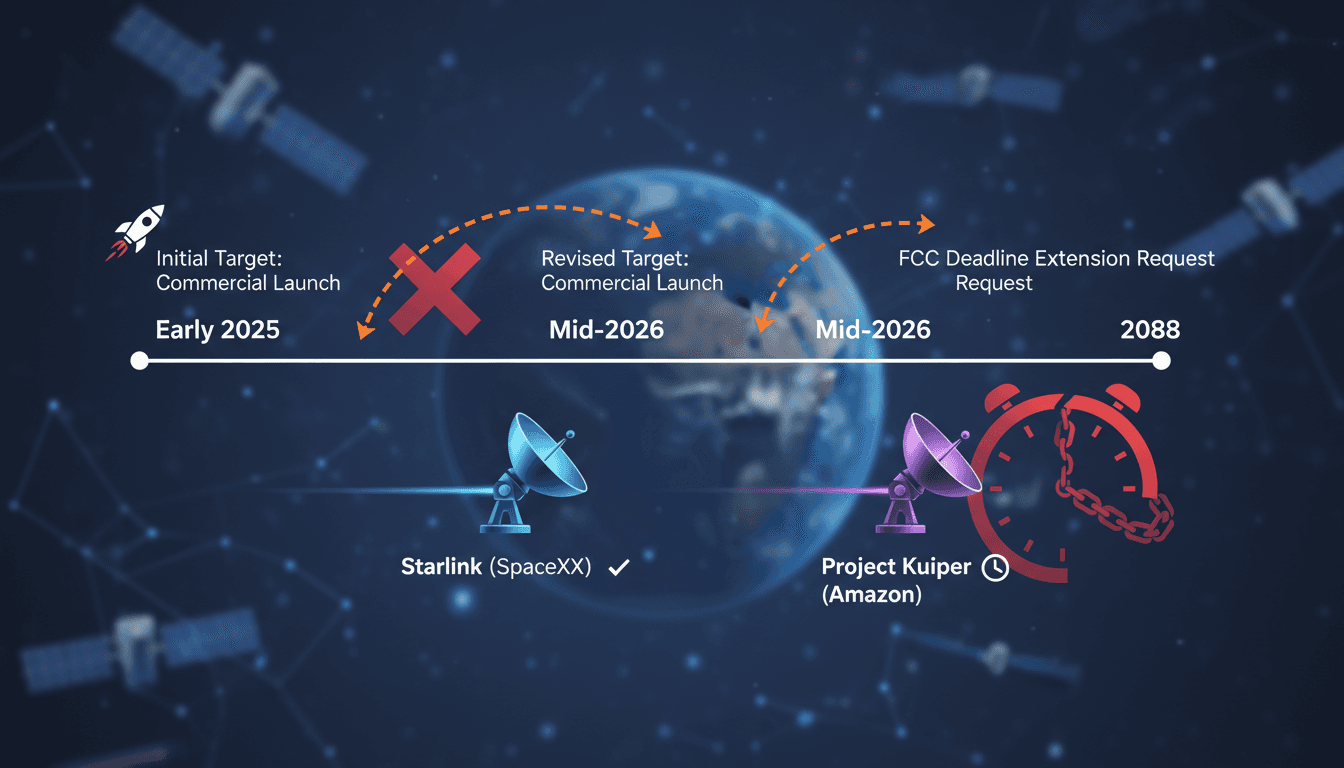
Here's what it means for you.
If you're in the market for satellite internet, this delay could affect your options and pricing in the near future.
Why it matters
The delay in Amazon's Leo satellite internet service could reshape competition in the satellite broadband market, particularly against established players like SpaceX's Starlink.
What happened (in 30 seconds)
- Amazon announced a delay in the commercial launch of its Leo satellite internet service to mid-2026, shifting from earlier targets of late 2025 or early 2026.
- CEO Andy Jassy cited challenges in deploying the required number of satellites to meet FCC milestones, prompting a request for an extension to 2028.
- Leo, previously known as Project Kuiper, aims to compete with Starlink by offering superior performance and lower costs, with backing from major companies like Delta Airlines and NASA.
The context you actually need
- Project Kuiper was initiated by Amazon in 2019, with FCC authorization obtained in 2020, requiring half of its planned 3,236 satellites to be operational by July 2026.
- Production delays have plagued the project, with weather and rocket availability issues causing setbacks in satellite launches since 2023.
- The competitive landscape is currently dominated by SpaceX's Starlink, which has over 9,800 active satellites, while Amazon's Leo has fewer than 250 operational.
What's really happening
Amazon's Leo satellite internet service, initially branded as Project Kuiper, has faced significant hurdles since its inception. The project was launched with ambitious goals in 2019, aiming to provide high-speed internet via a constellation of low-Earth orbit satellites. However, as of April 2026, the company has only managed to deploy a fraction of the required satellites, leading to a critical delay in its commercial launch.
The Federal Communications Commission (FCC) mandates that Amazon must have at least 1,600 satellites in orbit by July 2026 to retain its operational license. This requirement is a significant driver behind the delay, as Amazon has struggled to meet the necessary deployment pace. CEO Andy Jassy's announcement of the postponement highlights the challenges faced in satellite manufacturing and launch logistics, particularly with the reliance on third-party providers like United Launch Alliance (ULA) and SpaceX for rocket launches.
The competitive dynamics in the satellite internet market are also shifting. SpaceX's Starlink has established a substantial lead with over 9,800 satellites, providing a robust service that has already captured a significant portion of the market. In contrast, Amazon's Leo, with fewer than 250 satellites operational, is at a disadvantage. The delay not only affects Amazon's market entry but also raises concerns about its ability to compete effectively against established players.
Moreover, the partnerships that Amazon has secured with major companies such as Delta Airlines, JetBlue, AT&T, and NASA indicate a strong interest in the service's potential. However, these partnerships may be contingent on Amazon's ability to deliver on its promises of superior performance and lower costs. The delay could jeopardize these relationships, as partners may seek alternatives if Amazon cannot meet its launch timelines.
The broader implications of this delay extend beyond Amazon and its competitors. The satellite internet market is poised for growth, particularly in underserved regions where traditional broadband infrastructure is lacking. As companies like Amazon and SpaceX vie for dominance, the outcome will significantly impact pricing, service availability, and technological advancements in satellite communications.
Who feels it first (and how)
- Consumers seeking satellite internet options may face limited choices and potentially higher prices due to reduced competition.
- Businesses in sectors like aviation and maritime, which rely on reliable internet connectivity, may experience delays in accessing Amazon's services.
- Investors in satellite technology and telecommunications may reassess their positions based on Amazon's ability to execute its launch plans and compete effectively.
What to watch next
- FCC decisions on Amazon's extension request will be crucial, as they will determine the timeline for Leo's operational status and its ability to compete.
- Launch cadence of Amazon's satellites in 2026 will indicate whether the company can ramp up its deployment to meet market demands and FCC requirements.
- Market reactions to Amazon's partnerships and performance claims may reveal shifts in consumer preferences and competitive strategies within the satellite internet sector.
Amazon's Leo satellite internet service has been delayed to mid-2026 due to deployment challenges.
The competitive landscape will continue to favor SpaceX's Starlink unless Amazon can accelerate its satellite launches.
The long-term impact of this delay on Amazon's partnerships and market positioning remains to be seen.
Frequently Asked Questions
- Why it matters?
- The delay in Amazon's Leo satellite internet service could reshape competition in the satellite broadband market, particularly against established players like SpaceX's Starlink.
- What happened (in 30 seconds)?
- Amazon announced a delay in the commercial launch of its Leo satellite internet service to mid-2026, shifting from earlier targets of late 2025 or early 2026. CEO Andy Jassy cited challenges in deploying the required number of satellites to meet FCC milestones, prompting a request for an extension to 2028. Leo, previously known as Project Kuiper, aims to compete with Starlink by offering superior performance and lower costs, with backing from major companies like Delta Airlines and NASA.
- What's really happening?
- Amazon's Leo satellite internet service, initially branded as Project Kuiper, has faced significant hurdles since its inception. The project was launched with ambitious goals in 2019, aiming to provide high-speed internet via a constellation of low-Earth orbit satellites. However, as of April 2026, the company has only managed to deploy a fraction of the required satellites, leading to a critical delay in its commercial launch. The Federal Communications Commission (FCC) mandates that Amazon mu
- Who feels it first (and how)?
- Consumers seeking satellite internet options may face limited choices and potentially higher prices due to reduced competition. Businesses in sectors like aviation and maritime, which rely on reliable internet connectivity, may experience delays in accessing Amazon's services. Investors in satellite technology and telecommunications may reassess their positions based on Amazon's ability to execute its launch plans and compete effectively.
- What to watch next?
- FCC decisions on Amazon's extension request will be crucial, as they will determine the timeline for Leo's operational status and its ability to compete. Launch cadence of Amazon's satellites in 2026 will indicate whether the company can ramp up its deployment to meet market demands and FCC requirements. Market reactions to Amazon's partnerships and performance claims may reveal shifts in consumer preferences and competitive strategies within the satellite internet sector.
Latest tech news, product reviews, and analysis for consumers and professionals.
"CNET delivers accessible and detailed technology reporting, including trusted product reviews and how-to guides."
— A47 Editor
Amazon Delays Launch of Leo, Its Satellite Network and Starlink Rival
Amazon has announced a delay in the launch of its satellite internet service, Leo, now expected to debut in mid-2026, as confirmed by CEO Andy Jassy. This postponement raises concerns about Amazon's competitive position in the satellite internet mark...
Consumer technology news with AI coverage.
"Gadget and tech site reporting on AI in products."
— A47 Editor
Amazon's satellite internet service is scheduled for mid-2026 availability
Amazon's satellite internet service, Amazon Leo, is set to launch in mid-2026, as announced by CEO Andy Jassy in his annual letter to shareholders. The service aims to provide download speeds of up to 1 Gbps, significantly higher than competitors lik...
Covers consumer technology, electronics, gadgets, and product reviews.
"Engadget is a trusted source for gadget reviews and consumer tech news, known for its hands-on analysis and industry coverage."
— A47 Editor
Amazon's satellite internet service is scheduled for mid-2026 availability
Amazon's satellite internet service, Amazon Leo, is set to launch in mid-2026, as announced by CEO Andy Jassy in his annual letter to shareholders. The service aims to provide download speeds of up to 1 Gbps, significantly higher than competitors lik...
Curated tech headlines including AI stories.
"Influential aggregator surfacing the day’s top tech/AI links."
— A47 Editor
In his annual letter, Andy Jassy says Amazon's space-internet service Leo will "launch in mid-2026", after delays; Amazon has FCC approval for 3,236 satellites (Thomas Ricker/The Verge)
Amazon CEO Andy Jassy announced in his annual letter that the company's space-internet service, Leo, is set to launch in mid-2026, following previous delays. The Federal Communications Commission (FCC) has granted Amazon approval for a constellation ...