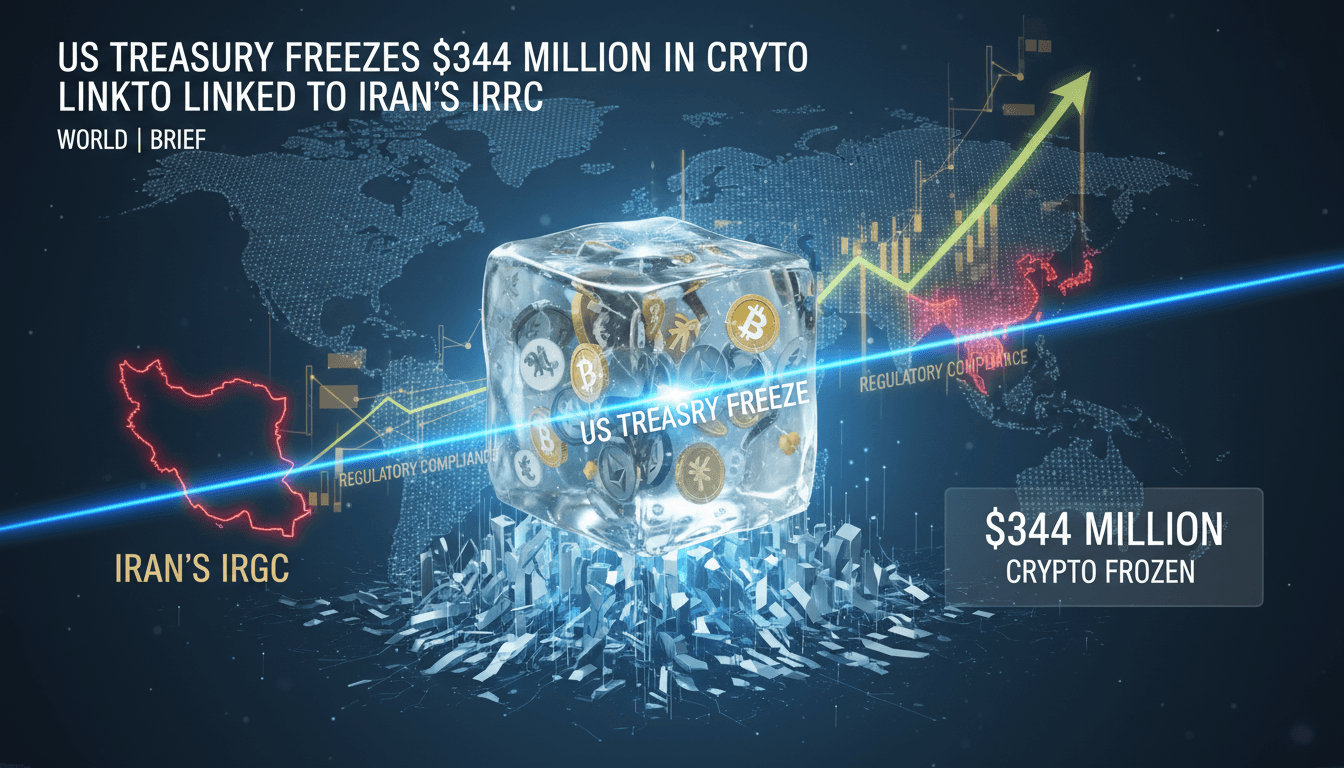
U.S. Treasury Sanctions Tron Wallets Linked to Iran's Central Bank Freezing $344 Million in USDT

Here's what it means for you.
If you’re involved in international trade or cryptocurrency, this action could signal increased scrutiny and regulation in your transactions.
Why it matters
This sanction underscores the U.S. government's commitment to disrupting financial networks that facilitate sanctions evasion, impacting global trade dynamics.
What happened (in 30 seconds)
- On April 24, 2026, the U.S. Treasury sanctioned two Tron wallets linked to Iran's Central Bank, freezing $344 million in USDT.
- Tether complied with a law enforcement request to freeze the funds, marking a significant enforcement action against sanctions evasion.
- Treasury Secretary Scott Bessent announced this as part of the broader "Economic Fury" campaign targeting Iran's financial lifelines.
The context you actually need
- Escalating tensions between the U.S. and Iran have led to military actions and economic sanctions, disrupting global oil flows and trade routes.
- Iran's reliance on cryptocurrency has grown, with its holdings reaching $7.8 billion by 2025, primarily controlled by the Islamic Revolutionary Guard Corps (IRGC).
- The U.S. naval blockade in the Strait of Hormuz has prompted Iran to demand cryptocurrency payments for safe passage, leveraging digital assets to evade traditional sanctions.
What's really happening
The U.S. Treasury's recent sanctions against two Tron wallets linked to Iran's Central Bank represent a strategic move in the ongoing economic conflict between the U.S. and Iran. By freezing $344 million in Tether USDT, the U.S. aims to disrupt Iran's financial networks that facilitate sanctions evasion. This action is part of a broader initiative known as "Economic Fury," which targets Iran's oil shadow fleet and financial lifelines.
The sanctions come in the wake of heightened tensions following joint U.S.-Israel airstrikes on Iranian targets in February 2026. In retaliation, Iran has engaged in aggressive actions against commercial shipping in the Strait of Hormuz, a critical chokepoint for global oil transport. The U.S. responded with a naval blockade, which has significantly impacted shipping routes and global oil flows.
Iran's strategy to leverage cryptocurrency for revenue generation has become increasingly apparent. With its crypto holdings reaching $7.8 billion, the IRGC has utilized these assets for arms procurement and to stabilize the Iranian rial. By demanding Bitcoin payments for safe passage through the Strait of Hormuz, Iran has sought to circumvent traditional financial systems and sanctions.
The U.S. Treasury's action to freeze the funds in these Tron wallets is a direct response to this evolving landscape. By targeting wallets associated with Iranian exchanges and the Central Bank, the U.S. is sending a clear message: it will not tolerate attempts to evade sanctions through digital currencies. The inclusion of these wallets on the Specially Designated Nationals (SDN) list further solidifies the U.S. stance against Iran's financial maneuvers.
This situation also raises questions about the broader implications for the cryptocurrency market. As the U.S. intensifies its focus on financial networks tied to sanctions evasion, stablecoins like USDT may face increased scrutiny. The potential for regulatory changes could impact how cryptocurrencies are used in international trade and finance.
Who feels it first (and how)
- Cryptocurrency exchanges: Increased compliance requirements and scrutiny from regulators.
- Shipping and logistics companies: Potential disruptions in operations due to sanctions affecting trade routes.
- Investors in stablecoins: Heightened risk perception and potential regulatory impacts on asset values.
What to watch next
- Regulatory developments: Monitor any new regulations or enforcement actions targeting cryptocurrencies and sanctions compliance, as these could reshape the market landscape.
- Geopolitical tensions: Keep an eye on U.S.-Iran relations and any escalations that could lead to further sanctions or military actions, impacting global trade.
- Market reactions: Watch for shifts in cryptocurrency market dynamics, particularly in stablecoins, as regulatory scrutiny increases.
The U.S. Treasury has frozen $344 million in USDT linked to Iran's Central Bank.
Increased regulatory scrutiny on cryptocurrency transactions related to sanctions compliance.
The long-term impact on global trade routes and shipping logistics due to ongoing U.S.-Iran tensions.
Insights by A47 Intelligence
News and analysis on Bitcoin, altcoins, and blockchain innovation.
"Bitcoinist delivers news and analysis on Bitcoin, altcoins, and blockchain innovation with a focus on market trends and industry updates."
— A47 Editor
Iran’s Crypto Lifeline Hit As US Freezes $344 Million In Funds
The U.S. Treasury Department has frozen $344 million in cryptocurrency linked to Iran's Islamic Revolutionary Guard Corps (IRGC) as part of Operation Economic Fury, impacting Iran's attempts to utilize crypto payments for maritime activities in the S...
Real-time updates, analysis, and reports on the blockchain and cryptocurrency sectors.
"Crypto News delivers real-time updates, analysis, and reports on the blockchain and cryptocurrency sectors."
— A47 Editor
US Treasury Freezes $344 Million in Crypto Tied to Iran’s IRGC Under Operation Economic Fury
The U.S. Treasury, under Operation Economic Fury, has frozen $344 million in cryptocurrency linked to Iran's Islamic Revolutionary Guard Corps (IRGC). This action was confirmed by Treasury Secretary Scott Bessent and executed by Tether, which manages...
English-language news from Qatar covering domestic and regional affairs.
"Gulf Times reflects Qatari perspectives on regional developments."
— A47 Editor
US Treasury freezes $344 million Iran-linked digital assets
The US Treasury has frozen $344 million in digital assets linked to Iran, as announced by Secretary of Treasury Scott Bessent. This action is part of a broader strategy by the US administration to counter perceived threats from Iran and its activitie...
Arabic-language coverage of international news and geopolitics.
"RT Arabic is a Russian state-funded outlet often criticized for promoting Kremlin-aligned narratives."
— A47 Editor
الولايات المتحدة تجمد 344 مليون دولار من العملات المشفرة الإيرانية
The U.S. Treasury Secretary, Scott Pisent, announced that the United States has frozen $344 million worth of cryptocurrency wallets linked to Iran as part of an economic pressure campaign. This action is part of ongoing efforts to curb Iran's financi...
Covers blockchain, cryptocurrency news, project analysis, and market insights.
"Cointelegraph is a leading crypto-focused media outlet known for timely news, analysis, and educational content related to blockchain and digital assets."
— A47 Editor
US authorities freeze $344M in crypto linked to Iran
US authorities have frozen $344 million in cryptocurrency linked to Iran, following a request from Tether, which confirmed the action was taken in response to concerns over sanctions evasion and illicit activities. This freeze highlights the increasi...
Research, news, and analysis on blockchain startups, DeFi, and regulations.
"Crypto Briefing provides research, news, and analysis on blockchain startups, DeFi, and crypto regulations with investor-focused coverage."
— A47 Editor
US sanctions freeze $344M in Iranian crypto wallets on Tron network
The U.S. has frozen $344 million in cryptocurrency wallets linked to Iran on the Tron network, a move that underscores the country's stringent sanctions and hardline approach towards Iran. This action complicates ongoing diplomatic negotiations and s...
Real-time updates, analysis, and reports on the blockchain and cryptocurrency sectors.
"Crypto News delivers real-time updates, analysis, and reports on the blockchain and cryptocurrency sectors."
— A47 Editor
US freezes $344M in crypto tied to Iran as Treasury targets IRGC flows
The U.S. Treasury and Tether have frozen $344 million in USDT linked to Iran's Islamic Revolutionary Guard Corps (IRGC), highlighting the use of stablecoins in Tehran's $7.8 billion cryptocurrency ecosystem to evade sanctions and facilitate oil trans...
Covers blockchain, cryptocurrency news, project analysis, and market insights.
"CoinDesk is a well-established cryptocurrency and blockchain news provider, offering comprehensive insights, market data, and industry research."
— A47 Editor
Tether's $344 million USDT freeze linked to U.S. 'Economic Fury' against Iran regime
Tether has frozen $344 million in USDT, a decision prompted by requests from U.S. law enforcement due to the funds' links to sanctions evasion and illicit activities, particularly concerning the Iranian regime. Treasury Secretary Scott Bessent emphas...
Global business headlines with AI angles.
"General business outlet that frequently covers AI."
— A47 Editor
U.S. Freezes $344 Million In Crypto Tied To Iran Amid Escalating Regional Tensions
The Trump administration has frozen approximately $344 million in cryptocurrency linked to Iran, intensifying financial pressure on Tehran amid escalating tensions between the two nations. This action reflects ongoing concerns regarding Iran's activi...
Oil, metals, and agriculture: supply/demand headlines, OPEC chatter, inventories, and price action.
"Solid tape for energy and metals traders tracking macro and micro catalysts."
— A47 Editor
US sanctions wallets tied to Iran, freezing $344 million in cryptocurrency, Bessent says
The U.S. has imposed sanctions on cryptocurrency wallets linked to Iran, resulting in the freezing of approximately $344 million in digital assets, as reported by Bessent. This action underscores ongoing tensions between the two nations amid a backdr...
Arabic-language political and world news coverage for UAE readers.
"Emarat Al Youm world coverage usually presents international developments through a UAE and Arab audience lens."
— A47 Editor
الولايات المتحدة تجمد 344 مليون دولار من العملات المشفرة لارتباطها بإيران الولايات المتحدة تجمد 344 مليون دولار من العملات المشفرة لارتباطها بإيران
The Trump administration has frozen $344 million in cryptocurrency, claiming it is linked to Iran. This action reflects ongoing tensions between the United States and Iran, particularly in the context of financial transactions and sanctions.