
CERN BASE Experiment Achieves Historic Antiproton Transport Test
Here's what it means for you.
This groundbreaking experiment could redefine how antimatter research is conducted worldwide, potentially influencing future scientific collaborations and funding opportunities.
Why it matters
The successful transport of antiprotons enhances the feasibility of high-precision experiments, paving the way for advancements in fundamental physics.
What happened (in 30 seconds)
- CERN's BASE team transported 92 antiprotons by truck across its Geneva campus on March 24, 2026.
- A portable cryogenic Penning trap was used to suspend the antimatter particles in a vacuum, preventing annihilation.
- The experiment confirmed that antiprotons could be safely transported, allowing for further studies outside CERN's magnetic interference.
The context you actually need
- BASE's mission focuses on measuring antiproton properties to explore matter-antimatter asymmetry, a fundamental question in physics.
- Previous tests in 2024 successfully transported protons, laying the groundwork for this more complex antiproton transport.
- The BASE-STEP project developed a specialized portable trap, designed for road transport to other research facilities, enhancing collaboration across Europe.
What's really happening
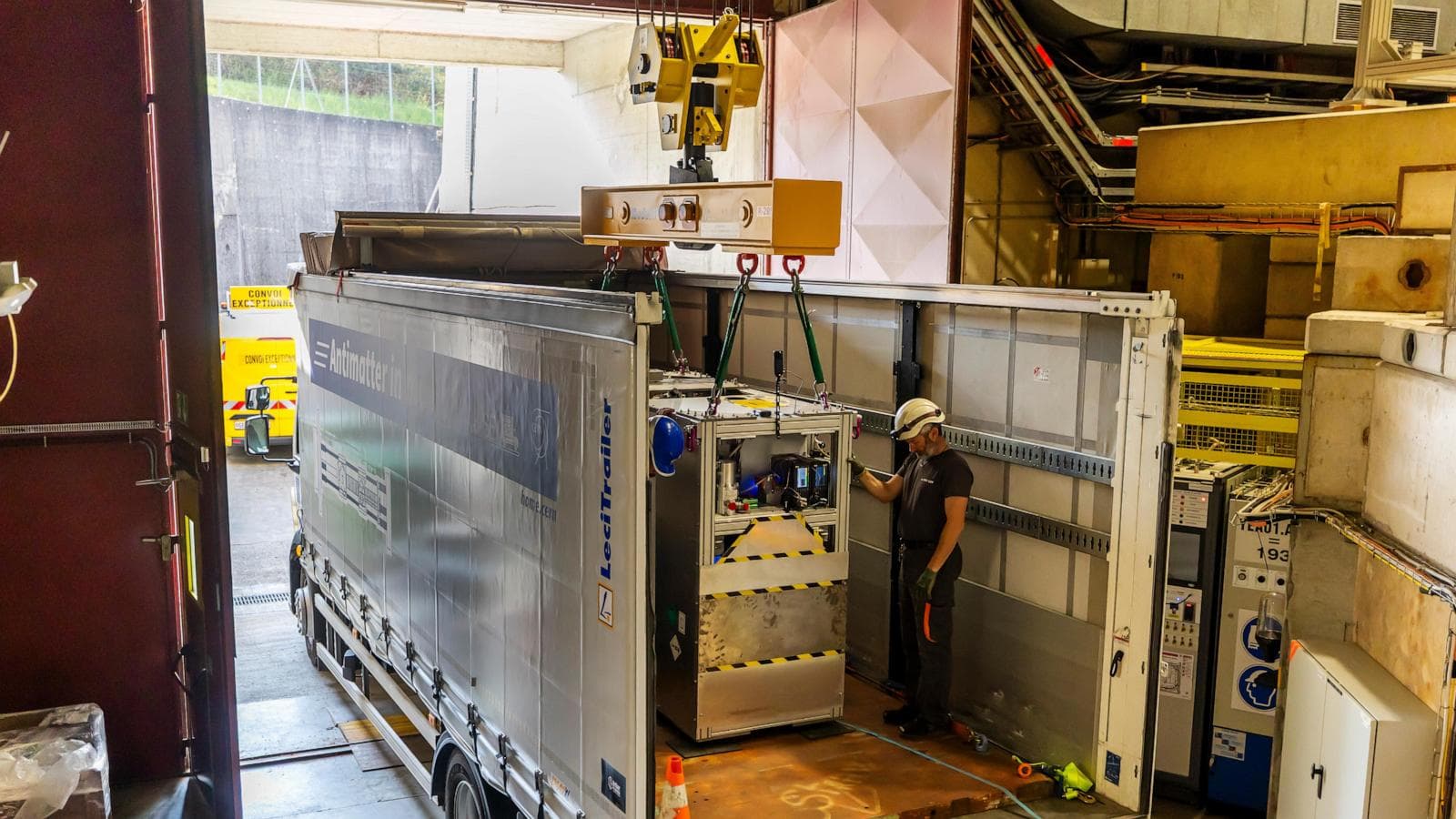
On March 24, 2026, the BASE experiment team at CERN achieved a significant milestone by successfully transporting 92 antiprotons using a portable cryogenic Penning trap. This innovative trap, weighing 1,000 kg and cooled to below 8.2 K with liquid helium, was designed specifically for road transport, allowing for the delicate handling of antimatter. The experiment was conducted to validate the feasibility of transporting antiprotons to external laboratories, which is crucial for conducting high-precision measurements without the magnetic interference present at CERN.
During the experiment, the trap was disconnected from the facility and craned onto a truck, where it was transported across CERN's main site for approximately 30 minutes. The team maintained vacuum suspension through carefully controlled magnetic and electric fields, ensuring the antiprotons remained intact despite the vibrations from the truck. Upon returning to the lab, the team confirmed that no annihilation occurred, demonstrating the integrity of the trap and the success of the transport.
This achievement is not just a technical feat; it opens the door to advanced studies of antimatter properties in various external environments. By enabling the transport of antiprotons, researchers can conduct experiments in locations with different magnetic conditions, potentially leading to more accurate measurements of fundamental properties like the magnetic moment of antiprotons. Enhanced measurement precision could help scientists better understand the asymmetry between matter and antimatter, a key question in the field of particle physics.
The implications of this experiment extend beyond CERN. It sets a precedent for future collaborations among research institutions across Europe and potentially worldwide. By demonstrating that antimatter can be safely transported, CERN is paving the way for distributed experiments that could lead to new discoveries and insights into the fundamental laws of nature.
Who feels it first (and how)
- Physicists and Researchers: Enhanced capabilities for conducting experiments away from CERN's magnetic interference.
- European Research Institutions: Opportunities for collaboration and shared resources in antimatter studies.
- Funding Agencies: Potential shifts in funding priorities towards projects that utilize this new transport capability.
What to watch next
- Future Collaborations: Watch for announcements of new partnerships between CERN and external laboratories leveraging this transport capability.
- Research Publications: Keep an eye on upcoming studies that utilize transported antiprotons to see how findings evolve.
- Funding Trends: Monitor shifts in funding allocations towards antimatter research as the implications of this transport become clearer.
The transport of antiprotons was successfully completed without annihilation.
Increased collaboration among European research institutions in antimatter studies.
The long-term impact on funding and research priorities in the field of fundamental physics.
Frequently Asked Questions
- Why it matters?
- The successful transport of antiprotons enhances the feasibility of high-precision experiments, paving the way for advancements in fundamental physics.
- What happened (in 30 seconds)?
- CERN's BASE team transported 92 antiprotons by truck across its Geneva campus on March 24, 2026. A portable cryogenic Penning trap was used to suspend the antimatter particles in a vacuum, preventing annihilation. The experiment confirmed that antiprotons could be safely transported, allowing for further studies outside CERN's magnetic interference.
- What's really happening?
- On March 24, 2026, the BASE experiment team at CERN achieved a significant milestone by successfully transporting 92 antiprotons using a portable cryogenic Penning trap. This innovative trap, weighing 1,000 kg and cooled to below 8.2 K with liquid helium, was designed specifically for road transport, allowing for the delicate handling of antimatter. The experiment was conducted to validate the feasibility of transporting antiprotons to external laboratories, which is crucial for conducting high-
- Who feels it first (and how)?
- Physicists and Researchers: Enhanced capabilities for conducting experiments away from CERN's magnetic interference. European Research Institutions: Opportunities for collaboration and shared resources in antimatter studies. Funding Agencies: Potential shifts in funding priorities towards projects that utilize this new transport capability.
- What to watch next?
- Future Collaborations: Watch for announcements of new partnerships between CERN and external laboratories leveraging this transport capability. Research Publications: Keep an eye on upcoming studies that utilize transported antiprotons to see how findings evolve. Funding Trends: Monitor shifts in funding allocations towards antimatter research as the implications of this transport become clearer.
Science and technology stories including AI.
"Longstanding science magazine with thoughtful AI coverage."
— A47 Editor
Physicists just took a road trip with a load of antimatter. Here’s how it went
Scientists at CERN successfully transported a container weighing approximately one ton, which held 92 subatomic antimatter particles, without causing their annihilation. This operation marks a significant achievement in the field of particle physics,...
Scientific research, technology, environment, and society.
"Scientific American is one of the oldest and most authoritative science magazines, known for deep dives into science, technology, and society."
— A47 Editor
Physicists just took a road trip with a load of antimatter. Here’s how it went
Scientists at CERN successfully transported a container weighing approximately one ton, which held 92 subatomic antimatter particles, without causing their annihilation. This operation marks a significant achievement in the field of particle physics,...
Discoveries, research, environment, and health innovations.
"New Scientist is a well-respected publication offering accessible science news, commentary, and expert analysis."
— A47 Editor
Antimatter has been transported by road for the first time
CERN has successfully transported 92 antiprotons around a 4-kilometre loop of road, marking the first time antimatter has been moved by road. This achievement is part of a larger initiative to establish an antimatter delivery service aimed at facilit...
Technology innovations, startups, and trends.
"ABC News delivers broad national coverage with a mainstream editorial stance, focusing on accessibility and balanced reporting."
— A47 Editor
On the road with antiprotons: CERN runs delicate test on transporting antimatter
Scientists at CERN conducted a groundbreaking test involving the transportation of antiprotons, marking a significant step in antimatter research. This unprecedented experiment aimed to explore the feasibility of moving these particles, which are cru...
Regional and international reporting focused on Middle Eastern politics, diplomacy, and economics.
"Asharq Al-Awsat is a Saudi-owned international newspaper reflecting mainstream Gulf political perspectives."
— A47 Editor
On the Road with Antiprotons: CERN Runs Delicate Test on Transporting Ultrasensitive Antimatter
CERN has conducted a delicate test on the transportation of ultrasensitive antimatter, specifically focusing on antiprotons. This experiment is crucial for understanding the complexities involved in handling such rare and delicate particles, which ar...