
Saudi Arabia Forecasted to Lead Gulf Economic Growth at 3.1% Amid Regional Turmoil
Here's what it means for you.
If you’re involved in energy markets or regional investments, understanding Saudi Arabia's strategic maneuvers can help you navigate potential volatility.
Why it matters
Saudi Arabia's economic resilience amidst regional disruptions signals a shift in Gulf dynamics that could reshape energy supply chains and investment strategies.
What happened (in 30 seconds)
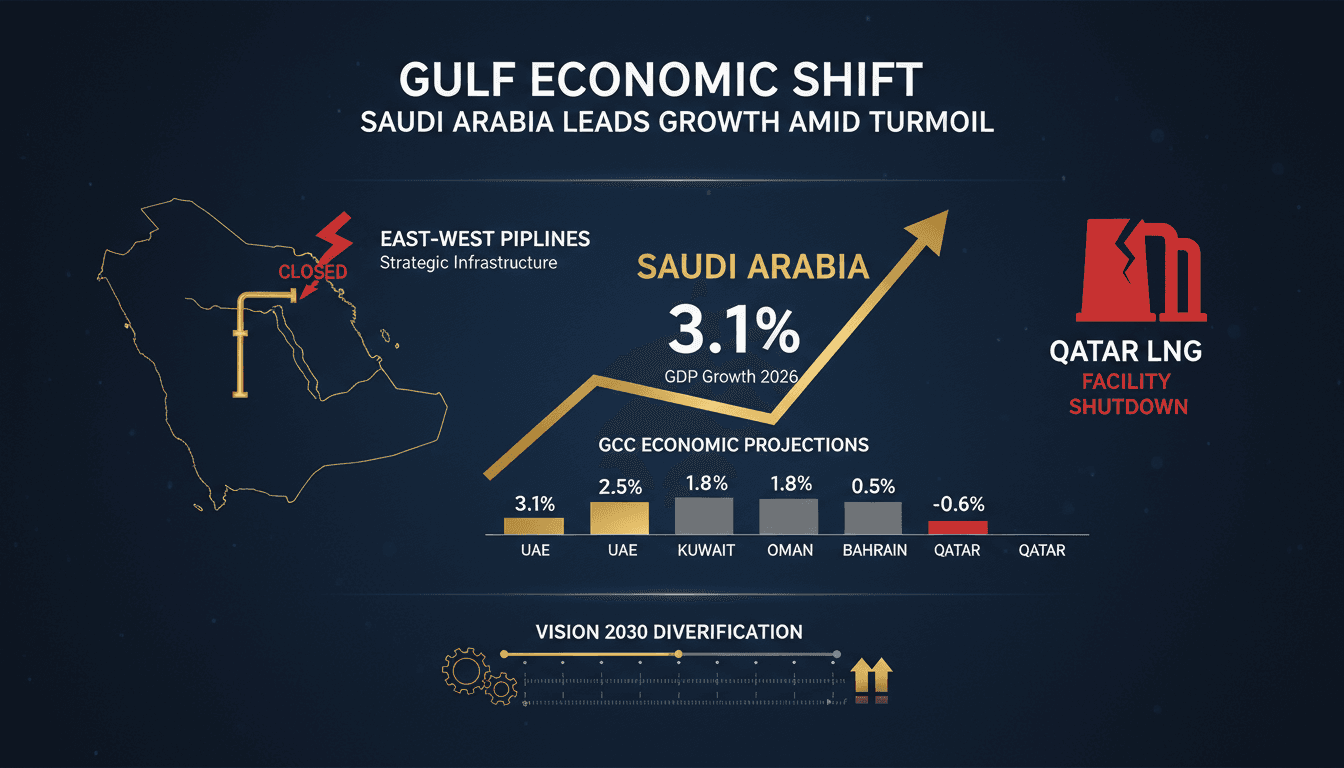
- Saudi Arabia is projected to achieve a 3.1% GDP growth in 2026, according to the IMF, despite regional conflicts.
- Qatar faces an 8.6% GDP contraction due to the shutdown of its Ras Laffan LNG facility, significantly impacting its economy.
- The IMF downgraded the average GDP growth for the Gulf Cooperation Council (GCC) to 1.1%, highlighting the stark contrast in resilience among member states.
The context you actually need
- Iran's missile strikes on Qatar's LNG complex have disrupted 17% of its export capacity, exacerbating regional economic instability.
- Saudi Arabia's East-West pipeline, operational at full capacity, allows it to bypass the closed Strait of Hormuz, ensuring continued oil exports.
- Vision 2030 initiatives have positioned Saudi Arabia to adapt effectively to external shocks, unlike its Gulf neighbors who are more vulnerable.
What's really happening
The economic landscape of the Gulf region is undergoing a significant transformation, driven by geopolitical tensions and strategic infrastructure investments. The ongoing Iran-U.S. conflict has escalated, leading to a blockade that effectively closed the Strait of Hormuz, a critical chokepoint for global oil flows. This disruption has impacted approximately 20% of the world's oil supply, creating a ripple effect across the region.
In response to these challenges, Saudi Arabia has leveraged its East-West Crude Oil Pipeline, which spans 1,200 kilometers and has a capacity of 7 million barrels per day (bpd). By activating this pipeline, Saudi Arabia has successfully neutralized the risks associated with the Strait of Hormuz closure, ensuring that its oil exports continue uninterrupted. This strategic move is a testament to the country's preparedness and adaptability, stemming from its Vision 2030 diversification efforts and substantial investments in energy infrastructure.
In stark contrast, Qatar's economy is reeling from the Iranian missile strikes on its Ras Laffan LNG facility, which has led to a staggering 8.6% contraction in GDP for 2026. This represents the sharpest regional revision, with a decline of 14.7 percentage points. The vulnerability of Qatar, Kuwait, and Bahrain highlights the varying degrees of resilience among Gulf states, with Saudi Arabia emerging as a leader in economic stability.
The IMF's World Economic Outlook report, released on April 14, 2026, reflects these dynamics, projecting a 1.1% average growth for the GCC, with Saudi Arabia's growth forecast at 3.1%. This figure, while down 1.4 points from previous estimates, still positions Saudi Arabia favorably compared to its neighbors. Oman is projected to grow at 3.5%, while the UAE's growth is also revised down to 3.1%. The stark contrast with Qatar and Kuwait, both facing negative growth, underscores the importance of strategic infrastructure and diversification in mitigating economic shocks.
As the situation evolves, the resilience demonstrated by Saudi Arabia may influence investment decisions and energy market dynamics, prompting stakeholders to reassess their strategies in light of these developments.
Who feels it first (and how)
- Energy sector professionals in Saudi Arabia benefit from stable export flows, while those in Qatar face job insecurity due to LNG facility shutdowns.
- Investors in Gulf markets will need to navigate increased volatility, particularly in Qatar and Kuwait, as economic forecasts shift.
- Consumers in the UAE may experience rising energy and food prices due to supply chain disruptions, impacting household budgets.
What to watch next
- Global oil prices: Fluctuations could indicate how well Saudi Arabia manages to maintain export levels amidst regional tensions.
- GCC economic policies: Watch for potential shifts in fiscal strategies as governments respond to the economic forecasts and market conditions.
- Infrastructure developments: Continued investments in energy infrastructure across the region will be crucial for long-term resilience and growth.
Saudi Arabia's GDP growth is projected at 3.1% for 2026, despite regional disruptions.
Other GCC countries will implement contingency plans to mitigate economic impacts, particularly in Qatar and Kuwait.
The long-term effects of the Iran-U.S. conflict on regional stability and energy markets remain uncertain.
Frequently Asked Questions
- Why it matters?
- Saudi Arabia's economic resilience amidst regional disruptions signals a shift in Gulf dynamics that could reshape energy supply chains and investment strategies.
- What happened (in 30 seconds)?
- Saudi Arabia is projected to achieve a 3.1% GDP growth in 2026, according to the IMF, despite regional conflicts. Qatar faces an 8.6% GDP contraction due to the shutdown of its Ras Laffan LNG facility, significantly impacting its economy. The IMF downgraded the average GDP growth for the Gulf Cooperation Council (GCC) to 1.1%, highlighting the stark contrast in resilience among member states.
- What's really happening?
- The economic landscape of the Gulf region is undergoing a significant transformation, driven by geopolitical tensions and strategic infrastructure investments. The ongoing Iran-U.S. conflict has escalated, leading to a blockade that effectively closed the Strait of Hormuz, a critical chokepoint for global oil flows. This disruption has impacted approximately 20% of the world's oil supply, creating a ripple effect across the region. In response to these challenges, Saudi Arabia has leveraged its
- Who feels it first (and how)?
- Energy sector professionals in Saudi Arabia benefit from stable export flows, while those in Qatar face job insecurity due to LNG facility shutdowns. Investors in Gulf markets will need to navigate increased volatility, particularly in Qatar and Kuwait, as economic forecasts shift. Consumers in the UAE may experience rising energy and food prices due to supply chain disruptions, impacting household budgets.
- What to watch next?
- Global oil prices: Fluctuations could indicate how well Saudi Arabia manages to maintain export levels amidst regional tensions. GCC economic policies: Watch for potential shifts in fiscal strategies as governments respond to the economic forecasts and market conditions. Infrastructure developments: Continued investments in energy infrastructure across the region will be crucial for long-term resilience and growth.
Pan-Arab news coverage spanning politics, business, sports, and regional affairs.
"Asharq Al-Awsat reflects a broad Arab editorial perspective with strong attention to regional geopolitics."
— A47 Editor
السعودية تتصدر صمود النمو خليجياً
Amid a bleak economic outlook painted by the International Monetary Fund (IMF), which lowered its global growth forecast by 0.2 percentage points to 3.1% due to geopolitical conflicts, Saudi Arabia has emerged as a leader in resilience within the Gul...
Sports reporting with a focus on Saudi and regional competitions.
"Okaz sports coverage is broad and audience-friendly, with strong attention to Saudi teams and leagues."
— A47 Editor
«النقد الدولي»: 3.1% نمو لاقتصاد السعودية في 2026
The International Monetary Fund (IMF) has projected a 3.1% growth for Saudi Arabia's economy in 2026, indicating that the country is expected to be less affected by the ongoing US-Israeli conflict against Iran compared to its Gulf neighbors. The IMF'...
Arabic-language UAE newspaper coverage focused on domestic affairs, public institutions, business, society, and regional developments.
"Al Khaleej coverage generally reflects a mainstream UAE editorial lens with strong attention to public affairs, institutions, and regional developments."
— A47 Editor
صندوق النقد يخفض توقعات النمو العالمي إلى 3.1%
The International Monetary Fund (IMF) has revised its global economic growth forecast for the current year down to 3.1%, a decrease from the previous estimate of 3.3%. This adjustment is attributed to significant shocks in oil markets following the o...