
Paris Summit Establishes Multinational Mission for Strait of Hormuz Security Post-Iran Conflict
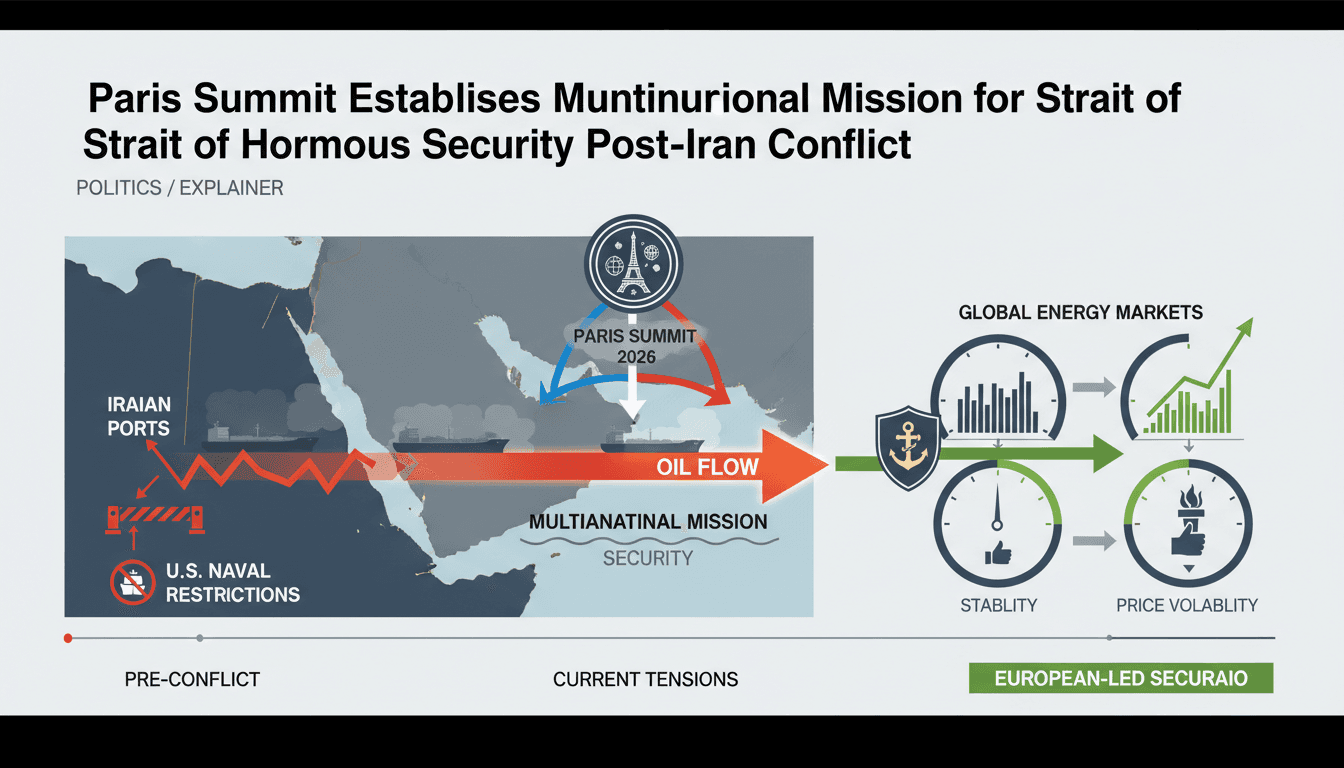
Here's what it means for you.
If you rely on global energy markets, the outcomes of the Paris Summit could directly impact oil prices and shipping routes.
Why it matters
The Strait of Hormuz is a critical chokepoint for global oil supply, with approximately 20% of the world's oil transiting through it annually.
What happened (in 30 seconds)
- Paris Summit scheduled for late April 2026 will convene leaders to establish a multinational mission for securing commercial shipping in the Strait of Hormuz.
- Iran's blockade since February 2026 has disrupted shipping traffic, prompting U.S. naval restrictions and a fragile ceasefire.
- European leaders aim for independent operations to ensure navigation security, responding to U.S. criticisms of their previous involvement.
The context you actually need
- The Strait of Hormuz crisis began on February 28, 2026, when Iran imposed a blockade amid escalating tensions with the U.S. and Israel, halting significant shipping traffic.
- The U.S. initiated a naval blockade on Iranian ports on April 13, 2026, leading to ceasefire negotiations and increased diplomatic efforts from European nations.
- European leaders are pursuing independent channels to avoid escalation and ensure post-conflict navigation security, distinct from U.S. military operations.
What's really happening
The Paris Summit represents a pivotal moment in international maritime security, particularly concerning the Strait of Hormuz, which is vital for global energy supply. The summit's agenda focuses on forming a multinational defensive mission to escort commercial vessels through the strait once conditions allow. This initiative arises from a backdrop of heightened tensions following Iran's blockade and the U.S. naval response, which has disrupted shipping routes critical for oil transport.
The summit is a direct response to U.S. President Donald Trump's criticisms of European allies for their limited involvement in previous operations. By establishing an independent mechanism, European leaders aim to assert their role in global security and navigation, distancing themselves from U.S. military actions while still addressing the urgent need for stability in the region. This approach reflects a broader strategy to enhance European autonomy in foreign policy and defense matters, particularly in the face of U.S. unpredictability.
The implications of this summit extend beyond immediate security concerns. The Strait of Hormuz handles approximately 20% of global oil exports, making its security crucial for energy markets worldwide. Disruptions in this region can lead to fluctuations in oil prices, impacting economies reliant on stable energy supplies. For instance, Dubai has already experienced a suspension of crude oil nominations on the Dubai Mercantile Exchange due to the blockade, highlighting the ripple effects of regional tensions on global trading systems.
As the summit approaches, the focus will be on how effectively participating nations can coordinate their efforts to restore freedom of navigation. The success of this multinational mission will depend on the ability to navigate complex geopolitical dynamics, including Iran's response to increased international military presence and the ongoing U.S.-Iran negotiations regarding sanctions and strait control.
Who feels it first (and how)
- Energy traders: Fluctuations in oil prices will directly affect trading strategies and profit margins.
- Shipping companies: Increased security measures may alter shipping routes and costs.
- Regional economies: Countries reliant on oil exports, like the UAE, will feel immediate impacts on trade and economic stability.
- Consumers: Rising oil prices could lead to increased costs for goods and services globally.
What to watch next
- U.S.-Iran negotiations: Progress or setbacks in talks could significantly influence the security situation in the Strait of Hormuz.
- Oil price fluctuations: Watch for changes in oil prices as the summit approaches and as new security measures are implemented.
- European military deployments: The extent and nature of European military involvement in the region will indicate the seriousness of the multinational mission.
The Paris Summit will convene leaders to discuss maritime security in the Strait of Hormuz.
A multinational mission will be established to escort commercial vessels through the strait.
The long-term effectiveness of this mission in stabilizing the region and its impact on U.S.-Iran relations.
Frequently Asked Questions
- Why it matters?
- The Strait of Hormuz is a critical chokepoint for global oil supply, with approximately 20% of the world's oil transiting through it annually.
- What happened (in 30 seconds)?
- Paris Summit scheduled for late April 2026 will convene leaders to establish a multinational mission for securing commercial shipping in the Strait of Hormuz. Iran's blockade since February 2026 has disrupted shipping traffic, prompting U.S. naval restrictions and a fragile ceasefire. European leaders aim for independent operations to ensure navigation security, responding to U.S. criticisms of their previous involvement.
- What's really happening?
- The Paris Summit represents a pivotal moment in international maritime security, particularly concerning the Strait of Hormuz, which is vital for global energy supply. The summit's agenda focuses on forming a multinational defensive mission to escort commercial vessels through the strait once conditions allow. This initiative arises from a backdrop of heightened tensions following Iran's blockade and the U.S. naval response, which has disrupted shipping routes critical for oil transport. The su
- Who feels it first (and how)?
- Energy traders: Fluctuations in oil prices will directly affect trading strategies and profit margins. Shipping companies: Increased security measures may alter shipping routes and costs. Regional economies: Countries reliant on oil exports, like the UAE, will feel immediate impacts on trade and economic stability. Consumers: Rising oil prices could lead to increased costs for goods and services globally.
- What to watch next?
- U.S.-Iran negotiations: Progress or setbacks in talks could significantly influence the security situation in the Strait of Hormuz. Oil price fluctuations: Watch for changes in oil prices as the summit approaches and as new security measures are implemented. European military deployments: The extent and nature of European military involvement in the region will indicate the seriousness of the multinational mission.
Arabic-language coverage of Saudi, regional, and international affairs.
"Al Bilad offers mainstream Saudi newspaper coverage across domestic and broader Arab topics."
— A47 Editor
خطة دولية لحماية الملاحة.. «قمة باريس» تبحث أمن مضيق هرمز
As tensions rise in the Strait of Hormuz and the maritime blockade on Iran continues to have repercussions, European efforts led by France and the United Kingdom are taking shape through an upcoming international conference in Paris aimed at coordina...
Pan-Arab news coverage spanning politics, business, sports, and regional affairs.
"Asharq Al-Awsat reflects a broad Arab editorial perspective with strong attention to regional geopolitics."
— A47 Editor
جهود فرنسية - بريطانية مكثفة لضمان حرية الإبحار في «هرمز»
France and Britain are intensifying efforts to ensure freedom of navigation in the Strait of Hormuz, with a summit led by President Macron and Keir Starmer, involving 35 international officials to launch a new mission.
Arabic-language political and world news coverage for UAE readers.
"Emarat Al Youm world coverage usually presents international developments through a UAE and Arab audience lens."
— A47 Editor
ستارمر وماكرون يستضيفان محادثات حول مضيق هرمز في باريس الجمعة ستارمر وماكرون يستضيفان محادثات حول مضيق هرمز في باريس الجمعة
International leaders are set to convene in Paris on Friday to discuss plans aimed at ensuring the safety of navigation in the Strait of Hormuz. This meeting, hosted by Keir Starmer and Emmanuel Macron, highlights the ongoing geopolitical concerns su...
Pan-Arab news coverage spanning politics, business, sports, and regional affairs.
"Asharq Al-Awsat reflects a broad Arab editorial perspective with strong attention to regional geopolitics."
— A47 Editor
ماكرون وستارمر يرأسان الجمعة مؤتمراً حول مضيق هرمز
French President Emmanuel Macron and British Prime Minister Keir Starmer will co-chair a conference on the Strait of Hormuz on Friday. This event highlights the ongoing geopolitical significance of the Strait, a critical waterway for global oil trans...
Arabic-language UAE newspaper coverage focused on domestic affairs, public institutions, business, society, and regional developments.
"Al Khaleej coverage generally reflects a mainstream UAE editorial lens with strong attention to public affairs, institutions, and regional developments."
— A47 Editor
فرنسا وبريطانيا تستضيفان اجتماعاً موسعاً لاستعادة حرية الملاحة
France and Britain are set to hold an international meeting this week aimed at restoring freedom of navigation in the Strait of Hormuz. NATO members have indicated they will not participate in U.S. President Donald Trump's plan for control over the s...
Arabic-language coverage of political affairs and current events.
"Okaz political coverage typically follows mainstream Saudi framing on national and regional affairs."
— A47 Editor
ماكرون يعلن تنظيم مؤتمر دولي حول «هرمز» لاستعادة حرية الملاحة
French President Emmanuel Macron announced that France, in collaboration with the United Kingdom, will organize an international conference in the coming days focused on the Strait of Hormuz. The conference aims to gather countries interested in cont...
Pan-Arab news coverage spanning politics, business, sports, and regional affairs.
"Asharq Al-Awsat reflects a broad Arab editorial perspective with strong attention to regional geopolitics."
— A47 Editor
ماكرون: فرنسا وبريطانيا تعدّان لمحاثات بشأن مهمة «سلمية» لمضيق هرمز
French President Emmanuel Macron announced that Paris and London will hold talks aimed at establishing a 'multinational mission' to assist in restoring navigation through the Strait of Hormuz. This initiative reflects ongoing concerns about maritime ...
Arabic-language coverage of international news and geopolitics.
"RT Arabic is a Russian state-funded outlet often criticized for promoting Kremlin-aligned narratives."
— A47 Editor
ستارمر وماكرون يدعوان إلى ضمان حرية الملاحة في مضيق هرمز
British Prime Minister Keir Starmer and French President Emmanuel Macron have emphasized the importance of ensuring freedom of navigation in the Strait of Hormuz, amid concerns over the U.S. blockade in the region. This statement reflects a growing i...
Pan-Arab political news and analysis.
"Al-Quds Al-Arabi is a London-based Arabic newspaper known for political coverage."
— A47 Editor
ستارمر وماكرون يشددان على ضرورة شمول لبنان بالهدنة بين إيران وأمريكا
British Prime Minister Keir Starmer and French President Emmanuel Macron emphasized the necessity of including Lebanon in the ceasefire agreement between Iran and the United States during a phone conversation. They discussed the developments in the M...