
Aave Protocol Faces $293 Million Bad Debt After Kelp DAO Exploit
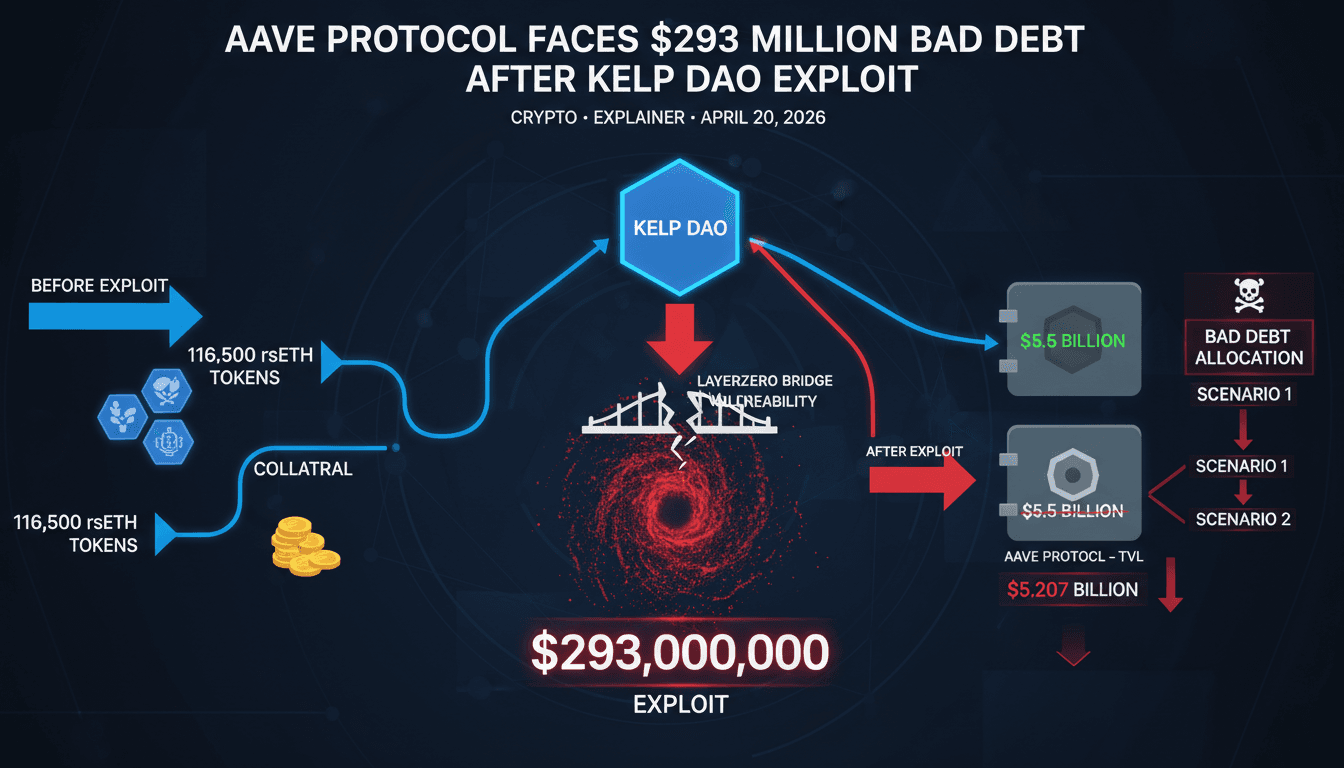
Here's what it means for you.
If you're involved in DeFi, the fallout from this exploit could reshape your risk assessment strategies.
Why it matters
This incident highlights vulnerabilities in cross-chain protocols, impacting investor confidence and liquidity across decentralized finance.
What happened (in 30 seconds)
- On April 18, 2026, attackers exploited vulnerabilities in Kelp DAO's LayerZero bridge, draining 116,500 rsETH valued at $293 million.
- Aave's risk manager, LlamaRisk, proposed two scenarios for allocating the resulting bad debt, estimating losses between $123.7 million and $230.1 million.
- Aave's total value locked (TVL) plummeted by $8–10 billion, leading to market freezes and governance discussions on recovery strategies.
The context you actually need
- Kelp DAO operates a liquid restaking protocol using LayerZero for cross-chain bridging, which had raised concerns about single-verifier risks since January 2025.
- The exploit involved compromised LayerZero RPC nodes and a DDoS attack, allowing attackers to forge messages and drain funds without proper collateral backing.
- Aave's response included freezing markets and adjusting borrow rates, while community discussions are split between uniform loss socialization and isolating Layer 2 losses.
What's really happening
The Kelp DAO exploit on April 18, 2026, serves as a stark reminder of the vulnerabilities inherent in decentralized finance, particularly in cross-chain protocols. The attackers leveraged weaknesses in LayerZero's infrastructure, specifically targeting compromised RPC nodes to execute a DDoS attack. This allowed them to forge cross-chain messages, resulting in the unauthorized release of 116,500 rsETH without the necessary collateral burns on the source chains.
In the aftermath, Kelp DAO took immediate action by pausing relevant contracts across Ethereum and over 20 Layer 2 networks, blacklisting the exploiter addresses, and preventing an additional $95 million theft. However, the damage was already done, with the stolen rsETH being supplied to Aave V3 markets, leading to significant borrowing of wETH and wstETH.
Aave's Protocol Guardian responded by freezing rsETH and wrsETH reserves across 11 markets, while the Risk Steward adjusted borrow rates to manage the crisis. This swift action was crucial in containing the fallout, but it also led to a dramatic decline in Aave's TVL, which fell by $8–10 billion amid a 100% utilization crunch.
LlamaRisk's modeling of the bad debt allocation scenarios reflects the complexity of the situation. The two proposed scenarios—one uniform across chains and the other isolated to Layer 2s—illustrate the difficult choices facing the Aave community. The total estimated losses range from $123.7 million to $230.1 million, depending on the approach taken.
Community reactions have been mixed, with some advocating for a uniform loss socialization to protect Layer 2 users, while others argue for isolating losses to shield Ethereum mainnet depositors. This division underscores the broader implications of the exploit, as it raises questions about the sustainability of cross-chain protocols and the need for more robust security measures.
As recovery efforts are coordinated among ecosystem participants, the incident has prompted discussions about the use of Aave's treasury, which currently holds $181 million, and the potential for external recoveries. The Kelp DAO breach has not only affected its own operations but has also sent shockwaves through the DeFi sector, leading to a sector-wide drop in total value locked exceeding $10 billion.
Who feels it first (and how)
- DeFi Investors: Those holding assets in Aave or Kelp DAO are directly impacted by the loss of value and liquidity.
- Developers: Teams working on cross-chain protocols may face increased scrutiny and pressure to enhance security measures.
- Regulators: While no direct governmental interventions have been reported, the incident may prompt future regulatory discussions around DeFi security standards.
What to watch next
- Recovery Strategies: Monitor how Aave and Kelp DAO implement their recovery plans and the community's response to proposed debt allocation scenarios.
- Market Reactions: Keep an eye on Aave's token performance and total value locked metrics as the situation evolves.
- Security Enhancements: Watch for announcements regarding improvements in cross-chain protocol security, particularly from LayerZero and similar platforms.
The exploit resulted in a significant loss of funds and a decline in Aave's total value locked.
There will be ongoing discussions within the DeFi community regarding loss allocation and security improvements.
The long-term impact on investor confidence in cross-chain protocols remains uncertain.
Frequently Asked Questions
- Why it matters?
- This incident highlights vulnerabilities in cross-chain protocols, impacting investor confidence and liquidity across decentralized finance.
- What happened (in 30 seconds)?
- On April 18, 2026, attackers exploited vulnerabilities in Kelp DAO's LayerZero bridge, draining 116,500 rsETH valued at $293 million. Aave's risk manager, LlamaRisk, proposed two scenarios for allocating the resulting bad debt, estimating losses between $123.7 million and $230.1 million. Aave's total value locked (TVL) plummeted by $8–10 billion, leading to market freezes and governance discussions on recovery strategies.
- What's really happening?
- The Kelp DAO exploit on April 18, 2026, serves as a stark reminder of the vulnerabilities inherent in decentralized finance, particularly in cross-chain protocols. The attackers leveraged weaknesses in LayerZero's infrastructure, specifically targeting compromised RPC nodes to execute a DDoS attack. This allowed them to forge cross-chain messages, resulting in the unauthorized release of 116,500 rsETH without the necessary collateral burns on the source chains. In the aftermath, Kelp DAO took
- Who feels it first (and how)?
- DeFi Investors: Those holding assets in Aave or Kelp DAO are directly impacted by the loss of value and liquidity. Developers: Teams working on cross-chain protocols may face increased scrutiny and pressure to enhance security measures. Regulators: While no direct governmental interventions have been reported, the incident may prompt future regulatory discussions around DeFi security standards.
- What to watch next?
- Recovery Strategies: Monitor how Aave and Kelp DAO implement their recovery plans and the community's response to proposed debt allocation scenarios. Market Reactions: Keep an eye on Aave's token performance and total value locked metrics as the situation evolves. Security Enhancements: Watch for announcements regarding improvements in cross-chain protocol security, particularly from LayerZero and similar platforms.
Covers blockchain, cryptocurrency news, project analysis, and market insights.
"Cointelegraph is a leading crypto-focused media outlet known for timely news, analysis, and educational content related to blockchain and digital assets."
— A47 Editor
Aave risk manager models 2 bad debt scenarios from Kelp DAO exploit
Aave's risk management team has modeled two potential bad debt scenarios following the recent exploit of Kelp DAO, which resulted in significant financial losses. The first scenario, while less expensive, poses a risk of a 15% depegging of rsETH, whi...
Covers Bitcoin plus altcoin news, market updates, and educational resources.
"Bitcoin.com provides news, market data, and guides focused on Bitcoin and the wider crypto industry."
— A47 Editor
Incident Report: Llamarisk, Aave Service Providers Detail Kelp rsETH Hack Across Ethereum and Arbitrum Markets
A significant security breach involving KelpDAO has resulted in the loss of approximately $292 million, including a substantial amount of rsETH, impacting Ethereum and Arbitrum markets. This incident has prompted Aave to suspend its rsETH markets and...