
Trump Issues Ultimatum to Iran Over Strait of Hormuz Reopening
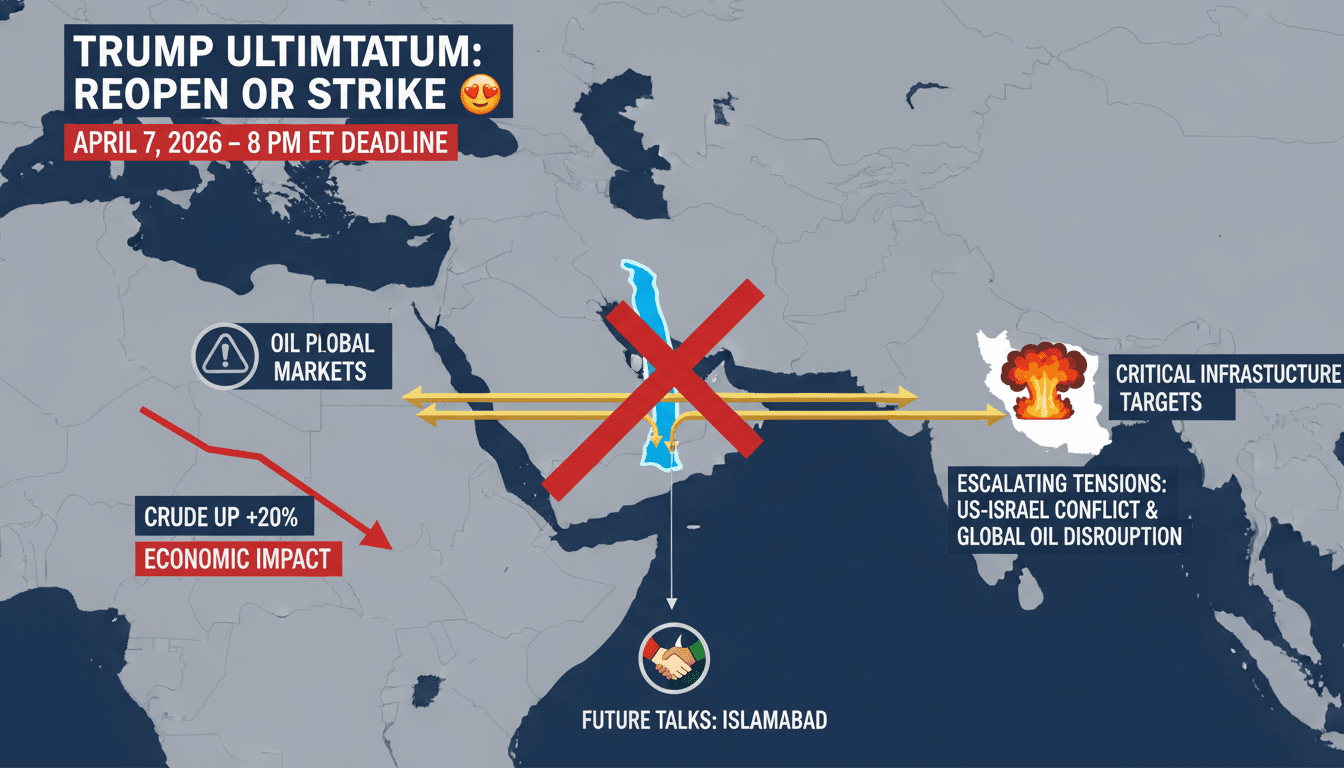
Here's what it means for you.
The escalating tensions in the Middle East could significantly impact global oil prices and supply chains, affecting your costs and economic stability.
Why it matters
The Strait of Hormuz is a critical chokepoint for global oil transit, and its closure can lead to substantial economic repercussions worldwide.
What happened (in 30 seconds)
- On April 7, 2026, President Trump issued an ultimatum to Iran, demanding the reopening of the Strait of Hormuz by 8:00 p.m. ET, threatening military strikes on infrastructure.
- Iran responded with panic among its 90 million residents, leading to stockpiling of essentials and the formation of human chains around power plants as a defense measure.
- A ceasefire was brokered by Pakistan, allowing for regulated passage through the strait and initiating negotiations set to begin on April 10, 2026.
The context you actually need
- Negotiations between the US and Iran had previously collapsed over nuclear and missile issues, leading to the current military escalation.
- The US-Israel war, which began on February 28, 2026, has already disrupted 20% of global oil transit, causing Brent crude prices to surge above $120 per barrel.
- Iran's closure of the Strait of Hormuz on March 4, 2026, has heightened regional tensions and economic instability, prompting urgent international diplomatic efforts.
What's really happening
The ultimatum from President Trump represents a culmination of escalating tensions that began with the US-Israel military strikes against Iran in late February 2026. The assassination of Iran's Supreme Leader Ali Khamenei marked a significant turning point, igniting a full-scale war and prompting Iran to retaliate by closing the Strait of Hormuz. This strategic waterway is crucial for global oil transit, with approximately 20% of the world's oil passing through it. The closure has led to a spike in oil prices, which directly affects global markets and consumer costs.
In response to the ultimatum, the Iranian populace has reacted with anxiety, leading to panic buying and the formation of human chains around critical infrastructure. This grassroots mobilization reflects the deep-seated fear of potential military strikes that could devastate civilian life and the economy. The Iranian government, while accepting the ceasefire, has emphasized that this does not signify an end to hostilities, indicating that the underlying tensions remain unresolved.
The involvement of Pakistan as a mediator highlights the complexities of regional diplomacy, as it seeks to balance its relationships with both Iran and the United States. The ceasefire agreement allows for regulated passage through the Strait of Hormuz under Iranian military coordination, which could ease immediate tensions but does not address the broader issues at play, such as Iran's nuclear ambitions and military capabilities.
The situation is further complicated by the reactions of Gulf states, particularly the UAE and Qatar, which have placed their defense forces on high alert. The activation of missile sirens across the UAE and the suspension of operations at Bahrain's Khalifa Bin Salman Port underscore the regional ramifications of the conflict. As oil prices remain volatile, the economic strain is felt by consumers, with gasoline prices in the US exceeding $4.11 per gallon.
In summary, the ultimatum and subsequent ceasefire are indicative of a precarious balance in the region, where military threats coexist with diplomatic efforts. The long-term implications of this standoff will likely shape not only Middle Eastern geopolitics but also global economic conditions.
Who feels it first (and how)
- Consumers in the US: Higher gasoline prices and increased costs of goods due to oil price surges.
- Residents of Iran: Direct impact on daily life due to infrastructure threats and economic instability.
- Businesses in the Gulf region: Increased operational costs and potential disruptions in trade and logistics.
- International investors: Heightened risk in Middle Eastern markets, affecting investment strategies and portfolio allocations.
What to watch next
- Negotiations in Islamabad: The outcome of talks starting April 10, 2026, will be crucial in determining the future of US-Iran relations and regional stability.
- Oil price fluctuations: Monitor Brent crude prices for signs of market reactions to ongoing tensions and any developments in the Strait of Hormuz.
- Military readiness in the Gulf: Watch for changes in defense postures among Gulf states, which could signal shifts in regional security dynamics.
The Strait of Hormuz is vital for global oil transit, and its closure has immediate economic impacts.
Continued diplomatic efforts will be necessary to prevent further escalation and potential military conflict.
The long-term effectiveness of the ceasefire and whether it will lead to a sustainable resolution of underlying tensions.
Frequently Asked Questions
- Why it matters?
- The Strait of Hormuz is a critical chokepoint for global oil transit, and its closure can lead to substantial economic repercussions worldwide.
- What happened (in 30 seconds)?
- On April 7, 2026, President Trump issued an ultimatum to Iran, demanding the reopening of the Strait of Hormuz by 8:00 p.m. ET, threatening military strikes on infrastructure. Iran responded with panic among its 90 million residents, leading to stockpiling of essentials and the formation of human chains around power plants as a defense measure. A ceasefire was brokered by Pakistan, allowing for regulated passage through the strait and initiating negotiations set to begin on April 10, 2026.
- What's really happening?
- The ultimatum from President Trump represents a culmination of escalating tensions that began with the US-Israel military strikes against Iran in late February 2026. The assassination of Iran's Supreme Leader Ali Khamenei marked a significant turning point, igniting a full-scale war and prompting Iran to retaliate by closing the Strait of Hormuz. This strategic waterway is crucial for global oil transit, with approximately 20% of the world's oil passing through it. The closure has led to a spike
- Who feels it first (and how)?
- Consumers in the US: Higher gasoline prices and increased costs of goods due to oil price surges. Residents of Iran: Direct impact on daily life due to infrastructure threats and economic instability. Businesses in the Gulf region: Increased operational costs and potential disruptions in trade and logistics. International investors: Heightened risk in Middle Eastern markets, affecting investment strategies and portfolio allocations.
- What to watch next?
- Negotiations in Islamabad: The outcome of talks starting April 10, 2026, will be crucial in determining the future of US-Iran relations and regional stability. Oil price fluctuations: Monitor Brent crude prices for signs of market reactions to ongoing tensions and any developments in the Strait of Hormuz. Military readiness in the Gulf: Watch for changes in defense postures among Gulf states, which could signal shifts in regional security dynamics.
Comprehensive coverage of Middle Eastern and global issues.
"Al Jazeera is a prominent voice from the Global South, especially the Middle East, with an emphasis on underreported stories."
— A47 Editor
Iranians brace for possible devastation as Trump’s deadline looms
As the deadline set by President Donald Trump approaches, anxiety grips Iran amid threats of severe military action targeting civilian infrastructure, including power plants and bridges, if Tehran does not comply with demands regarding the reopening ...
Global news coverage with extensive reporting on Middle Eastern conflicts and geopolitics.
"Al Jazeera is a Qatar-based broadcaster known for wide regional coverage and alternative perspectives."
— A47 Editor
Iranians brace for possible devastation as Trump’s deadline looms
As the deadline set by U.S. President Donald Trump approaches, anxiety is mounting in Iran over potential military strikes targeting civilian infrastructure, including power plants and bridges. Trump has issued a stark ultimatum demanding the reopeni...
International coverage of politics, culture, and current affairs.
"BBC News is widely regarded as a reputable international news organization, known for its impartial tone and public service mandate."
— A47 Editor
What the US military could do if Iran fails to meet Trump's ultimatum
U.S. President Donald Trump has issued a stark ultimatum to Iran, threatening severe military action against critical infrastructure, including bridges and power plants, if Tehran does not comply with demands to reopen the Strait of Hormuz by a speci...
National headlines across the United States including breaking stories and societal issues.
"NBC News is a mainstream media outlet known for comprehensive national and international news coverage with a centrist to slightly left-leaning editorial tone."
— A47 Editor
Trump Vows to Target Iranian Civilian Infrastructure if No Deal
President Donald Trump has issued a stark ultimatum to Iran, threatening military action against its civilian infrastructure, including bridges and power plants, if a deal is not reached by his self-imposed deadline. This warning comes as tensions es...
24/7 international news from a French perspective in multiple languages.
"France 24 is viewed as a globally focused outlet with balanced coverage and a European perspective."
— A47 Editor
Trump says can take out Iran 'in one night' as deadline ticks closer
U.S. President Donald Trump has escalated his threats against Iran, stating that the country could be 'taken out in one night' if a deal is not reached by the impending deadline. This ultimatum includes targeting critical infrastructure such as power...
English-language reporting on Saudi politics, policy, and society.
"Saudi Gazette reflects mainstream Saudi institutional perspectives."
— A47 Editor
Iran defiant as Trump doubles down on his threat to take out country
Iran has firmly rejected President Donald Trump's threats to take military action against the country, specifically targeting critical infrastructure such as bridges and power plants, if it does not reopen the strategically vital Strait of Hormuz by ...
European coverage of Middle East politics and security issues.
"France 24 offers international reporting with a European editorial perspective."
— A47 Editor
Middle East war live: Trump agrees to suspend attack on Iran for two weeks
Russia and China have vetoed a UN resolution aimed at reopening the strategic Strait of Hormuz, a critical maritime route for global oil shipments, amid escalating tensions in the Middle East. This decision reflects the ongoing geopolitical complexit...
Coverage of current events and conflicts in the Middle East.
"France 24 is viewed as a globally focused outlet with balanced coverage and a European perspective."
— A47 Editor
Trump agrees to suspend attack on Iran for two weeks
U.S. President Donald Trump has agreed to suspend military action against Iran for two weeks, following mediation efforts by Pakistani leaders. This ceasefire allows for the reopening of the strategically significant Strait of Hormuz, which has been ...
Policy, elections, and government reporting.
"NPR is an American public media organization known for thoughtful reporting and a slightly left-leaning editorial tone."
— A47 Editor
Trump doubles down on threats to Iran's civilian infrastructure unless there's a deal
President Trump has reiterated his threats against Iran, stating that military action will be taken against its civilian infrastructure, including bridges and power plants, unless a deal is reached regarding the reopening of the Strait of Hormuz. Thi...
International news with cultural insight.
"The Los Angeles Times is a major West Coast newspaper offering in-depth reporting with a liberal editorial tone and strong regional focus."
— A47 Editor
Trump holds fast to Tuesday deadline, threatening Iran's bridges and power plants
President Trump has maintained a firm deadline for Iran, threatening military action against its bridges and power plants if the Strait of Hormuz is not reopened by Tuesday. Despite expressing optimism about engaging with Iran's new government, Tehra...
U.S. national news with a West Coast perspective.
"The Los Angeles Times is a major West Coast newspaper offering in-depth reporting with a liberal editorial tone and strong regional focus."
— A47 Editor
Trump holds fast to Tuesday deadline, threatening Iran's bridges and power plants
President Trump has maintained a firm deadline for Iran, threatening military action against its bridges and power plants if the Strait of Hormuz is not reopened by Tuesday. Despite expressing optimism about engaging with Iran's new government, Tehra...
Regional coverage and analysis focused on politics, diplomacy, and business across the Middle East.
"Al-Monitor is known for analytical reporting on Middle East politics and policy developments."
— A47 Editor
‘No bridges, no power plants’: Trump ups threats against Iran if deal fails
President Donald Trump has escalated threats against Iran, stating that if a peace deal is not reached, he will destroy all of Iran's bridges and power plants within four hours. This ultimatum follows a demand for the reopening of the strategic Strai...
Insights and news on social issues, policy, and political movements across the United States.
"The Wall Street Journal is known for its deep political coverage, especially at the intersection of policy, regulation, and social dynamics."
— A47 Editor
President Trump told the WSJ that Iran has until Tuesday night to reopen the Strait of Hormuz or he will destroy the country’s bridges and power plants. Read more in today’s WSJ politics newsletter:
President Trump has issued a stark ultimatum to Iran, demanding the reopening of the Strait of Hormuz by Tuesday night, or face military action targeting the country's bridges and power plants. This threat follows escalating tensions between the U.S....
Global political, business, and cultural coverage from WSJ international desks.
"The Wall Street Journal offers extensive international reporting with a reputation for financial insight and a center-right editorial stance."
— A47 Editor
Trump Says He’s Calling Iran’s Bluff in Eight-Minute Interview With WSJ
President Trump has issued a stark ultimatum to Iran, demanding the reopening of the Strait of Hormuz by Tuesday night, or face military action targeting the country's bridges and power plants. This threat follows escalating tensions between the U.S....
European coverage of Middle East politics and security issues.
"France 24 offers international reporting with a European editorial perspective."
— A47 Editor
War in the Middle East: Donald Trump threatens to hit Iran power plants
Tensions in the Middle East have escalated as President Donald Trump threatened Iran with military action against its power plants and other critical infrastructure if it does not reopen the strategic Strait of Hormuz within 48 hours. This ultimatum ...
Coverage of current events and conflicts in the Middle East.
"France 24 is viewed as a globally focused outlet with balanced coverage and a European perspective."
— A47 Editor
War in the Middle East: Donald Trump threatens to hit Iran power plants
Tensions in the Middle East have escalated as President Donald Trump threatened Iran with military action against its power plants and other critical infrastructure if it does not reopen the strategic Strait of Hormuz within 48 hours. This ultimatum ...
European coverage of Middle East politics and security issues.
"France 24 offers international reporting with a European editorial perspective."
— A47 Editor
Trump says will destroy all Iran bridges, power plants in '4 hours' if no deal
U.S. President Donald Trump announced at a White House press conference that he would destroy all bridges and power plants in Iran within four hours if a peace deal is not reached. This statement follows a series of escalating tensions between the U....
Coverage of current events and conflicts in the Middle East.
"France 24 is viewed as a globally focused outlet with balanced coverage and a European perspective."
— A47 Editor
Trump says will destroy all Iran bridges, power plants in '4 hours' if no deal
U.S. President Donald Trump announced at a White House press conference that he would destroy all bridges and power plants in Iran within four hours if a peace deal is not reached. This statement follows a series of escalating tensions between the U....
Pan-Arab news coverage spanning politics, business, sports, and regional affairs.
"Asharq Al-Awsat reflects a broad Arab editorial perspective with strong attention to regional geopolitics."
— A47 Editor
ترمب يضع إيران أمام مهلة نهائية بين اتفاق أو ضرب البنية التحتية
U.S. President Donald Trump has given Iran a 10-day ultimatum, presenting two critical options: either agree to reopen the Strait of Hormuz or face potential military strikes on its infrastructure, including power stations and bridges. This warning u...
Regional and international reporting focused on Middle Eastern politics, diplomacy, and economics.
"Asharq Al-Awsat is a Saudi-owned international newspaper reflecting mainstream Gulf political perspectives."
— A47 Editor
Trump Vows Strikes on Iran’s Power Plants, Bridges if Strait of Hormuz isn't Reopened
U.S. President Donald Trump has threatened military action against Iran's critical infrastructure, including power plants and bridges, if the Strait of Hormuz is not reopened. This ultimatum comes amid ongoing tensions and a fragile ceasefire between...