
NASA's Artemis II Successfully Launches Amid Solar Cycle 25 Maximum Radiation Risks
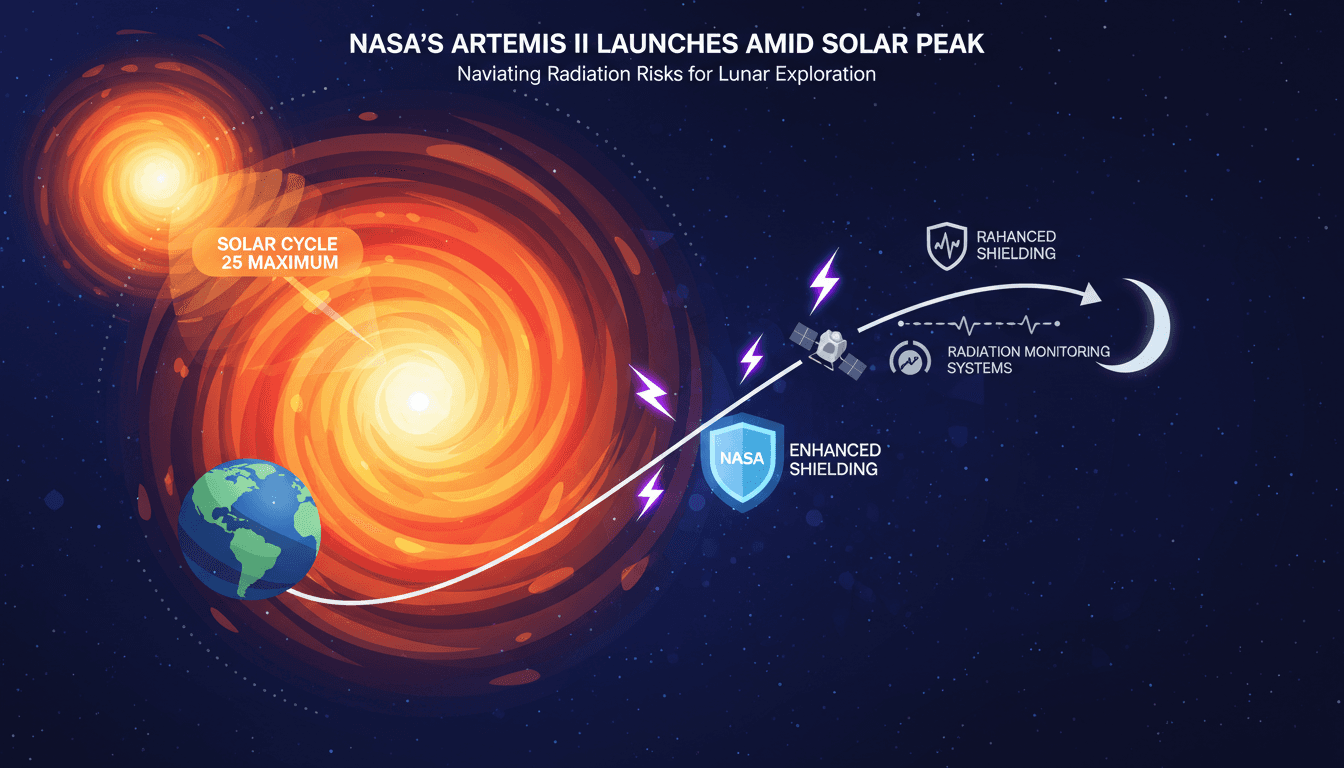
Here's what it means for you.
As the Artemis II mission embarks on its lunar journey, understanding the interplay between solar activity and space exploration could influence future project planning and risk management in your field.
What happened
NASA's Artemis II crewed lunar flyby mission launched on April 1, 2026, from Kennedy Space Center, Florida.
The Context
- Solar Cycle 25 reached its peak activity in late 2025, with a recorded sunspot number of 156.7, exceeding earlier predictions.
- Enhanced safety measures for the Artemis II mission include Orion's advanced shielding and real-time radiation monitoring, addressing risks from solar radiation.
- Expert insights from Patricia Reiff highlight that launching during solar maximum can actually reduce long-term exposure to galactic cosmic rays, despite short-term flare risks.
The Number
This peak sunspot number indicates a significant increase in solar activity, which can impact satellite operations and communications, making it crucial for professionals in tech and communications to stay informed.
Takeaway
As Artemis II continues its mission, the ongoing monitoring of solar activity will be essential for ensuring astronaut safety and could shape future space exploration strategies.
Scientific discoveries, health, technology, and natural phenomena.
"Live Science reports on scientific discoveries, health, technology, and natural phenomena with a popular science tone."
— A47 Editor
Astronauts can face 'nearly lethal doses' of solar radiation — so why launch Artemis II during the sun's peak of activity? Space scientist Patricia Reiff explains.
NASA's Artemis II mission is set to launch on April 1, 2026, marking the first crewed lunar expedition since the Apollo era. Astronauts will embark on a journey around the moon, facing potential exposure to solar radiation and solar flares, which cou...
Scientific discoveries, health, technology, and natural phenomena.
"Live Science reports on scientific discoveries, health, technology, and natural phenomena with a popular science tone."
— A47 Editor
'80% chance of a go,' launch weather officer says at NASA's Artemis II prelaunch conference
NASA's Artemis II mission is on track for launch on April 1, 2026, with an 80% chance of favorable weather conditions, according to the launch weather officer. The agency has confirmed that an X-class solar flare is not expected to impact the mission...
Space science news, astronomy updates, and spaceflight developments.
"Space.com delivers space science news, astronomy updates, and spaceflight developments with engaging coverage."
— A47 Editor
What will happen if Artemis 2 astronauts get hit by a solar storm during NASA's ambitious moon mission?
NASA's Artemis 2 mission, scheduled for launch on April 1, 2026, aims to send astronauts on a lunar flyby, marking the first crewed lunar mission in over 50 years. Concerns have been raised about the potential impact of solar storms on the astronauts...
Science and technology stories including AI.
"Longstanding science magazine with thoughtful AI coverage."
— A47 Editor
Space weather could threaten NASA’s Artemis II astronauts during their trip to the moon
NASA's Artemis II mission, set to launch on April 1, 2026, faces potential threats from space weather, particularly solar storms, which could endanger the astronauts during their lunar journey. The agency is implementing protective measures to mitiga...
Scientific research, technology, environment, and society.
"Scientific American is one of the oldest and most authoritative science magazines, known for deep dives into science, technology, and society."
— A47 Editor
Space weather could threaten NASA’s Artemis II astronauts during their trip to the moon
NASA's Artemis II mission, set to launch on April 1, 2026, faces potential threats from space weather, particularly solar storms, which could endanger the astronauts during their lunar journey. The agency is implementing protective measures to mitiga...