
Honor's Lightning Robot Sets New Half-Marathon Record in Beijing
Here's what it means for you.
As robotics technology advances, industries reliant on physical labor may face significant shifts in workforce dynamics and operational efficiency.
Why it matters
This event highlights China's strategic push in robotics, potentially reshaping global competition and labor markets.
What happened (in 30 seconds)
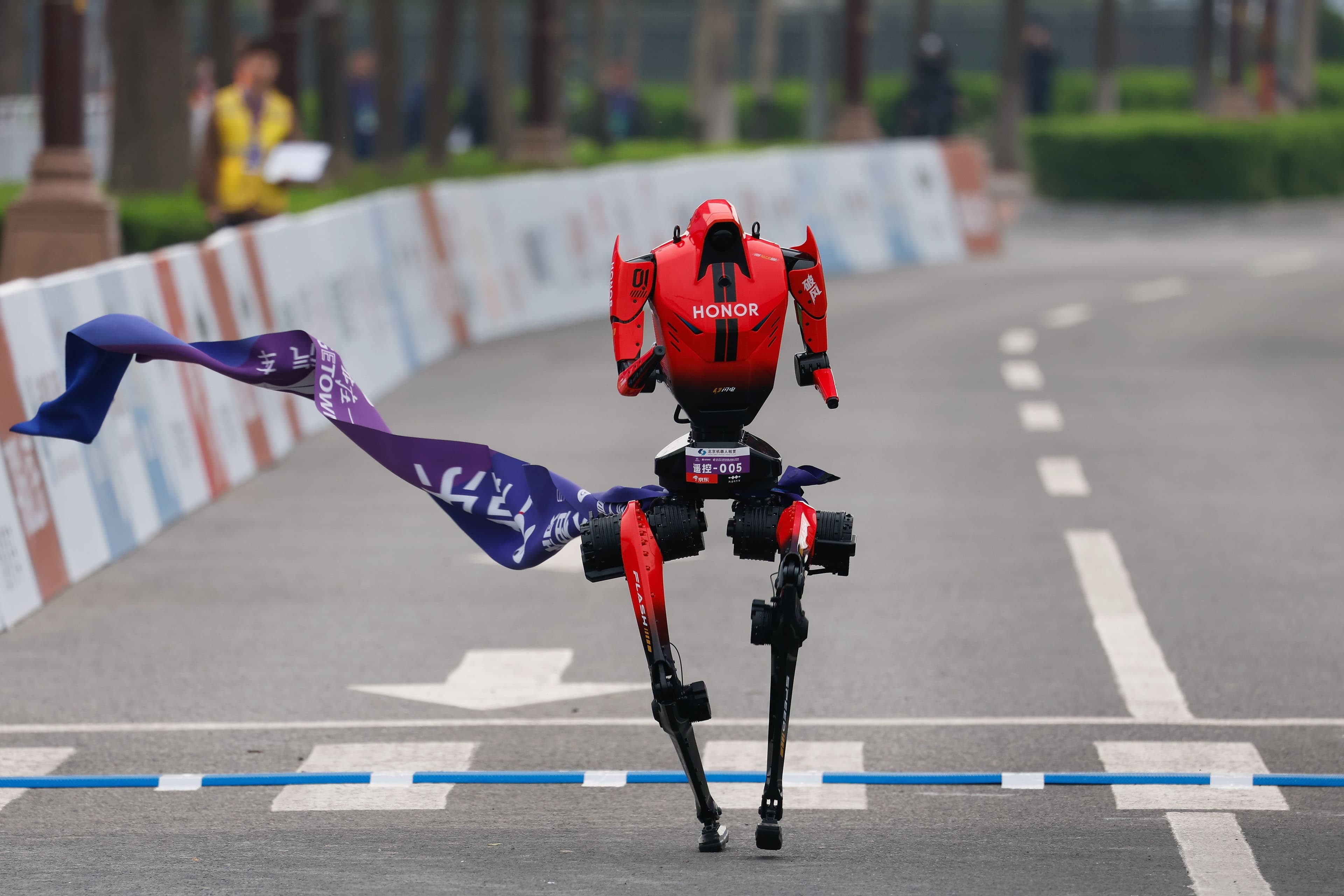
- Honor's Lightning completed the Beijing E-Town Humanoid Robot Half Marathon in 50 minutes and 26 seconds, breaking the human world record by 6 minutes and 54 seconds.
- Over 100 humanoid robots from 76 institutions raced alongside 12,000 human runners, showcasing advancements in autonomous navigation and cooling systems.
- The event reflects China's commitment to leading in humanoid robotics, following the inaugural race in 2025 where many robots failed to finish.
The context you actually need
- China's investment in robotics is part of a broader strategy to dominate the global market, leveraging technology from consumer electronics.
- Honor's Lightning utilized advanced features like liquid cooling and AI for terrain adaptation, demonstrating significant engineering progress.
- The race format was designed to minimize collisions, with robots and humans on separate courses, highlighting the current limitations of robot autonomy in unstructured environments.
What's really happening
The 2026 Beijing E-Town Humanoid Robot Half Marathon marked a pivotal moment in robotics, showcasing not only technological advancements but also the competitive landscape of AI-driven automation. Honor's Lightning, with its innovative design, completed the race in a record time that surpassed the previous human benchmark, signaling a potential shift in how we perceive the capabilities of robots in physical tasks.
China's aggressive investment in robotics is driven by a national strategy to lead in this field, which includes substantial funding, technology transfers from consumer electronics, and a focus on reinforcement learning for improved performance. The integration of advanced cooling systems, originally developed for smartphones, into humanoid robots exemplifies how cross-industry innovations can enhance robotic capabilities. This race is not just a demonstration of speed; it reflects a broader ambition to redefine labor and productivity.
The implications of this event extend beyond the race itself. As robots like Lightning become more capable, industries that rely heavily on physical labor—such as logistics, manufacturing, and even healthcare—may begin to adopt these technologies more widely. This could lead to increased efficiency and reduced costs, but also raises questions about job displacement and the future of work. The excitement surrounding the race, as expressed by spectators and engineers alike, underscores a growing optimism about the role of technology in society.
However, experts caution that while robots can excel in controlled environments, their performance in unstructured settings remains limited. The challenges faced by many robots during the race, including falls and course deviations, highlight the ongoing need for improvement in robotic autonomy. As these technologies evolve, the balance between human and robotic labor will continue to shift, prompting discussions about ethics, employment, and the future of work.
Who feels it first (and how)
- Manufacturing sectors: Increased automation may lead to job shifts and new skill requirements.
- Logistics and delivery services: Robotics could enhance efficiency, impacting labor needs.
- Tech companies: Innovations in robotics may create new market opportunities and competitive pressures.
- Policy makers: Need to address the implications of automation on employment and economic structures.
What to watch next
- Investment trends: Monitor funding in robotics and AI sectors to gauge future advancements.
- Regulatory changes: Watch for new policies addressing automation's impact on labor markets.
- Technological breakthroughs: Keep an eye on developments in AI and robotics that could enhance autonomy and performance.
Honor's Lightning set a new record for humanoid robots in a half-marathon.
Increased investment in robotics will continue, influencing various industries.
The long-term impact on employment and labor markets remains to be fully understood.
Frequently Asked Questions
- Why it matters?
- This event highlights China's strategic push in robotics, potentially reshaping global competition and labor markets.
- What happened (in 30 seconds)?
- Honor's Lightning completed the Beijing E-Town Humanoid Robot Half Marathon in 50 minutes and 26 seconds, breaking the human world record by 6 minutes and 54 seconds. Over 100 humanoid robots from 76 institutions raced alongside 12,000 human runners, showcasing advancements in autonomous navigation and cooling systems. The event reflects China's commitment to leading in humanoid robotics, following the inaugural race in 2025 where many robots failed to finish.
- What's really happening?
- The 2026 Beijing E-Town Humanoid Robot Half Marathon marked a pivotal moment in robotics, showcasing not only technological advancements but also the competitive landscape of AI-driven automation. Honor's Lightning, with its innovative design, completed the race in a record time that surpassed the previous human benchmark, signaling a potential shift in how we perceive the capabilities of robots in physical tasks. China's aggressive investment in robotics is driven by a national strategy to lea
- Who feels it first (and how)?
- Manufacturing sectors: Increased automation may lead to job shifts and new skill requirements. Logistics and delivery services: Robotics could enhance efficiency, impacting labor needs. Tech companies: Innovations in robotics may create new market opportunities and competitive pressures. Policy makers: Need to address the implications of automation on employment and economic structures.
- What to watch next?
- Investment trends: Monitor funding in robotics and AI sectors to gauge future advancements. Regulatory changes: Watch for new policies addressing automation's impact on labor markets. Technological breakthroughs: Keep an eye on developments in AI and robotics that could enhance autonomy and performance.
Science and technology stories including AI.
"Longstanding science magazine with thoughtful AI coverage."
— A47 Editor
A humanoid robot beat the human half-marathon record at a Beijing race. But what did it actually prove?
A humanoid robot named Lightning completed a half-marathon in Beijing, achieving a time of 50 minutes and 26 seconds, surpassing the previous human world record by approximately seven minutes. This event highlights the advancements in robotics techno...
Scientific research, technology, environment, and society.
"Scientific American is one of the oldest and most authoritative science magazines, known for deep dives into science, technology, and society."
— A47 Editor
A humanoid robot beat the human half-marathon record at a Beijing race. But what did it actually prove?
A humanoid robot named Lightning completed a half-marathon in Beijing, achieving a time of 50 minutes and 26 seconds, surpassing the previous human world record by approximately seven minutes. This event highlights the advancements in robotics techno...
Emerging technologies, digital transformation, IT, and cultural impact of tech.
"WIRED covers the intersection of technology, culture, and politics with a progressive, forward-looking editorial stance."
— A47 Editor
A Humanoid Robot Set a Half-Marathon Record in China
A humanoid robot developed by Honor completed a half-marathon in Beijing, achieving a time of 50 minutes and 26 seconds, which surpasses the previous human world record by seven minutes. This event marks a significant milestone in robotics and artifi...
Business and policy angles on tech and AI.
"Business desk coverage intersecting with AI trends."
— A47 Editor
A Humanoid Robot Set a Half-Marathon Record in China
A humanoid robot developed by Honor completed a half-marathon in Beijing, achieving a time of 50 minutes and 26 seconds, which surpasses the previous human world record by seven minutes. This event marks a significant milestone in robotics and artifi...
In-depth coverage of hardware, software, science, and policy.
"Ars Technica provides expert technology news, hardware reviews, and analysis for a technically savvy audience."
— A47 Editor
Robot runner handily beats humans in half-marathon, setting new record
A humanoid robot in Beijing has set a new world record for the half-marathon, completing the race in 50 minutes and 26 seconds, surpassing the previous men's record by approximately seven minutes. This remarkable achievement highlights the rapid adva...
In-depth reporting on tech, policy, and science including AI.
"Respected analysis for technically savvy readers, including AI topics."
— A47 Editor
Robot runner handily beats humans in half-marathon, setting new record
A humanoid robot in Beijing has set a new world record for the half-marathon, completing the race in 50 minutes and 26 seconds, surpassing the previous men's record by approximately seven minutes. This remarkable achievement highlights the rapid adva...
Tech business coverage, major deals, product launches, and Silicon Valley trends.
"WSJ’s tech section offers authoritative reporting on the intersection of technology and business, including exclusive industry analysis."
— A47 Editor
Chinese Robot Beats Human Best Time in Half-Marathon, After a Stumble
A Chinese robot has achieved a remarkable feat by beating the best human time in a half-marathon, despite experiencing a stumble during the race. This achievement highlights the advancements made by tech companies in addressing the malfunctions of hu...
Global political, business, and cultural coverage from WSJ international desks.
"The Wall Street Journal offers extensive international reporting with a reputation for financial insight and a center-right editorial stance."
— A47 Editor
Chinese Robot Beats Human Best Time in Half-Marathon, After a Stumble
A Chinese robot has achieved a remarkable feat by beating the best human time in a half-marathon, despite experiencing a stumble during the race. This event highlights the advancements made by tech companies in developing humanoid runners capable of ...
24/7 international news from a French perspective in multiple languages.
"France 24 is viewed as a globally focused outlet with balanced coverage and a European perspective."
— A47 Editor
Robot beats human half-marathon world record
In a groundbreaking event held in Beijing on April 19, a humanoid robot completed a half-marathon in an impressive time of 50 minutes and 26 seconds, surpassing the previous human world record by nearly seven minutes. This achievement highlights the ...
Technology business and AI-related headlines.
"Data-driven tech newsroom with global scope."
— A47 Editor
China Robot’s 50-Minute Half Marathon Shows Pace of AI Progress
A humanoid robot in Beijing completed a half-marathon in 50 minutes and 26 seconds, surpassing the men's world record by approximately seven minutes. This event, held in a Beijing suburb, highlights significant advancements in robotics technology in ...
Technology business news, market impacts, and innovation trends.
"Bloomberg is a premier financial and tech news provider, respected for its in-depth reporting and analytical rigor."
— A47 Editor
China Robot’s 50-Minute Half Marathon Shows Pace of AI Progress
A humanoid robot in Beijing completed a half-marathon in 50 minutes and 26 seconds, surpassing the men's world record by approximately seven minutes. This event, held in a Beijing suburb, highlights significant advancements in robotics technology in ...
Scientific research, space, environment, and health coverage.
"The New York Times is a globally recognized newspaper offering authoritative reporting with a center-left editorial stance."
— A47 Editor
A Humanoid Robot Races to a Record Half-Marathon Finish
A humanoid robot named Lightning achieved a remarkable milestone by winning a half-marathon race in Beijing, finishing faster than any human in history. The robot, standing at 5-foot-5, demonstrated its advanced capabilities with a completion time th...
Consumer tech news, reviews, and buying guides for gadgets and electronics.
"TechRadar is known for comprehensive buying advice, hardware reviews, and consumer tech news targeted at mainstream audiences."
— A47 Editor
Humanoid robot beats human world record for the first time at the Beijing half marathon — but some are still stumbling at the starting line
A humanoid robot named Lightning has set a new world record at the Beijing half-marathon, completing the race in a remarkable time and surpassing human competitors. This event marks the second iteration of the Humanoid Robot Half Marathon in Beijing,...
Global coverage of politics, crises, and international affairs.
"HuffPost provides progressive-oriented reporting on international developments, often focusing on humanitarian and social justice issues."
— A47 Editor
This Humans vs. Robots Half-Marathon Didn’t Go Well… For Humans
In a recent half-marathon held in Beijing, humanoid robots significantly outperformed human runners, with one robot completing the race in an astonishing 50 minutes and 26 seconds, thereby breaking the previous human world record. This event featured...
International stories from NPR’s global desk.
"NPR is an American public media organization known for thoughtful reporting and a slightly left-leaning editorial tone."
— A47 Editor
A humanoid robot sprints past the human half-marathon world record in Beijing race
A humanoid robot developed by Honor completed a half-marathon in Beijing, finishing in 50 minutes and 26 seconds, thereby surpassing the previous human world record. This event showcased the rapid advancements in robotics and artificial intelligence,...
Science discoveries, research, and analysis.
"NPR is a nonprofit media organization offering thoughtful, in-depth journalism and storytelling, often with a liberal or progressive slant."
— A47 Editor
A humanoid robot sprints past the human half-marathon world record in Beijing race
A humanoid robot developed by Honor completed a half-marathon in Beijing, finishing in 50 minutes and 26 seconds, thereby surpassing the previous human world record. This event showcased the rapid advancements in robotics and artificial intelligence,...