
Oil Prices Rise Over 2% Due to Strait of Hormuz Security Concerns
Here's what it means for you.
Rising oil prices could lead to increased transportation and household costs, impacting your budget directly.
Why it matters
The Strait of Hormuz is a critical artery for global oil supply, and disruptions here can ripple through economies worldwide.
What happened (in 30 seconds)
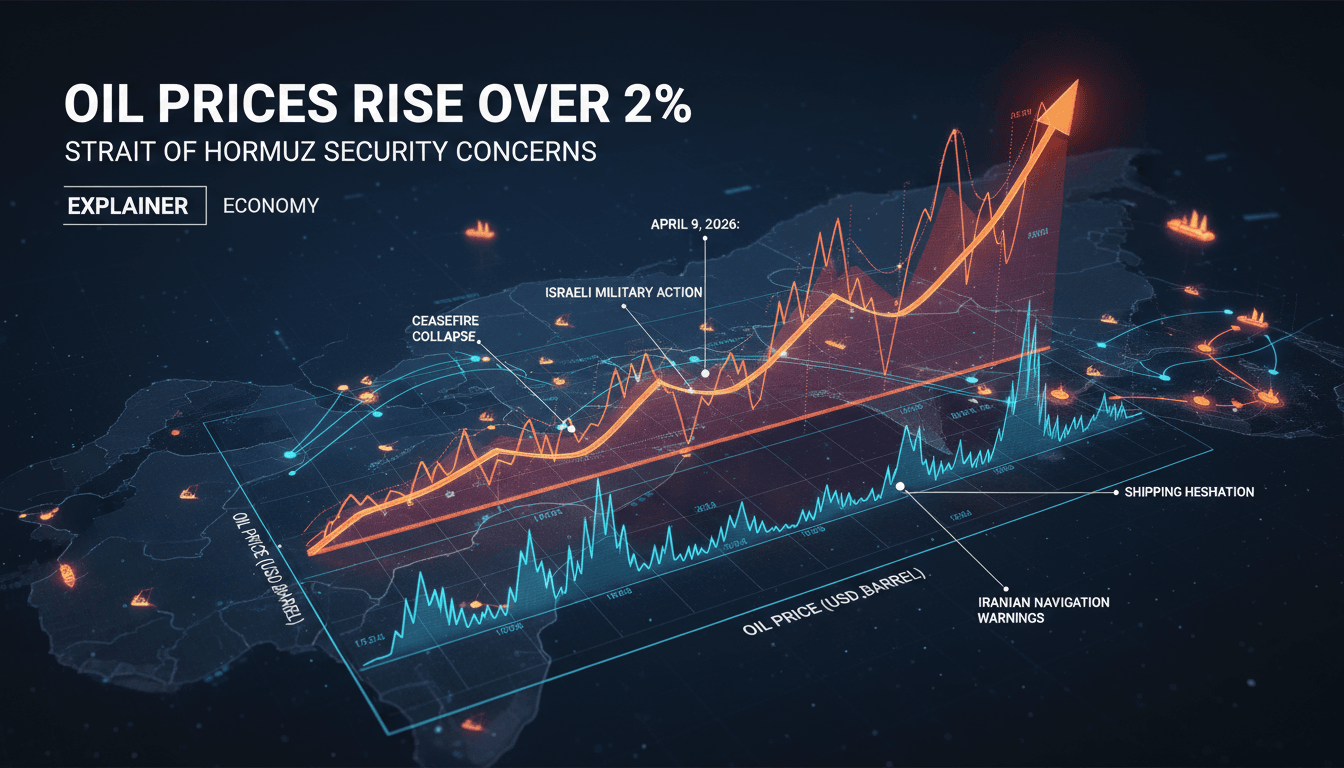
- Oil prices rose over 2% on April 9, 2026, due to concerns about safe passage through the Strait of Hormuz.
- Brent crude settled at $96.71 per barrel, while West Texas Intermediate reached $97.01, reflecting market anxiety.
- Shipping companies are demanding clearer terms before resuming operations amid ongoing geopolitical tensions.
The context you actually need
- The Strait of Hormuz handles 20% of global oil and gas supplies, making it a pivotal point for energy security.
- A fragile ceasefire between the US and Iran has been undermined by recent military actions, complicating shipping logistics.
- UAE fuel prices surged, with diesel rising 72% and petrol grades increasing up to 30%, affecting costs for residents.
What's really happening
The recent surge in oil prices is a direct consequence of escalating tensions in the Middle East, particularly surrounding the Strait of Hormuz. This strategic waterway is crucial for global energy supplies, with approximately 20% of the world's oil and gas transiting through it. The crisis began in late March 2026, when heightened hostilities between the US and Iran led to a partial closure of the strait, resulting in an estimated disruption of 11 million barrels per day.
Initially, a conditional two-week ceasefire allowed for limited transits, which caused oil prices to dip below $100 per barrel. However, the fragile peace was shattered on April 8, 2026, when Israeli forces conducted strikes in Lebanon. In response, Iran declared that permanent peace negotiations were unreasonable, further escalating tensions. Iranian state media then issued navigation maps indicating safe passages around potential mines, a move coordinated by the Revolutionary Guard. This announcement has left shipping operators wary, as they require explicit ceasefire details before resuming voyages.
The market's reaction has been swift. Analysts from Vanda Insights and Standard Chartered have pointed out that logistical disruptions, heightened insurance costs, and security fears are significant barriers to restoring oil flows. The early trading on April 9 saw Brent futures climb by $1.96 (2.07%) to $96.71 and West Texas Intermediate advance by $2.60 (2.75%) to $97.01. The likelihood of significant additional volumes entering the market remains low due to these persistent disruptions.
The aftermath of these developments has seen UAE authorities expressing disappointment over the UN Security Council's inaction, urging for measures to secure navigation through Hormuz. Markets are exhibiting volatility, with Goldman Sachs raising its second-quarter Brent forecast to $90 per barrel. The situation remains precarious, with Gulf Cooperation Council (GCC) states calling for de-escalation and a cessation of regional attacks.
Who feels it first (and how)
- Consumers: Higher fuel prices lead to increased transportation and household costs.
- Shipping companies: Increased insurance and logistical costs affect profitability and operations.
- Energy sector: Oil producers may benefit from higher prices, but volatility can complicate planning.
- Regional economies: Countries reliant on oil exports face uncertainty and potential revenue fluctuations.
What to watch next
- Ceasefire developments: Continued military actions or negotiations could either stabilize or further disrupt oil flows.
- Insurance costs: Rising insurance premiums for shipping in the region will impact overall logistics and pricing.
- Global demand shifts: Changes in consumer behavior or economic conditions could influence oil demand and pricing trends.
Oil prices are currently elevated due to geopolitical tensions.
Continued volatility in oil markets as the situation develops.
The long-term implications for global oil supply and pricing stability.
Frequently Asked Questions
- Why it matters?
- The Strait of Hormuz is a critical artery for global oil supply, and disruptions here can ripple through economies worldwide.
- What happened (in 30 seconds)?
- Oil prices rose over 2% on April 9, 2026, due to concerns about safe passage through the Strait of Hormuz. Brent crude settled at $96.71 per barrel, while West Texas Intermediate reached $97.01, reflecting market anxiety. Shipping companies are demanding clearer terms before resuming operations amid ongoing geopolitical tensions.
- What's really happening?
- The recent surge in oil prices is a direct consequence of escalating tensions in the Middle East, particularly surrounding the Strait of Hormuz. This strategic waterway is crucial for global energy supplies, with approximately 20% of the world's oil and gas transiting through it. The crisis began in late March 2026, when heightened hostilities between the US and Iran led to a partial closure of the strait, resulting in an estimated disruption of 11 million barrels per day. Initially, a conditi
- Who feels it first (and how)?
- Consumers: Higher fuel prices lead to increased transportation and household costs. Shipping companies: Increased insurance and logistical costs affect profitability and operations. Energy sector: Oil producers may benefit from higher prices, but volatility can complicate planning. Regional economies: Countries reliant on oil exports face uncertainty and potential revenue fluctuations.
- What to watch next?
- Ceasefire developments: Continued military actions or negotiations could either stabilize or further disrupt oil flows. Insurance costs: Rising insurance premiums for shipping in the region will impact overall logistics and pricing. Global demand shifts: Changes in consumer behavior or economic conditions could influence oil demand and pricing trends.
Pan-Arab news coverage spanning politics, business, sports, and regional affairs.
"Asharq Al-Awsat reflects a broad Arab editorial perspective with strong attention to regional geopolitics."
— A47 Editor
النفط يقفز مجدداً مع تزايد الشكوك حول عبور مضيق هرمز
Oil prices surged on Thursday amid increasing concerns regarding the ongoing restrictions on energy flows through the Strait of Hormuz. This rise in prices reflects the heightened uncertainty surrounding the stability of one of the world's most criti...
UAE-based English-language newspaper covering regional politics, economics, and global affairs.
"The National reflects Emirati policy perspectives while maintaining international editorial standards."
— A47 Editor
Oil prices rise on concerns about resumption of flows through Strait of Hormuz
Oil prices have risen due to escalating tensions in the Strait of Hormuz, where Iran has threatened to close the waterway and attack vessels, causing Brent crude prices to surge above $84 per barrel. This situation has raised concerns about the stabi...