
Advances in quantum error correction progress toward practical quantum computers
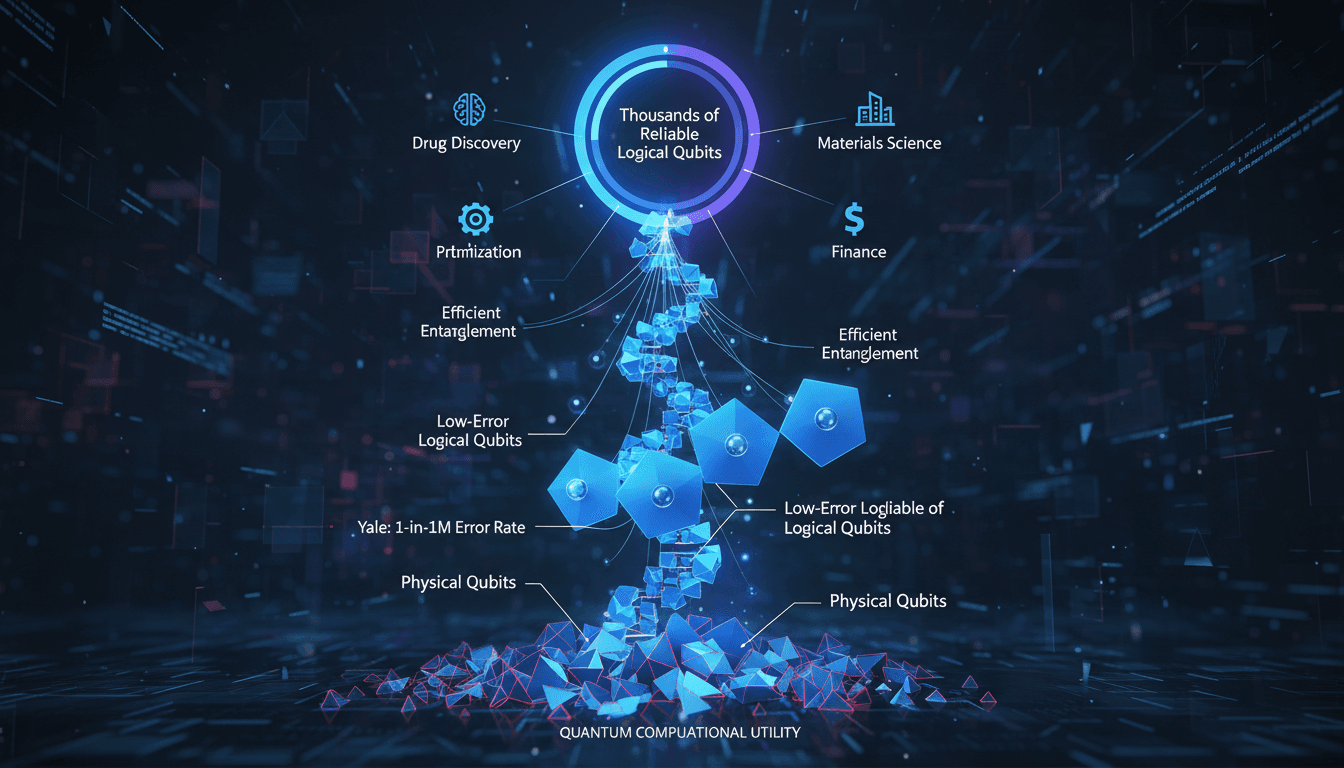
Here's what it means for you.
As quantum computing advances, industries reliant on high-speed computation will face transformative shifts in capabilities and efficiencies.
Why it matters
The development of fault-tolerant quantum computers could revolutionize sectors from pharmaceuticals to finance by enabling complex calculations previously deemed impossible.
What happened (in 30 seconds)
- Recent breakthroughs in quantum error correction techniques have shown promising results in reducing error rates.
- Key researchers from institutions like Yale University and the International Quantum Academy are leading efforts to create reliable logical qubits.
- Ongoing experimental progress indicates that practical applications of quantum computing may be closer than anticipated.
The context you actually need
- Quantum computers are inherently susceptible to errors due to environmental noise and decoherence, which hampers their reliability for computation.
- Quantum error correction is essential as it allows logical qubits to be encoded across multiple entangled physical qubits, addressing the no-cloning theorem that prohibits direct copying of quantum information.
- Recent advancements include the creation of logical qubits that can automatically flag errors and the implementation of quantum operations with error rates as low as one in a million.
What's really happening
The race to achieve fault-tolerant quantum computing is intensifying, with significant contributions from global leaders in the field. Xiayu Linpeng's team at the International Quantum Academy has pioneered a method that combines two superconducting qubits with a resonator, resulting in a logical qubit capable of reducing errors and automatically flagging them. This innovation extends to three qubits for entanglement without error propagation, marking a pivotal step toward reliable quantum computation.
Meanwhile, Robert Schoelkopf's team at Yale University has demonstrated quantum operations with an impressive error rate of just one in a million manipulations, as detailed in their recent publication. This level of precision is crucial for practical applications, as it significantly enhances the reliability of quantum computations. Arian Vezvaee at Quantum Elements has also made strides by demonstrating how electromagnetic radiation kicks can protect idle qubits, facilitating reliable entanglement.
David Muñoz Ramo from Quantinuum has highlighted the necessity for advanced error correction in precise molecular simulations, such as those involving hydrogen energy levels. This underscores the broader implications of error correction techniques, as they are foundational for future quantum applications in various fields, including materials science and drug discovery.
James Wootton from Moth Quantum emphasizes that the engineering foundations for error-correcting programs are emerging, suggesting that the field is on the brink of significant breakthroughs. The convergence of theoretical advancements and practical implementations is creating a fertile ground for innovation, where researchers are beginning to understand how all the pieces of error correction fit together.
As these advancements unfold, the implications for industries that rely on computational power are profound. The ability to perform complex calculations with high reliability could lead to breakthroughs in fields ranging from artificial intelligence to cryptography, fundamentally altering the landscape of technology and business.
Who feels it first (and how)
- Tech companies: Firms developing quantum technologies will gain a competitive edge in computational capabilities.
- Pharmaceuticals: Companies will benefit from accelerated drug discovery processes through advanced molecular simulations.
- Financial institutions: Banks and investment firms could leverage quantum computing for complex risk assessments and algorithmic trading.
- Research institutions: Academic and private research entities will enhance their capabilities in various scientific fields, leading to faster innovations.
What to watch next
- Further publications: Keep an eye on upcoming research papers detailing experimental results and error correction techniques, as they will indicate the pace of progress.
- Industry partnerships: Watch for collaborations between tech companies and research institutions, which could signal the commercialization of quantum technologies.
- Investment trends: Monitor funding flows into quantum computing startups and research initiatives, as increased investment often correlates with accelerated advancements.
Quantum error correction is essential for the development of fault-tolerant quantum computers.
Continued advancements in error correction techniques will lead to more reliable quantum operations in the near future.
The timeline for practical, widespread applications of quantum computing remains uncertain.
Frequently Asked Questions
- Why it matters?
- The development of fault-tolerant quantum computers could revolutionize sectors from pharmaceuticals to finance by enabling complex calculations previously deemed impossible.
- What happened (in 30 seconds)?
- Recent breakthroughs in quantum error correction techniques have shown promising results in reducing error rates. Key researchers from institutions like Yale University and the International Quantum Academy are leading efforts to create reliable logical qubits. Ongoing experimental progress indicates that practical applications of quantum computing may be closer than anticipated.
- What's really happening?
- The race to achieve fault-tolerant quantum computing is intensifying, with significant contributions from global leaders in the field. Xiayu Linpeng's team at the International Quantum Academy has pioneered a method that combines two superconducting qubits with a resonator, resulting in a logical qubit capable of reducing errors and automatically flagging them. This innovation extends to three qubits for entanglement without error propagation, marking a pivotal step toward reliable quantum compu
- Who feels it first (and how)?
- Tech companies: Firms developing quantum technologies will gain a competitive edge in computational capabilities. Pharmaceuticals: Companies will benefit from accelerated drug discovery processes through advanced molecular simulations. Financial institutions: Banks and investment firms could leverage quantum computing for complex risk assessments and algorithmic trading. Research institutions: Academic and private research entities will enhance their capabilities in various scientific fiel
- What to watch next?
- Further publications: Keep an eye on upcoming research papers detailing experimental results and error correction techniques, as they will indicate the pace of progress. Industry partnerships: Watch for collaborations between tech companies and research institutions, which could signal the commercialization of quantum technologies. Investment trends: Monitor funding flows into quantum computing startups and research initiatives, as increased investment often correlates with accelerated advan
Discoveries, research, environment, and health innovations.
"New Scientist is a well-respected publication offering accessible science news, commentary, and expert analysis."
— A47 Editor
The race to solve the biggest problem in quantum computing
Researchers are making significant progress in quantum error correction, addressing the persistent errors that have limited the advancement of quantum computing, according to New Scientist.
Tech coverage including AI and robotics.
"Accessible science/tech magazine with AI coverage."
— A47 Editor
The race to solve the biggest problem in quantum computing
Quantum computing faces a major hurdle as persistent errors limit the technology's progress, but recent advances in quantum error correction have generated optimism among researchers.