
Astronomers Measure Power and Velocity of Relativistic Jets from Cygnus X-1 Black Hole
Here's what it means for you.
This groundbreaking measurement enhances our understanding of black holes, potentially influencing future space exploration and technology.
Why it matters
Understanding black hole dynamics is crucial for astrophysics and could inform future technological advancements in space exploration.
What happened (in 30 seconds)
- On April 16, 2026, astronomers announced the first direct measurement of the instantaneous power and speed of relativistic jets from the Cygnus X-1 black hole system.
- The study, led by Steve Prabu from the University of Oxford, utilized 18 years of high-resolution radio imaging to observe jets influenced by a companion star's wind.
- Findings revealed jet power equivalent to 10,000 solar luminosities and velocities at half the speed of light, advancing our understanding of black hole feedback in galactic evolution.
The context you actually need
- Cygnus X-1 was first detected in 1961 and confirmed as a stellar-mass black hole in the 1970s, consisting of a black hole and a blue supergiant star in a binary system.
- Prior estimates of jet power were averaged over thousands of years, lacking the precision of instantaneous measurements now achieved.
- The binary geometry of Cygnus X-1 allows for predictable jet bending due to the supergiant's stellar wind, providing a unique opportunity for dynamic modeling.
What's really happening
The recent measurements of the relativistic jets from Cygnus X-1 mark a significant advancement in astrophysics, particularly in understanding black hole dynamics. For decades, black holes have been enigmatic objects, with their powerful jets often shrouded in mystery. The study led by Steve Prabu and his team utilized 18 years of high-resolution radio imaging data from global very long baseline interferometry (VLBI) networks, which allowed them to observe the jets' behavior in real-time.
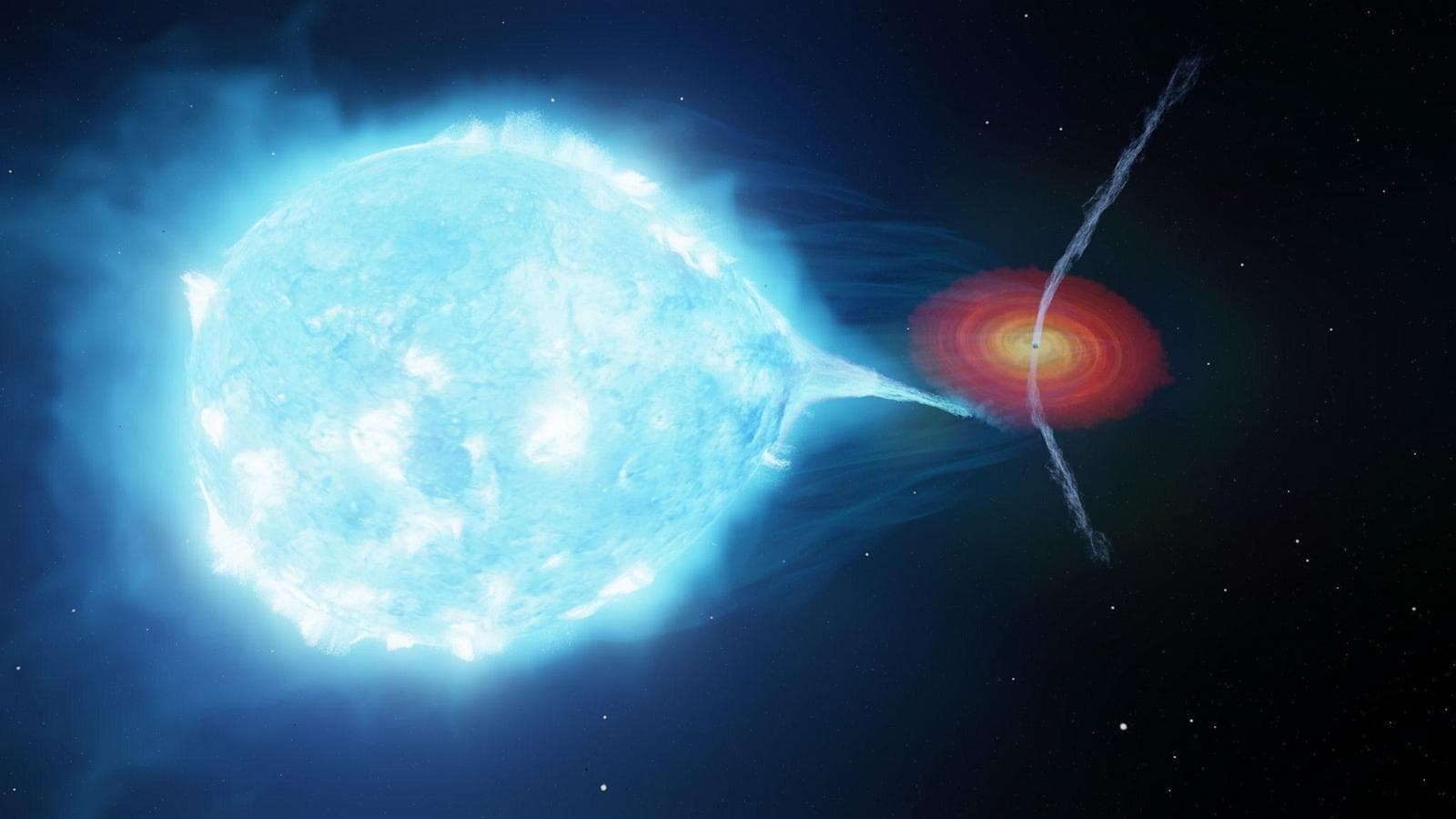
The Cygnus X-1 system, located 7,200 light-years away, consists of a stellar-mass black hole with approximately 21 solar masses and a blue supergiant companion star. This unique binary system enables the jets to be influenced by the stellar wind from the supergiant, creating a predictable bending pattern. This interaction is crucial for understanding the instantaneous properties of the jets, which had previously been estimated over much longer timescales.
The findings revealed that the jets possess an instantaneous kinetic power output of about 10,000 solar luminosities and travel at half the speed of light (0.5c). This level of power is significant, as it provides insights into how black holes can influence their surrounding environments and contribute to galactic evolution. The ability to measure these properties in real-time opens new avenues for research, allowing scientists to validate existing models of jet launching and dynamics.
Moreover, the implications of this research extend beyond Cygnus X-1. The techniques developed can be applied to other black hole systems, enhancing our understanding of their behavior across the universe. The validation of jet launching models is particularly important as it lays the groundwork for future observations with advanced arrays like the Square Kilometre Array, which will further refine our understanding of black hole feedback mechanisms.
In summary, the measurement of the instantaneous power and velocity of the jets from Cygnus X-1 not only advances fundamental astrophysics but also sets the stage for future discoveries that could reshape our understanding of the universe.
Who feels it first (and how)
- Astrophysicists: Gain deeper insights into black hole dynamics and jet behavior.
- Space agencies: Potentially influence future missions and technologies related to black hole research.
- Academics and researchers: Access to new data and methodologies for studying other astronomical phenomena.
What to watch next
- Future publications: Look for follow-up studies that apply these techniques to other black hole systems, which could reveal more about their dynamics.
- Technological advancements: Monitor developments in radio astronomy technology, particularly with the Square Kilometre Array, which may enhance observational capabilities.
- Public interest: Watch for increased public engagement in astrophysics as discoveries like this capture the imagination and highlight the importance of space research.
The instantaneous power and speed of jets from Cygnus X-1 have been measured.
The techniques used will be applicable to other black hole systems, enhancing our understanding of their dynamics.
The broader implications for technology and space exploration remain to be fully realized.
Frequently Asked Questions
- Why it matters?
- Understanding black hole dynamics is crucial for astrophysics and could inform future technological advancements in space exploration.
- What happened (in 30 seconds)?
- On April 16, 2026, astronomers announced the first direct measurement of the instantaneous power and speed of relativistic jets from the Cygnus X-1 black hole system. The study, led by Steve Prabu from the University of Oxford, utilized 18 years of high-resolution radio imaging to observe jets influenced by a companion star's wind. Findings revealed jet power equivalent to 10,000 solar luminosities and velocities at half the speed of light, advancing our understanding of black hole feedback in g
- What's really happening?
- The recent measurements of the relativistic jets from Cygnus X-1 mark a significant advancement in astrophysics, particularly in understanding black hole dynamics. For decades, black holes have been enigmatic objects, with their powerful jets often shrouded in mystery. The study led by Steve Prabu and his team utilized 18 years of high-resolution radio imaging data from global very long baseline interferometry (VLBI) networks, which allowed them to observe the jets' behavior in real-time. The C
- Who feels it first (and how)?
- Astrophysicists: Gain deeper insights into black hole dynamics and jet behavior. Space agencies: Potentially influence future missions and technologies related to black hole research. Academics and researchers: Access to new data and methodologies for studying other astronomical phenomena.
- What to watch next?
- Future publications: Look for follow-up studies that apply these techniques to other black hole systems, which could reveal more about their dynamics. Technological advancements: Monitor developments in radio astronomy technology, particularly with the Square Kilometre Array, which may enhance observational capabilities. Public interest: Watch for increased public engagement in astrophysics as discoveries like this capture the imagination and highlight the importance of space research.
Major U.S. developments and regional news.
"ABC News delivers broad national coverage with a mainstream editorial stance, focusing on accessibility and balanced reporting."
— A47 Editor
Astronomers measure the mind-blowing power and speed of black hole jets for the first time
For the first time, astronomers have successfully measured the instantaneous power of jets emitted from a black hole, revealing their extraordinary speed and energy. This groundbreaking achievement marks a significant advancement in the understanding...
Technology innovations, startups, and trends.
"ABC News delivers broad national coverage with a mainstream editorial stance, focusing on accessibility and balanced reporting."
— A47 Editor
Astronomers measure the power and speed of black hole jets for the first time
For the first time, astronomers have successfully measured the instantaneous power of jets emitted from a black hole, revealing their astonishing speed and energy output. This groundbreaking achievement marks a significant advancement in the understa...