
Larry Fink Warns of Global Recession Risk from High Oil Prices Amid Iran Conflict
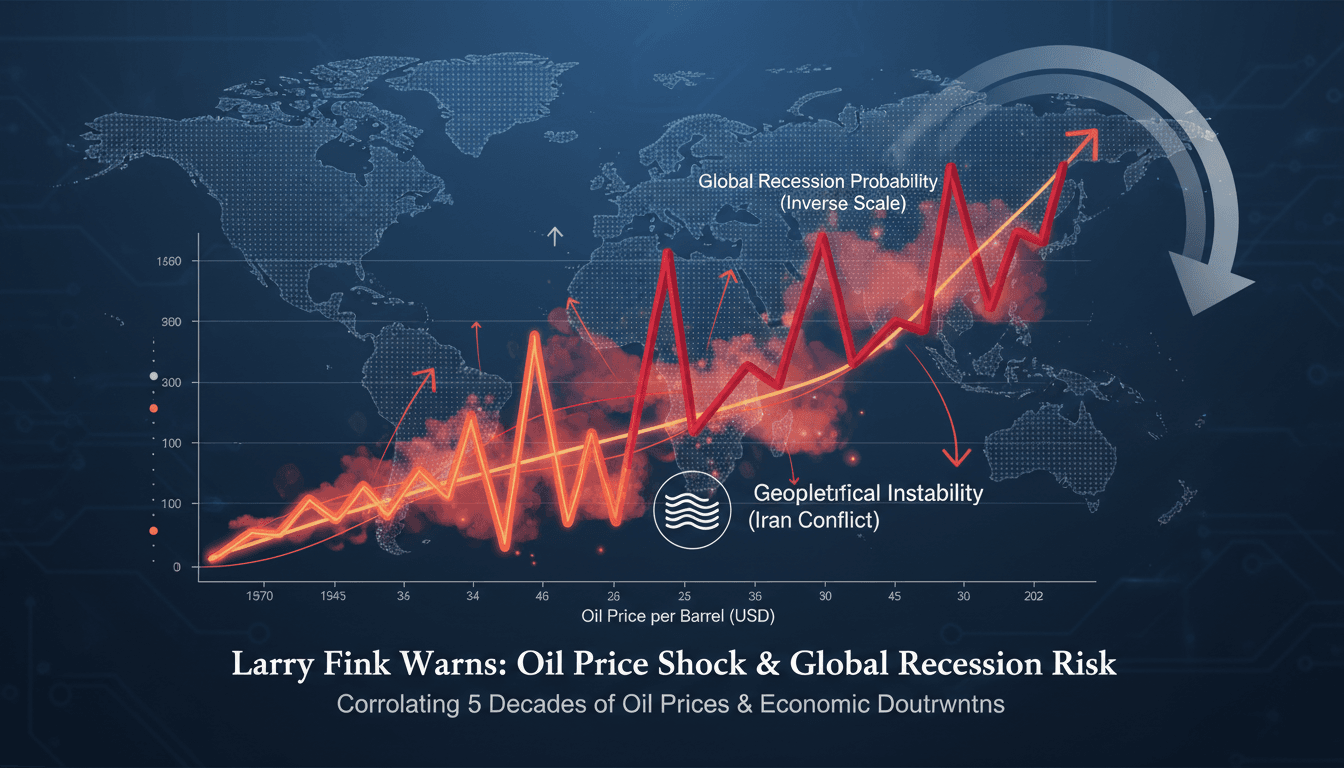
Here's what it means for you.
If you’re in a sector sensitive to oil prices, brace for potential economic turbulence.
Why it matters
High oil prices could trigger a global recession, impacting consumer spending and corporate profitability.
What happened (in 30 seconds)
- Larry Fink, CEO of BlackRock, warned that sustained oil prices above $100 per barrel could lead to a global recession.
- Iran's closure of the Strait of Hormuz has disrupted oil supplies, pushing Brent crude prices to $97.26 and raising recession probabilities to 30-49%.
- Ceasefire proposals emerged, causing a temporary dip in oil prices, but volatility remains high amid ongoing geopolitical tensions.
The context you actually need
- The 2026 Iran war, which began on February 28, has significantly impacted global oil supply, marking the largest disruption in history.
- Oil prices have surged 60.1% year-to-date, reminiscent of the 1970s oil crises that led to U.S. recessions.
- Analysts predict recession odds are rising, with Goldman Sachs and JPMorgan estimating a 30-35% chance due to persistent inflation and weakened demand.
What's really happening
The geopolitical landscape surrounding oil production and distribution is increasingly volatile, primarily due to the ongoing conflict involving Iran. Since the U.S.-Israeli strikes on Iran began on February 28, 2026, the closure of the Strait of Hormuz has severely disrupted oil shipments, affecting one-fifth of global oil and gas supplies. This disruption has not only driven prices up but has also raised alarms about the potential for a global recession.
Larry Fink's warning highlights the economic implications of sustained high oil prices, which he describes as a "regressive tax" on the economy. When oil prices soar, consumers face higher costs for transportation and goods, leading to reduced discretionary spending. This contraction in consumer behavior can erode corporate margins, forcing companies to tighten their belts, which may include layoffs or reduced investment in growth. The cycle can spiral, leading to broader economic downturns.
The International Energy Agency (IEA) has characterized the current situation as the largest supply shock in history, with Brent crude prices reaching $97.26 and WTI at $90.32 as of March 26, 2026. This price volatility is reminiscent of the oil crises of the 1970s, which were significant contributors to economic recessions in the U.S. during that era. The correlation between high oil prices and recessionary periods is well-documented, as seen in the recessions of 1973-75, 1980, and 1990-91.
As the situation evolves, analysts are adjusting their recession probabilities. Goldman Sachs has raised its estimates to 30%, while Moody’s Analytics chief economist Mark Zandi has suggested a 49% chance of recession within the next year if oil prices remain elevated. This reflects a growing consensus that the economic fallout from the Iran conflict could be severe, particularly if oil prices stay high.
The implications extend beyond immediate consumer behavior. Central banks may respond to high inflation driven by oil prices by tightening monetary policy, which could further stifle economic growth. The interconnectedness of global markets means that a recession in one region can have ripple effects worldwide, impacting trade, investment, and employment.
Who feels it first (and how)
- Consumers: Higher fuel and goods prices will reduce disposable income.
- Corporations: Companies with thin margins may face profitability challenges, leading to layoffs.
- Tourism and logistics sectors: In Dubai, these sectors could see reduced demand as global economic conditions worsen.
- Investors: Market volatility may lead to increased uncertainty and risk aversion.
What to watch next
- Oil price fluctuations: Continued volatility in oil prices will indicate the severity of the supply disruption and its economic impact.
- Geopolitical developments: Any escalation or resolution in the Iran conflict could significantly alter market conditions and recession probabilities.
- Central bank responses: Watch for changes in monetary policy that could signal tightening measures in response to inflation.
High oil prices are linked to reduced consumer spending and corporate profitability.
Recession probabilities will continue to rise if oil prices remain elevated.
The duration of the Iran conflict and its long-term impact on global oil supply and economic stability.
Frequently Asked Questions
- Why it matters?
- High oil prices could trigger a global recession, impacting consumer spending and corporate profitability.
- What happened (in 30 seconds)?
- Larry Fink, CEO of BlackRock, warned that sustained oil prices above $100 per barrel could lead to a global recession. Iran's closure of the Strait of Hormuz has disrupted oil supplies, pushing Brent crude prices to $97.26 and raising recession probabilities to 30-49%. Ceasefire proposals emerged, causing a temporary dip in oil prices, but volatility remains high amid ongoing geopolitical tensions.
- What's really happening?
- The geopolitical landscape surrounding oil production and distribution is increasingly volatile, primarily due to the ongoing conflict involving Iran. Since the U.S.-Israeli strikes on Iran began on February 28, 2026, the closure of the Strait of Hormuz has severely disrupted oil shipments, affecting one-fifth of global oil and gas supplies. This disruption has not only driven prices up but has also raised alarms about the potential for a global recession. Larry Fink's warning highlights the ec
- Who feels it first (and how)?
- Consumers: Higher fuel and goods prices will reduce disposable income. Corporations: Companies with thin margins may face profitability challenges, leading to layoffs. Tourism and logistics sectors: In Dubai, these sectors could see reduced demand as global economic conditions worsen. Investors: Market volatility may lead to increased uncertainty and risk aversion.
- What to watch next?
- Oil price fluctuations: Continued volatility in oil prices will indicate the severity of the supply disruption and its economic impact. Geopolitical developments: Any escalation or resolution in the Iran conflict could significantly alter market conditions and recession probabilities. Central bank responses: Watch for changes in monetary policy that could signal tightening measures in response to inflation.
Stock market news, investing ideas, and trading analysis.
"TheStreet provides market news and retail-investor-focused analysis."
— A47 Editor
BlackRock CEO issues stark warning on recession risk
BlackRock CEO Larry Fink has issued a stark warning regarding the risk of a potential global recession, highlighting that oil prices could soar to $150 a barrel if geopolitical tensions involving Iran continue. This statement reflects growing concern...
RT is a Russian state-funded network covering global events from a Russian perspective.
"RT is widely criticized for promoting pro-Kremlin narratives and is considered by many to be a state propaganda outlet."
— A47 Editor
BlackRock CEO does U-turn on Iran war optimism
BlackRock CEO Larry Fink has reversed his earlier optimistic stance on the Iran conflict, now warning that it could lead to a global recession. This shift comes as the ongoing war disrupts global value chains and raises concerns about stagflation, dr...
Business and tech news excluding paywalled content.
"High-volume business/tech outlet with frequent AI coverage."
— A47 Editor
Larry Fink lays out 2 Iran war outcomes: cheaper oil and big growth, or a global recession
Larry Fink, CEO of BlackRock, has outlined two potential outcomes of the ongoing conflict involving Iran: one scenario could lead to cheaper oil and significant economic growth, while the other may result in a global recession. He emphasized that the...