
NASA Unveils $30 Billion Plan for Permanent Lunar South Pole Base
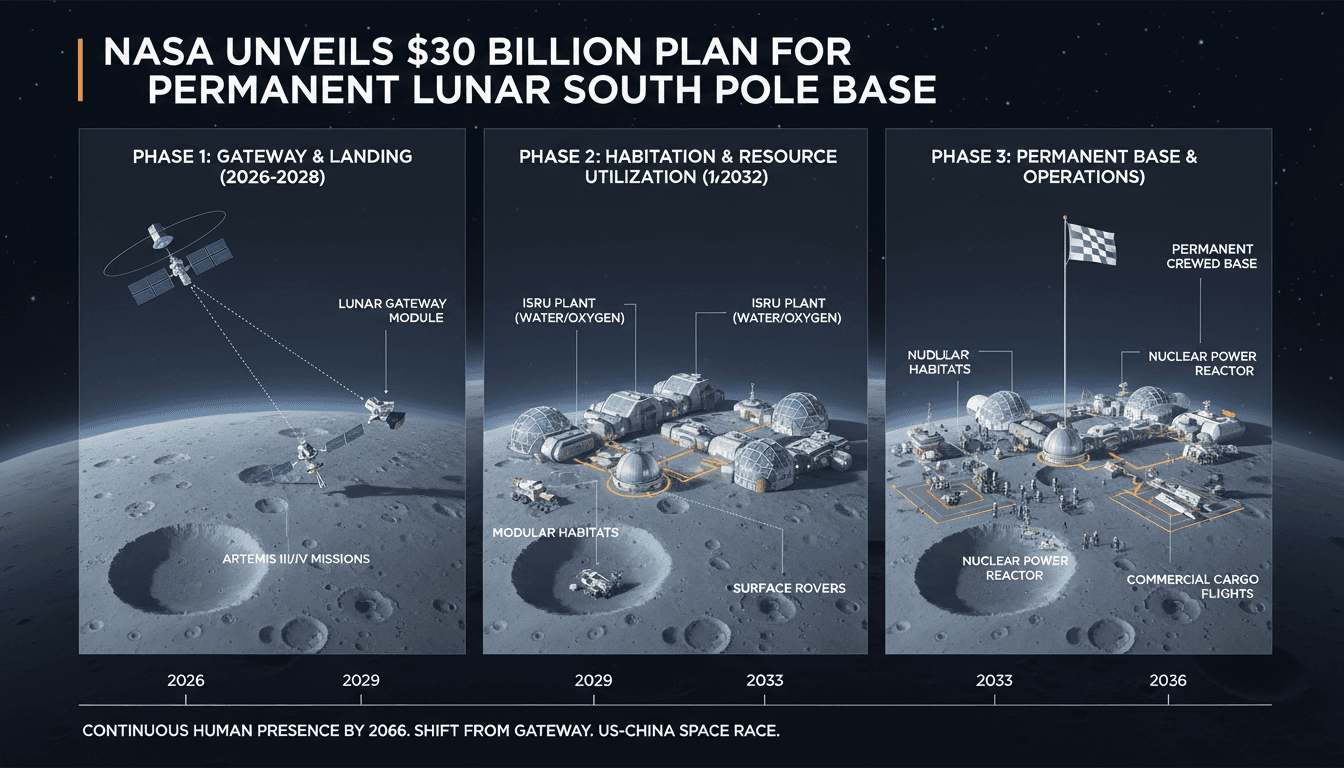
Here's what it means for you.
If you work in the space sector or related industries, this ambitious lunar initiative could reshape job opportunities and research funding.
Why it matters
This $30 billion investment in a permanent lunar base signals a shift in U.S. space policy, prioritizing surface operations over orbital projects amid global competition.
What happened (in 30 seconds)
- NASA announced a phased $30 billion plan for a permanent moon base at the lunar south pole during the 'Ignition' event on March 24, 2026.
- The initiative aims to establish a continuously crewed outpost by 2036, canceling the Lunar Gateway to focus on surface infrastructure.
- Phase 1 includes 25 missions through 2029, delivering essential payloads and setting the stage for future habitation.
The context you actually need
- NASA's Artemis program, initiated in 2017, faced significant delays and budget overruns, exceeding $100 billion, prompting a strategic pivot.
- A December 2025 Executive Order under President Trump emphasized U.S. space superiority, particularly in light of China's ambitions for a crewed lunar landing by 2030.
- The Moon Base plan embraces commercial partnerships and nuclear technologies, aiming for sustained human presence on the Moon and pathways to Mars.
What's really happening
NASA's announcement on March 24, 2026, marks a pivotal moment in the U.S. space program, reflecting a broader strategy to establish a permanent human presence on the Moon. The plan is structured in three phases, with a total estimated cost of $30 billion.
Phase 1, running through 2029, focuses on executing 25 missions that will deliver 4 metric tons of payloads, including rovers, MoonFall drones, and communications relays. This phase is crucial for laying the groundwork for future operations and testing technologies essential for human habitation. The emphasis on robotic missions indicates a shift towards a more sustainable and efficient approach to lunar exploration.
Phase 2, scheduled from 2029 to 2032, aims to deliver 60 tons of cargo, facilitating semi-permanent habitation and enhancing power capabilities on the lunar surface. This phase will likely involve significant collaboration with commercial partners, as NASA seeks to leverage private sector innovations to expedite development.
Phase 3, commencing in 2032, will focus on achieving sustained operations using fission reactors and increasing annual cargo deliveries to 38 tons. This long-term vision underscores NASA's commitment to not only establishing a lunar base but also using it as a stepping stone for future Mars missions.
The cancellation of the Lunar Gateway, an orbiting lunar station, reflects a strategic realignment in response to international competition, particularly from China. By prioritizing surface infrastructure, NASA aims to enhance its capabilities and maintain leadership in space exploration. The decision to focus on the Moon's south pole is driven by its potential resources, including water ice, which can support life and fuel future missions.
This shift in strategy is also influenced by the need for a robust commercial space sector. NASA's approach encourages partnerships with private companies, creating opportunities for innovation and job creation in the space industry. As the program develops, it is expected to stimulate advancements in technologies such as nuclear propulsion, which could revolutionize space travel.
Who feels it first (and how)
- Space industry professionals: Increased job opportunities and funding for research and development.
- Commercial space companies: Potential contracts for payload delivery and technology development.
- Scientists and researchers: New avenues for lunar research and collaboration on international projects.
- UAE's Mohammed Bin Rashid Space Centre: Possible redirection of efforts towards lunar surface projects, sustaining local space jobs.
What to watch next
- Commercial partnerships: Monitor how NASA's collaborations with private companies evolve, as they will be crucial for the program's success.
- Technological advancements: Watch for developments in nuclear propulsion and other technologies that could emerge from this initiative.
- International collaborations: Keep an eye on how NASA engages with global partners to repurpose Gateway assets and share lunar research.
The total estimated cost of the Moon Base program is $30 billion.
Increased collaboration with commercial partners will accelerate technology development and job creation in the space sector.
The full impact of the Moon Base on international space dynamics and competition with other nations remains to be seen.
Frequently Asked Questions
- Why it matters?
- This $30 billion investment in a permanent lunar base signals a shift in U.S. space policy, prioritizing surface operations over orbital projects amid global competition.
- What happened (in 30 seconds)?
- NASA announced a phased $30 billion plan for a permanent moon base at the lunar south pole during the 'Ignition' event on March 24, 2026. The initiative aims to establish a continuously crewed outpost by 2036, canceling the Lunar Gateway to focus on surface infrastructure. Phase 1 includes 25 missions through 2029, delivering essential payloads and setting the stage for future habitation.
- What's really happening?
- NASA's announcement on March 24, 2026, marks a pivotal moment in the U.S. space program, reflecting a broader strategy to establish a permanent human presence on the Moon. The plan is structured in three phases, with a total estimated cost of $30 billion. Phase 1, running through 2029, focuses on executing 25 missions that will deliver 4 metric tons of payloads, including rovers, MoonFall drones, and communications relays. This phase is crucial for laying the groundwork for future operations a
- Who feels it first (and how)?
- Space industry professionals: Increased job opportunities and funding for research and development. Commercial space companies: Potential contracts for payload delivery and technology development. Scientists and researchers: New avenues for lunar research and collaboration on international projects. UAE's Mohammed Bin Rashid Space Centre: Possible redirection of efforts towards lunar surface projects, sustaining local space jobs.
- What to watch next?
- Commercial partnerships: Monitor how NASA's collaborations with private companies evolve, as they will be crucial for the program's success. Technological advancements: Watch for developments in nuclear propulsion and other technologies that could emerge from this initiative. International collaborations: Keep an eye on how NASA engages with global partners to repurpose Gateway assets and share lunar research.
Science and technology stories including AI.
"Longstanding science magazine with thoughtful AI coverage."
— A47 Editor
NASA unveils ambitious new moon base plans
NASA has announced an ambitious $30 billion plan to accelerate lunar landings and establish a permanent U.S. moon base by 2036, as revealed by NASA chief Jared Isaacman. This initiative aims to enhance the United States' presence on the Moon and supp...
Scientific research, technology, environment, and society.
"Scientific American is one of the oldest and most authoritative science magazines, known for deep dives into science, technology, and society."
— A47 Editor
NASA unveils ambitious new moon base plans
NASA has announced an ambitious $30 billion plan to accelerate lunar landings and establish a permanent U.S. moon base by 2036, as revealed by NASA chief Jared Isaacman. This initiative aims to enhance the United States' presence on the Moon and supp...
Reports on science policy, discoveries, and public debate in the scientific realm.
"The Guardian’s science section is known for thoughtful and critical reporting on global research, ethics, and public understanding of science."
— A47 Editor
Nasa to spend $20bn on moon base after cancelling orbiting station
NASA has announced a significant shift in its lunar exploration strategy, opting to cancel plans for an orbiting space station and instead invest $20 billion in constructing a base on the moon's surface over the next seven years, as stated by new NAS...
Top international stories selected by The Guardian editors.
"The Guardian is known for its progressive editorial stance and in-depth analysis."
— A47 Editor
Nasa to spend $20bn on moon base after cancelling orbiting station
NASA has announced a significant shift in its lunar exploration strategy, opting to cancel plans for an orbiting space station and instead invest $20 billion in constructing a base on the moon's surface over the next seven years, as stated by new NAS...
Regional and international reporting focused on Middle Eastern politics, diplomacy, and economics.
"Asharq Al-Awsat is a Saudi-owned international newspaper reflecting mainstream Gulf political perspectives."
— A47 Editor
NASA to Build $20 Bn Moon Base, Pause Orbital Lunar Station Plans
NASA has announced a significant investment of $20 billion to establish a moon base while pausing plans for an orbital lunar station. This decision reflects a strategic shift in the agency's lunar exploration priorities, emphasizing the creation of a...