
Breakthrough in Gene Editing Enables Immune System to Produce Therapeutic Antibodies
Here's what it means for you.
This breakthrough in gene editing could lead to more effective vaccines and treatments for infectious diseases that directly impact global health.
Why it matters
The ability to produce broadly neutralizing antibodies could revolutionize vaccine development and therapeutic strategies against persistent pathogens.
What happened (in 30 seconds)
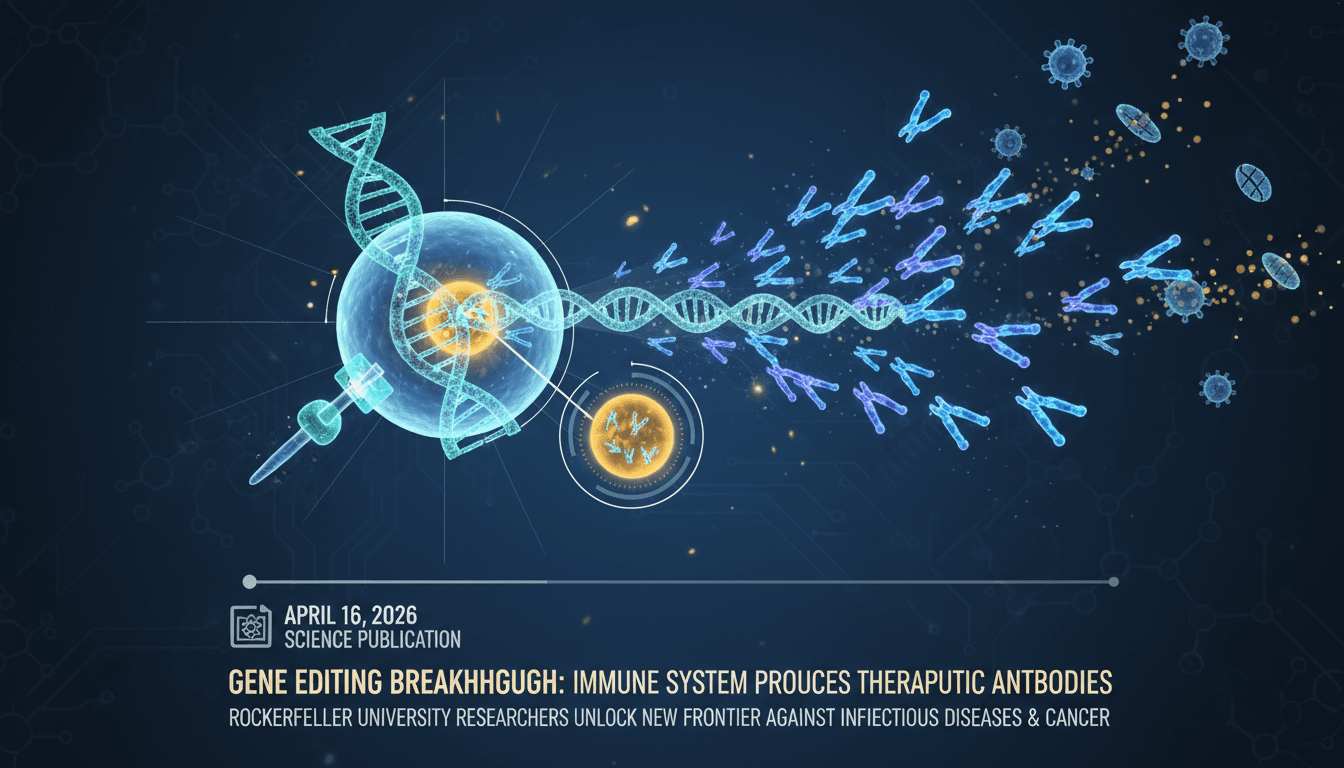
- On April 16, 2026, researchers at Rockefeller University published a study demonstrating a CRISPR-based method to edit hematopoietic stem cells for producing therapeutic antibodies.
- The technique enables the immune system to generate rare broadly neutralizing antibodies (bnAbs) against pathogens like HIV and influenza, addressing longstanding vaccine challenges.
- Initial results showed that edited stem cells in mice produced high levels of antibodies that persisted long-term and could be boosted upon vaccination.
The context you actually need
- Broadly neutralizing antibodies are crucial for effective vaccines against pathogens that evade standard immune responses, such as HIV and malaria.
- Previous methods for generating bnAbs faced scalability issues, limiting their practical application in vaccine development.
- This research builds on advances in CRISPR technology and hematopoietic stem cell transplantation, aiming to harness the immune system's natural capabilities for therapeutic purposes.
What's really happening
The recent study led by Harald Hartweger at Rockefeller University marks a significant advancement in immunology and gene editing. By utilizing CRISPR technology, researchers successfully edited hematopoietic stem and progenitor cells (HSPCs) to express genes for broadly neutralizing antibodies (bnAbs). This innovative approach allows for the direct insertion of antibody genes into stem cells, which then differentiate into B cells capable of producing these therapeutic proteins.
Historically, the development of bnAbs has been hampered by the rarity of their precursors and the complexity of eliciting them through traditional vaccination methods. The immune system typically generates bnAbs through a lengthy process of somatic hypermutation, which is not easily replicated in vaccine formulations. Previous strategies focused on isolating bnAbs from elite controllers or engineering them ex vivo, but these methods struggled with scalability and durability.
The breakthrough study demonstrated that edited HSPCs could be transplanted into mice, where they successfully produced high titers of antibodies upon vaccination. This not only showed the potential for long-lasting immunity but also the ability to boost antibody production with subsequent vaccinations. The researchers validated their findings in human cells, indicating a promising pathway for future clinical applications.
The implications of this research extend beyond infectious diseases. The ability to program the immune system to produce therapeutic proteins could lead to new treatments for various conditions, including cancers and protein deficiencies. The Rockefeller University team plans to advance their research into non-human primate trials for HIV, which could pave the way for human clinical trials.
This innovative approach aligns with the growing interest in precision medicine and personalized therapies, particularly in regions like the UAE, where investments in biotech and healthcare infrastructure are rapidly expanding. The Dubai Health Authority and initiatives like Dubai Science Park are well-positioned to leverage such advancements, potentially accelerating the translation of these therapies into clinical practice.
Who feels it first (and how)
- Biotech companies: Increased investment opportunities in gene editing and immunotherapy sectors.
- Healthcare providers: Potential for new treatment protocols and vaccine strategies against persistent pathogens.
- Patients with chronic infections: Access to more effective therapies that could improve health outcomes.
- Researchers and scientists: New avenues for exploration in immunology and genetic engineering.
What to watch next
- Clinical trials: Watch for the initiation of non-human primate trials for HIV, which will be a critical step toward human applications.
- Regulatory developments: Keep an eye on how regulatory bodies respond to these advancements in gene editing and immunotherapy.
- Market reactions: Monitor biotech stock movements and investments in companies focusing on gene editing technologies.
The study demonstrates the feasibility of using CRISPR to edit HSPCs for therapeutic antibody production.
This research will lead to further clinical trials and potential applications in treating infectious diseases and other conditions.
The timeline for regulatory approval and widespread clinical use of these therapies remains uncertain.
Frequently Asked Questions
- Why it matters?
- The ability to produce broadly neutralizing antibodies could revolutionize vaccine development and therapeutic strategies against persistent pathogens.
- What happened (in 30 seconds)?
- On April 16, 2026, researchers at Rockefeller University published a study demonstrating a CRISPR-based method to edit hematopoietic stem cells for producing therapeutic antibodies. The technique enables the immune system to generate rare broadly neutralizing antibodies (bnAbs) against pathogens like HIV and influenza, addressing longstanding vaccine challenges. Initial results showed that edited stem cells in mice produced high levels of antibodies that persisted long-term and could be boos
- What's really happening?
- The recent study led by Harald Hartweger at Rockefeller University marks a significant advancement in immunology and gene editing. By utilizing CRISPR technology, researchers successfully edited hematopoietic stem and progenitor cells (HSPCs) to express genes for broadly neutralizing antibodies (bnAbs). This innovative approach allows for the direct insertion of antibody genes into stem cells, which then differentiate into B cells capable of producing these therapeutic proteins. Historically, t
- Who feels it first (and how)?
- Biotech companies: Increased investment opportunities in gene editing and immunotherapy sectors. Healthcare providers: Potential for new treatment protocols and vaccine strategies against persistent pathogens. Patients with chronic infections: Access to more effective therapies that could improve health outcomes. Researchers and scientists: New avenues for exploration in immunology and genetic engineering.
- What to watch next?
- Clinical trials: Watch for the initiation of non-human primate trials for HIV, which will be a critical step toward human applications. Regulatory developments: Keep an eye on how regulatory bodies respond to these advancements in gene editing and immunotherapy. Market reactions: Monitor biotech stock movements and investments in companies focusing on gene editing technologies.
Arabic-language UAE newspaper coverage focused on domestic affairs, public institutions, business, society, and regional developments.
"Al Khaleej coverage generally reflects a mainstream UAE editorial lens with strong attention to public affairs, institutions, and regional developments."
— A47 Editor
باحثون: برمجة الجهاز المناعي تنتج أجساماً مضادة نادرة
American researchers have announced a new method to program the immune system to produce beneficial proteins, including rare and highly effective antibodies that are typically difficult to generate. This technique involves reprogramming immune cells,...
Pan-Arab news coverage spanning politics, business, sports, and regional affairs.
"Asharq Al-Awsat reflects a broad Arab editorial perspective with strong attention to regional geopolitics."
— A47 Editor
دراسة: الجهاز المناعي يمكن إعادة برمجته لإنتاج أجسام مضادة نادرة
Researchers have potentially discovered a new method to reprogram the immune system to produce rare and highly effective antibodies, which are typically challenging to generate. This breakthrough could lead to significant advancements in therapeutic ...
Pan-Arab news coverage spanning politics, business, sports, and regional affairs.
"Asharq Al-Awsat reflects a broad Arab editorial perspective with strong attention to regional geopolitics."
— A47 Editor
دراسة: الجهاز المناعي يمكن إعادة برمجته لإنتاج أجسام مضادة نادرة
Researchers have potentially discovered a new method to reprogram the immune system to produce beneficial proteins, including highly effective antibodies that are typically difficult to generate. This advancement could lead to significant improvement...