
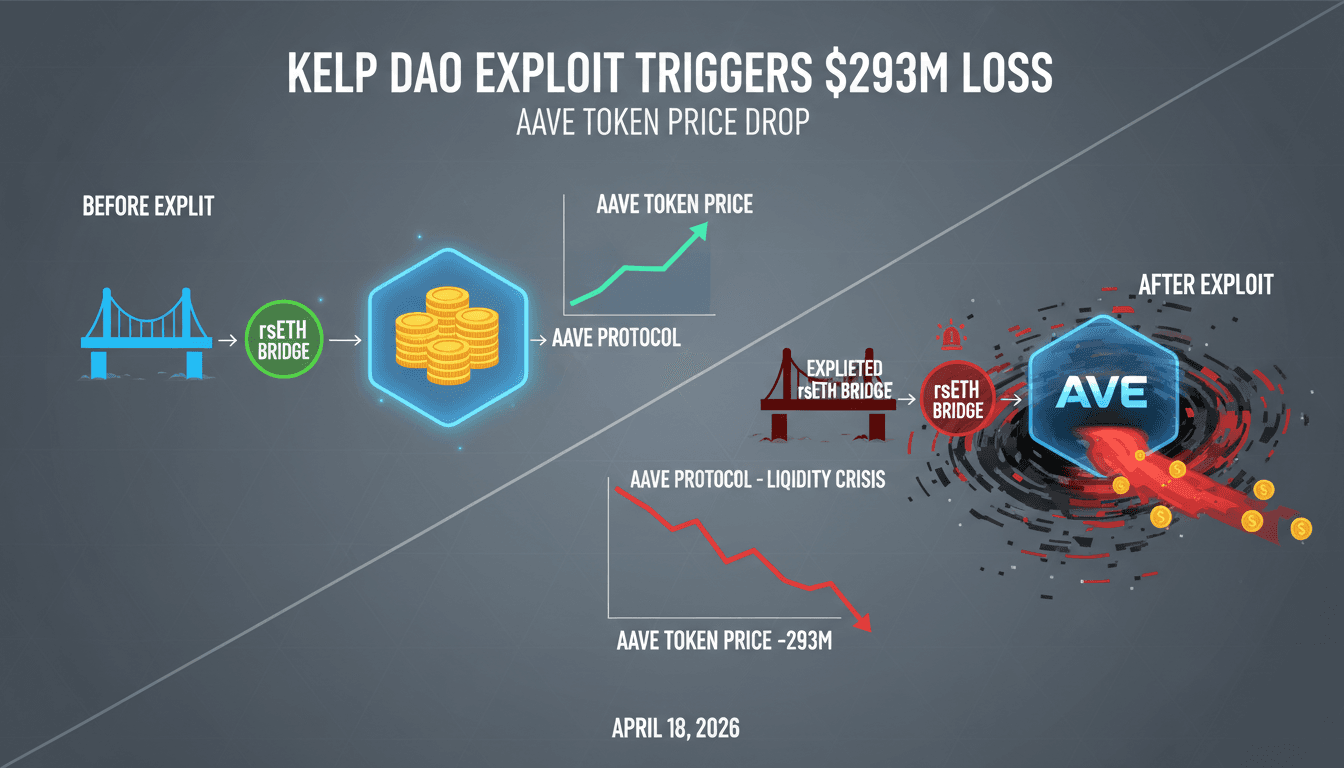
Kelp DAO Exploit Triggers $293 Million Loss and Aave Token Price Drop
Here's what it means for you.
If you're involved in DeFi, this incident highlights the risks of interconnected protocols and the potential for rapid market shifts.
Why it matters
This exploit underscores vulnerabilities in decentralized finance (DeFi) systems, affecting liquidity and investor confidence.
What happened (in 30 seconds)
- On April 18, 2026, Kelp DAO's rsETH bridge was exploited, draining approximately $293 million in unbacked tokens.
- Aave's token price dropped nearly 20%, from around $112 to $90, as panic withdrawals surged, leading to a liquidity crisis.
- Investigations are ongoing, with Aave freezing rsETH markets and derivatives markets showing signs of potential recovery.
The context you actually need
- Kelp DAO operated a liquid restaking protocol that issued rsETH, which was widely used as collateral in DeFi platforms like Aave.
- The exploit was facilitated by a misconfigured decentralized verifier network (DVN) within LayerZero's cross-chain bridge, allowing unauthorized minting of tokens.
- The incident exposed systemic risks in DeFi, particularly as liquid restaking gained traction, with 18% of the circulating supply of rsETH affected.
What's really happening
On April 18, 2026, at approximately 17:35 UTC, an attacker exploited Kelp DAO's rsETH bridge, minting and draining 116,500 unbacked rsETH tokens valued at $293 million. This exploit allowed the attacker to deposit these tokens as collateral on Aave's V3 and V4 protocols, enabling the borrowing of legitimate Wrapped Ether (WETH) and creating nearly $200 million in bad debt, primarily in the rsETH/WETH trading pair.
As news of the exploit spread, panic ensued among major investors, or "whales," leading to significant withdrawals. Notably, MEXC withdrew $431 million, and Abraxas Capital followed with $392 million, pushing Aave's ETH pool utilization to 100% and interest rates skyrocketing to 14-15%. Within 48 hours, Aave's total value locked (TVL) plummeted from $26.4 billion to $17.5 billion, reflecting a broader liquidity crisis across the DeFi landscape, which saw a total decline of $13 billion in TVL.
In response, Aave's governance activated emergency measures, freezing rsETH markets across its deployments. The AAVE token price fell sharply, stabilizing near $90 after a drop of 16-20%. Meanwhile, derivatives markets indicated a rising open interest of 17%, reaching $316.5 million, alongside negative funding rates, suggesting a potential short squeeze and a possible rebound in the token's value.
LayerZero, the technology behind Kelp DAO's bridge, attributed the exploit to the misconfiguration of the DVN and linked the attack to North Korea's Lazarus Group, raising concerns about the security of cross-chain bridges. Justin Sun, a prominent figure in the crypto space, publicly offered to negotiate with the attacker, highlighting the ongoing complexities of managing security and trust in DeFi.
Who feels it first (and how)
- DeFi investors holding AAVE or rsETH tokens may experience unrealized losses and withdrawal delays.
- Liquidity providers on Aave face increased borrowing costs and potential losses due to the liquidity crisis.
- Developers and protocols relying on LayerZero's technology may need to reassess their security measures and risk management strategies.
What to watch next
- Investigations into the exploit: Understanding the full scope of the attack and its implications for security protocols will be crucial for restoring confidence in DeFi.
- Market recovery indicators: Watch for signs of stabilization in AAVE's price and TVL across DeFi platforms, which could signal a rebound.
- Regulatory responses: Increased scrutiny on liquid restaking and cross-chain bridges may lead to new regulations that could reshape the DeFi landscape.
The exploit resulted in a significant loss of funds and a liquidity crisis affecting Aave and the broader DeFi ecosystem.
Aave will implement stricter security measures and governance changes to prevent future exploits.
The long-term impact on investor confidence and the overall DeFi market remains uncertain.
Frequently Asked Questions
- Why it matters?
- This exploit underscores vulnerabilities in decentralized finance (DeFi) systems, affecting liquidity and investor confidence.
- What happened (in 30 seconds)?
- On April 18, 2026, Kelp DAO's rsETH bridge was exploited, draining approximately $293 million in unbacked tokens. Aave's token price dropped nearly 20%, from around $112 to $90, as panic withdrawals surged, leading to a liquidity crisis. Investigations are ongoing, with Aave freezing rsETH markets and derivatives markets showing signs of potential recovery.
- What's really happening?
- On April 18, 2026, at approximately 17:35 UTC, an attacker exploited Kelp DAO's rsETH bridge, minting and draining 116,500 unbacked rsETH tokens valued at $293 million. This exploit allowed the attacker to deposit these tokens as collateral on Aave's V3 and V4 protocols, enabling the borrowing of legitimate Wrapped Ether (WETH) and creating nearly $200 million in bad debt, primarily in the rsETH/WETH trading pair. As news of the exploit spread, panic ensued among major investors, or "whales,"
- Who feels it first (and how)?
- DeFi investors holding AAVE or rsETH tokens may experience unrealized losses and withdrawal delays. Liquidity providers on Aave face increased borrowing costs and potential losses due to the liquidity crisis. Developers and protocols relying on LayerZero's technology may need to reassess their security measures and risk management strategies.
- What to watch next?
- Investigations into the exploit: Understanding the full scope of the attack and its implications for security protocols will be crucial for restoring confidence in DeFi. Market recovery indicators: Watch for signs of stabilization in AAVE's price and TVL across DeFi platforms, which could signal a rebound. Regulatory responses: Increased scrutiny on liquid restaking and cross-chain bridges may lead to new regulations that could reshape the DeFi landscape.
Real-time updates, analysis, and reports on the blockchain and cryptocurrency sectors.
"Crypto News delivers real-time updates, analysis, and reports on the blockchain and cryptocurrency sectors."
— A47 Editor
Aave price drops to $90 after Kelp DAO exploit, derivatives hint at potential rebound
Aave's price has fallen nearly 20% to approximately $90 following a significant exploit at Kelp DAO, which resulted in around $196 million in bad debt for the protocol. This incident has raised concerns about the security and stability of decentraliz...
Covers blockchain, cryptocurrency news, project analysis, and market insights.
"Cointelegraph is a leading crypto-focused media outlet known for timely news, analysis, and educational content related to blockchain and digital assets."
— A47 Editor
Aave's TVL tanks $8B a day after $293M Kelp DAO hack
Aave's total value locked (TVL) has plummeted by $8 billion following a significant hack of Kelp DAO, which drained approximately $293 million from its reserves. The Aave token has also seen a nearly 20% drop in value, falling to $89.5 within 24 hour...
Research, news, and analysis on blockchain startups, DeFi, and regulations.
"Crypto Briefing provides research, news, and analysis on blockchain startups, DeFi, and crypto regulations with investor-focused coverage."
— A47 Editor
AAVE TVL drops to $17B after KelpDAO exploit triggers $8.4B withdrawals
The total value locked (TVL) in AAVE has dropped to $17 billion following a significant exploit of KelpDAO, which triggered approximately $8.4 billion in withdrawals. This incident underscores vulnerabilities in cross-chain security and has led to th...
Research, news, and analysis on blockchain startups, DeFi, and regulations.
"Crypto Briefing provides research, news, and analysis on blockchain startups, DeFi, and crypto regulations with investor-focused coverage."
— A47 Editor
KelpDAO exploit causes $10.5B drop in DeFi TVL, AAVE suspends rsETH markets
The KelpDAO exploit has led to a significant $10.5 billion drop in the total value locked (TVL) in decentralized finance (DeFi), prompting AAVE to suspend its rsETH markets. This incident highlights the vulnerabilities present in DeFi platforms, rais...
Covers Bitcoin plus altcoin news, market updates, and educational resources.
"Bitcoin.com provides news, market data, and guides focused on Bitcoin and the wider crypto industry."
— A47 Editor
DeFi Lender Aave Battles Withdrawal Crisis After KelpDAO rsETH Exploit
Aave, a decentralized finance (DeFi) lender, is currently facing a withdrawal crisis following a significant exploit of KelpDAO's rsETH, which resulted in a loss of approximately $292 million. This breach has led Aave to suspend its rsETH markets and...
Covers blockchain, cryptocurrency news, project analysis, and market insights.
"CoinDesk is a well-established cryptocurrency and blockchain news provider, offering comprehensive insights, market data, and industry research."
— A47 Editor
Aave sees $6 billion deposit drop as Kelp hack exposes structural risk for DeFi lender
Aave has experienced a significant drop in deposits, losing approximately $6 billion, following a hack that exploited drained rsETH as collateral to borrow wrapped ether. This incident has resulted in a 16% decline in the value of the AAVE token as t...
Research, news, and analysis on blockchain startups, DeFi, and regulations.
"Crypto Briefing provides research, news, and analysis on blockchain startups, DeFi, and crypto regulations with investor-focused coverage."
— A47 Editor
KelpDAO exploit triggers $236M bad debt, $AAVE drops 18%
The KelpDAO exploit has triggered a staggering $236 million in bad debt, leading to an 18% drop in the value of AAVE. This incident underscores the vulnerabilities within decentralized finance (DeFi) platforms, raising alarms about their security and...
Research, news, and analysis on blockchain startups, DeFi, and regulations.
"Crypto Briefing provides research, news, and analysis on blockchain startups, DeFi, and crypto regulations with investor-focused coverage."
— A47 Editor
KelpDAO exploit causes AAVE ETH pool to utilization
The KelpDAO exploit has caused significant disruption in the decentralized finance (DeFi) sector, leading to a utilization crisis in the AAVE ETH pool. This incident has resulted in an estimated $280 million loss, raising alarms about the security vu...
Research, news, and analysis on blockchain startups, DeFi, and regulations.
"Crypto Briefing provides research, news, and analysis on blockchain startups, DeFi, and crypto regulations with investor-focused coverage."
— A47 Editor
KelpDAO exploit creates $236M bad debt risk for AAVE, Ethereum drops 3%
The KelpDAO exploit has resulted in a staggering $236 million in bad debt risk for AAVE, contributing to a 3% drop in Ethereum's value. This incident underscores significant vulnerabilities within decentralized finance (DeFi) protocols, raising conce...
Research, news, and analysis on blockchain startups, DeFi, and regulations.
"Crypto Briefing provides research, news, and analysis on blockchain startups, DeFi, and crypto regulations with investor-focused coverage."
— A47 Editor
AAVE drops 12% after Kelp DAO’s $280M DeFi exploit
AAVE's value has dropped by 12% following a significant $280 million exploit involving Kelp DAO, highlighting vulnerabilities within decentralized finance (DeFi) platforms. This incident raises concerns about the security of Ethereum-based financial ...