
NASA Unveils Phased Plan for Permanent Lunar South Pole Base
Why it matters
The U.S. aims to solidify its leadership in space amid rising international competition, particularly from China.
What happened (in 30 seconds)
- NASA announced a phased plan for a permanent moon base at the lunar south pole on March 24, 2026.
- The initiative accelerates the Artemis program while pausing the Lunar Gateway station to focus on surface infrastructure.
- Nuclear power technologies will be prioritized for long-term operations in shadowed craters rich in water ice.
The context you actually need
- The Artemis program, initiated in 2017, aims to return humans to the Moon and establish a sustainable presence by the 2030s.
- International competition is escalating, with China planning astronaut landings by 2030 and a joint lunar research station with Russia by 2036.
- The U.S. National Space Policy emphasizes American leadership, commercial reusability, and nuclear propulsion for Moon-to-Mars architecture.
What's really happening
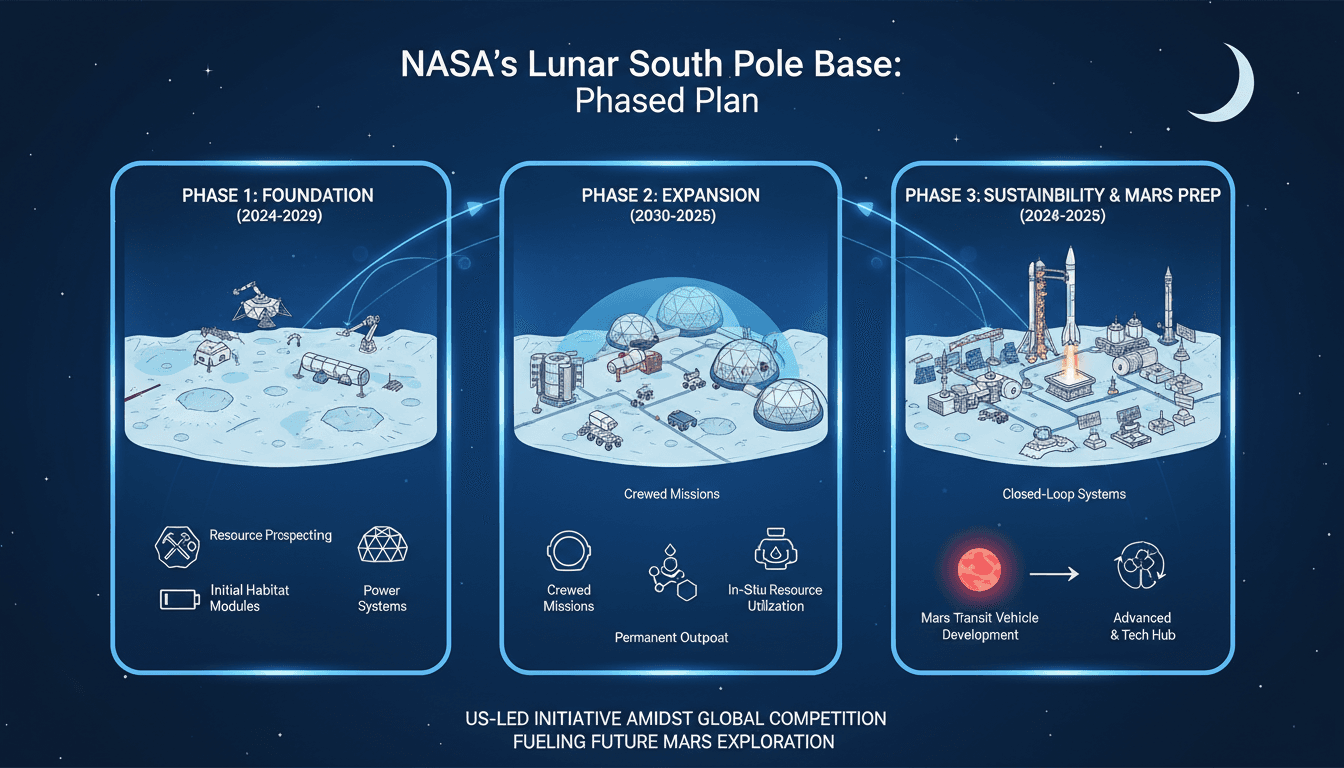
On March 24, 2026, NASA Administrator Jared Isaacman unveiled the "Ignition" initiatives, detailing a three-phase strategy for establishing a permanent lunar base. This plan is a direct response to growing geopolitical competition, particularly from China, which has ambitious lunar goals of its own. The phased approach is designed to ensure that the U.S. maintains its leadership in space exploration while fostering international and commercial partnerships.
Phase 1, set to run from now until 2029, will involve up to 25 missions, including 21 landings. These missions will utilize the Commercial Lunar Payload Services (CLPS) 2.0 program to deliver essential infrastructure such as rovers, MoonFall drones, and nuclear radioisotope power units. This initial phase is crucial for laying the groundwork for future operations and establishing a sustainable human presence on the Moon.
Phase 2, scheduled for 2029 to 2032, will focus on early habitation. This phase will introduce fission reactors to provide power, enhance mobility capabilities, and facilitate 24 landings that will deliver approximately 60 tons of cargo. The goal is to create a functional living environment that can support astronauts for extended periods.
Phase 3, beginning in 2032, aims to enable a sustained human presence on the lunar surface. This phase will see the establishment of full habitats and an annual cargo delivery system, ensuring that astronauts can live and work on the Moon for extended durations. The Artemis III mission will test critical technologies in 2027, with the first lunar landing expected in 2028 via Artemis IV, followed by a regular six-month cadence of missions.
The decision to pause the Lunar Gateway project reflects a strategic pivot towards surface operations, allowing NASA to repurpose assets and resources for direct lunar exploration. The emphasis on nuclear electric propulsion also indicates a long-term vision for Mars exploration, aligning with the broader goals of the Artemis program.
Who feels it first (and how)
- Space industry professionals: Increased demand for contracts related to lunar missions and infrastructure development.
- Technology developers: Opportunities for innovation in nuclear power and robotics for lunar applications.
- International partners: Countries involved in the Artemis Accords may see enhanced collaboration opportunities in lunar exploration.
What to watch next
- Commercial partnerships: Monitor how companies like SpaceX and Blue Origin position themselves for increased contracts related to lunar landers and infrastructure.
- International responses: Watch for any formal reactions from competitors like China and Russia, as their strategies may shift in response to U.S. plans.
- Technological advancements: Keep an eye on developments in nuclear power technologies and their applications for both lunar and Martian missions.
NASA's phased plan includes 25 missions and a focus on nuclear power for lunar operations.
Increased collaboration with international partners and commercial entities will emerge as the plan progresses.
The specific impacts on global space markets and technology sectors remain to be fully understood.
Frequently Asked Questions
- Why it matters?
- The U.S. aims to solidify its leadership in space amid rising international competition, particularly from China.
- What happened (in 30 seconds)?
- NASA announced a phased plan for a permanent moon base at the lunar south pole on March 24, 2026. The initiative accelerates the Artemis program while pausing the Lunar Gateway station to focus on surface infrastructure. Nuclear power technologies will be prioritized for long-term operations in shadowed craters rich in water ice.
- What's really happening?
- On March 24, 2026, NASA Administrator Jared Isaacman unveiled the "Ignition" initiatives, detailing a three-phase strategy for establishing a permanent lunar base. This plan is a direct response to growing geopolitical competition, particularly from China, which has ambitious lunar goals of its own. The phased approach is designed to ensure that the U.S. maintains its leadership in space exploration while fostering international and commercial partnerships. Phase 1, set to run from now until 20
- Who feels it first (and how)?
- Space industry professionals: Increased demand for contracts related to lunar missions and infrastructure development. Technology developers: Opportunities for innovation in nuclear power and robotics for lunar applications. International partners: Countries involved in the Artemis Accords may see enhanced collaboration opportunities in lunar exploration.
- What to watch next?
- Commercial partnerships: Monitor how companies like SpaceX and Blue Origin position themselves for increased contracts related to lunar landers and infrastructure. International responses: Watch for any formal reactions from competitors like China and Russia, as their strategies may shift in response to U.S. plans. Technological advancements: Keep an eye on developments in nuclear power technologies and their applications for both lunar and Martian missions.
Science and technology stories including AI.
"Longstanding science magazine with thoughtful AI coverage."
— A47 Editor
NASA unveils ambitious new moon base plans
NASA has announced an ambitious $30 billion plan to accelerate lunar landings and establish a permanent U.S. moon base by 2036, as revealed by NASA chief Jared Isaacman. This initiative aims to enhance the United States' presence on the Moon and supp...
Scientific research, technology, environment, and society.
"Scientific American is one of the oldest and most authoritative science magazines, known for deep dives into science, technology, and society."
— A47 Editor
NASA unveils ambitious new moon base plans
NASA has announced an ambitious $30 billion plan to accelerate lunar landings and establish a permanent U.S. moon base by 2036, as revealed by NASA chief Jared Isaacman. This initiative aims to enhance the United States' presence on the Moon and supp...
Reports on science policy, discoveries, and public debate in the scientific realm.
"The Guardian’s science section is known for thoughtful and critical reporting on global research, ethics, and public understanding of science."
— A47 Editor
Nasa to spend $20bn on moon base after cancelling orbiting station
NASA has announced a significant shift in its lunar exploration strategy, opting to cancel plans for an orbiting space station and instead invest $20 billion in constructing a base on the moon's surface over the next seven years, as stated by new NAS...
Top international stories selected by The Guardian editors.
"The Guardian is known for its progressive editorial stance and in-depth analysis."
— A47 Editor
Nasa to spend $20bn on moon base after cancelling orbiting station
NASA has announced a significant shift in its lunar exploration strategy, opting to cancel plans for an orbiting space station and instead invest $20 billion in constructing a base on the moon's surface over the next seven years, as stated by new NAS...
Regional and international reporting focused on Middle Eastern politics, diplomacy, and economics.
"Asharq Al-Awsat is a Saudi-owned international newspaper reflecting mainstream Gulf political perspectives."
— A47 Editor
NASA to Build $20 Bn Moon Base, Pause Orbital Lunar Station Plans
NASA has announced a significant investment of $20 billion to establish a moon base while pausing plans for an orbital lunar station. This decision reflects a strategic shift in the agency's lunar exploration priorities, emphasizing the creation of a...