
Record $18.84 Billion Withdrawn from Indian Equities Amid US-Iran Energy Crisis
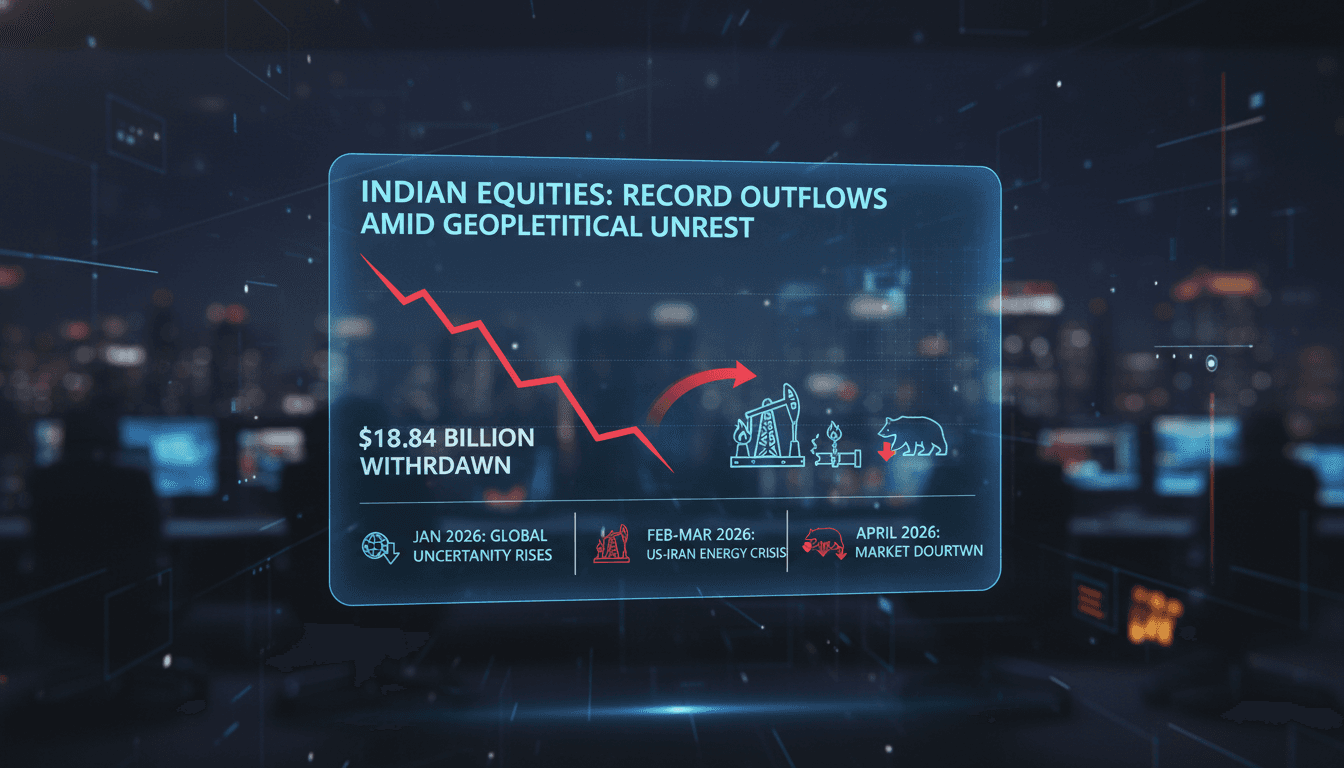
Here's what it means for you.
If you're invested in Indian equities or have exposure to the Indian market, this unprecedented outflow could significantly impact your portfolio.
Why it matters
The withdrawal of foreign investment from Indian equities signals a loss of confidence in the country's economic stability, which could have ripple effects on global markets.
What happened (in 30 seconds)
- Record outflow: Global investment funds withdrew $18.84 billion from Indian equities between January and early April 2026, surpassing the previous full-year outflow.
- Market impact: The exodus has erased over $600 billion in market value from Indian shares, leading to a significant depreciation of the rupee and increased inflationary pressures.
- Sector focus: The financial sector was hit hardest, with $6.53 billion in net sales, reflecting heightened fears over growth amid escalating geopolitical tensions.
The context you actually need
- Previous trends: In 2025, Indian equities already faced $18.79 billion in net foreign sales due to global reallocations, setting the stage for the current crisis.
- Geopolitical catalyst: The US-Iran conflict escalated in early 2026, culminating in a blockade of the Strait of Hormuz, which disrupted oil exports and drove Brent crude prices above $120 per barrel.
- Economic repercussions: The energy shock has prompted downgrades to India's growth projections and raised inflation risks, further exacerbating investor concerns.
What's really happening
The recent outflow of $18.84 billion from Indian equities is a direct consequence of the escalating US-Iran conflict, which has created significant disruptions in global energy markets. The blockade of the Strait of Hormuz in March 2026 stranded oil and LNG exports, leading to a surge in Brent crude prices that exceeded $120 per barrel. This energy shock has profound implications for India, an oil-importing economy that is particularly vulnerable to fluctuations in global oil prices.
As the cost of energy rises, inflationary pressures mount, prompting analysts to downgrade growth projections for India. The financial sector, which is heavily reliant on foreign investment, has been particularly affected, with $6.53 billion in net sales recorded in March alone. This has led to a cumulative market value loss of over $600 billion since the peak, with the Nifty 50 index experiencing its worst monthly performance in six years, declining by 11.3% in March.
The Reserve Bank of India (RBI) has responded to these pressures by tightening foreign exchange exposure limits, which has intensified short-term selling. Meanwhile, the Securities and Exchange Board of India (SEBI) has introduced stricter conflict-of-interest rules for officials, aiming to restore investor confidence. However, domestic institutional investors have also been impacted, depleting equity mutual fund cash reserves by 24% year-over-year as they attempt to absorb the outflows.
The market's dependence on foreign inflows for recovery is evident, as analysts from CLSA highlight the challenges posed by primary supply pressures. The ongoing geopolitical tensions and their economic ramifications are likely to keep investors on edge, with many seeking safer havens for their capital.
Who feels it first (and how)
- Foreign Portfolio Investors (FPIs/FIIs): Directly impacted by the outflow, facing significant portfolio losses.
- Financial sector employees: Job security may be threatened as financial institutions grapple with declining stock values.
- Domestic investors: Individuals holding equity mutual funds may see reduced returns and increased volatility in their investments.
- UAE investors: Those with exposure to Indian equities will incur losses, although oil-exporting sectors may benefit from higher global prices.
What to watch next
- Oil prices: Continued fluctuations in global oil prices will be critical. If prices remain elevated, inflation in India could worsen, further impacting economic growth.
- Geopolitical developments: Monitoring the US-Iran conflict is essential. Any escalation or resolution could significantly influence investor sentiment and market stability.
- Regulatory changes: Watch for potential policy shifts from the RBI and SEBI. New measures aimed at stabilizing the market could either restore confidence or exacerbate current challenges.
The record outflow of $18.84 billion from Indian equities has occurred, driven by geopolitical tensions and economic concerns.
Continued volatility in the Indian market is expected as foreign investors reassess their positions amid ongoing geopolitical risks.
The long-term impact on India's economic growth and recovery remains uncertain, depending on both domestic and international developments.
This article was generated by AI from 3 verified sources and reviewed by A47 editorial systems.
Arabic-language digital news outlet covering UAE, regional, and international developments with broad general-news coverage.
"Al Ain News coverage typically blends UAE-focused reporting with wider Arab regional and international news."
— A47 Editor
هروب قياسي لصناديق الاستثمار من الهند وسط مخاوف بشأن النمو
Indian financial markets are experiencing an unprecedented wave of foreign investment outflows amid rising concerns over economic slowdown due to the repercussions of the U.S.-Iran conflict, which has cast a heavy shadow over the global economy and e...
Global markets, investing, and macroeconomics from a premier financial newsroom.
"Bloomberg is respected for in-depth financial reporting and data-driven analysis."
— A47 Editor
Global Funds Flee Indian Stocks at Record Pace on Growth Fears
Global funds are exiting Indian equities at an unprecedented rate, driven by fears that the ongoing US-Iran conflict could disrupt the growth trajectory of India, the world's fastest-growing major economy. This trend has resulted in a significant dec...