
US Personal Consumption Expenditures Report Shows Real Spending Increase Amid Persistent Inflation
Here's what it means for you.
If you're navigating financial decisions in Dubai, the US economic landscape directly impacts your mortgage and financing costs.
Why it matters
Persistent inflation in the US complicates monetary policy, affecting global interest rates and financial markets.
What happened (in 30 seconds)
- Real personal consumption expenditures increased by 0.1% in February 2026, indicating sluggish consumer spending.
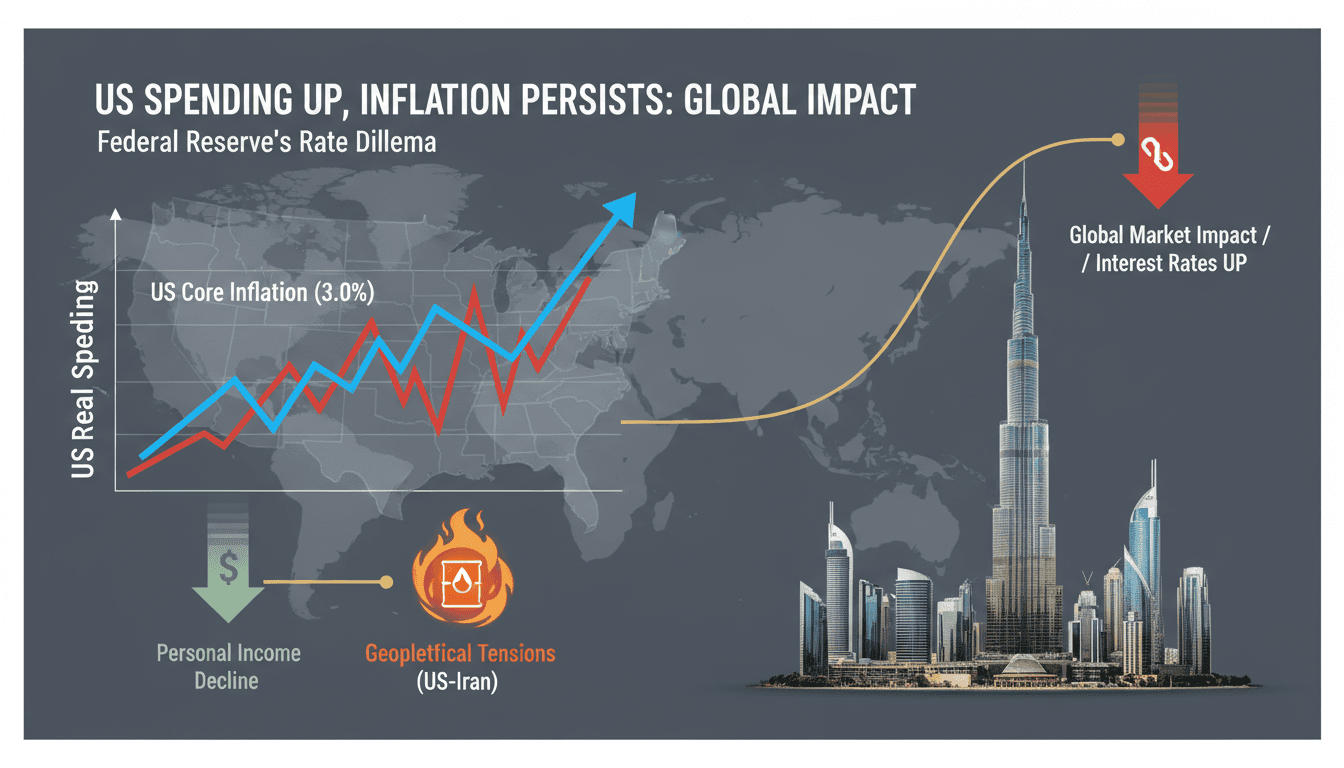
- Core PCE inflation remained elevated at 3.0% year-over-year, reflecting ongoing price pressures in the economy.
- Personal income declined by 0.1%, contributing to a personal saving rate of 4.0%, signaling cautious consumer behavior.
The context you actually need
- Inflationary pressures are being driven by high service costs and geopolitical tensions, notably the US-Iran conflict, which has affected energy prices.
- Nominal PCE rose by 0.5%, but this increase was largely offset by inflation, indicating that real purchasing power is under strain.
- Delayed data releases due to government shutdowns have compressed the reporting schedule, adding uncertainty to economic assessments.
What's really happening
The latest Personal Consumption Expenditures (PCE) report from the US Bureau of Economic Analysis, released on April 9, 2026, reveals a complex economic landscape. While nominal personal consumption expenditures rose by 0.5%, the real increase was a modest 0.1%. This discrepancy highlights the impact of inflation on consumer behavior, as rising prices erode purchasing power. The core PCE price index, which excludes volatile food and energy prices, advanced by 3.0% year-over-year, indicating persistent inflationary pressures that are not expected to ease in the near term.
The decline in personal income by 0.1% ($18.2 billion) further complicates the situation. With consumers earning less, the personal saving rate has dropped to 4.0%, suggesting that households are increasingly cautious about their spending. This cautiousness is reflected in the modest growth in real spending, which is not keeping pace with inflation. The increase in nominal PCE was driven primarily by spending on goods and services, with goods up $58.7 billion and services up $44.5 billion. However, the real spending increase of $17.3 billion signals that consumers are feeling the pinch of higher prices.
Geopolitical tensions, particularly the ongoing US-Iran conflict, have further exacerbated inflationary pressures by elevating oil prices. This situation has a cascading effect on various sectors, particularly energy and transportation, which could lead to higher costs for consumers in the coming months. Analysts are now adjusting their expectations for Federal Reserve monetary policy, as the persistent core inflation suggests limited scope for rate cuts. The Fed's upper tolerance for core PCE is being tested, and with inflation remaining sticky, the likelihood of easing monetary policy diminishes.
In the broader context, the economic data from February 2026 follows a stronger nominal PCE growth of 0.4% in January, indicating a potential slowdown in consumer activity. The revisions to Q4 2025 GDP growth, now at 0.5% annualized, further underscore the challenges facing the economy. As consumers grapple with rising costs and stagnant income, the outlook for future spending remains uncertain, with implications for both domestic and global markets.
Who feels it first (and how)
- Consumers: Households with fixed incomes or lower wages are most affected by rising prices and stagnant income.
- Retailers: Businesses reliant on consumer spending may see reduced sales as consumers cut back.
- Investors: Those in the financial markets will be closely monitoring the Fed's response to inflation, impacting investment strategies.
- Real estate buyers in Dubai: Higher interest rates in the US can lead to elevated financing costs for mortgages in Dubai due to the dirham's peg to the dollar.
What to watch next
- Federal Reserve announcements: Any signals regarding interest rate changes will be crucial for market expectations and consumer financing costs.
- Energy prices: Continued volatility in oil prices could further impact inflation and consumer spending patterns.
- Consumer confidence indices: These metrics will provide insight into how consumers are feeling about their financial situations and spending intentions.
Core PCE inflation remains at 3.0%, indicating persistent price pressures.
Federal Reserve will maintain a cautious approach to monetary policy, limiting rate cuts.
The long-term impact of geopolitical tensions on energy prices and inflation remains uncertain.
Frequently Asked Questions
- Why it matters?
- Persistent inflation in the US complicates monetary policy, affecting global interest rates and financial markets.
- What happened (in 30 seconds)?
- Real personal consumption expenditures increased by 0.1% in February 2026, indicating sluggish consumer spending. Core PCE inflation remained elevated at 3.0% year-over-year, reflecting ongoing price pressures in the economy. Personal income declined by 0.1%, contributing to a personal saving rate of 4.0%, signaling cautious consumer behavior.
- What's really happening?
- The latest Personal Consumption Expenditures (PCE) report from the US Bureau of Economic Analysis, released on April 9, 2026, reveals a complex economic landscape. While nominal personal consumption expenditures rose by 0.5%, the real increase was a modest 0.1%. This discrepancy highlights the impact of inflation on consumer behavior, as rising prices erode purchasing power. The core PCE price index, which excludes volatile food and energy prices, advanced by 3.0% year-over-year, indicating pers
- Who feels it first (and how)?
- Consumers: Households with fixed incomes or lower wages are most affected by rising prices and stagnant income. Retailers: Businesses reliant on consumer spending may see reduced sales as consumers cut back. Investors: Those in the financial markets will be closely monitoring the Fed's response to inflation, impacting investment strategies. Real estate buyers in Dubai: Higher interest rates in the US can lead to elevated financing costs for mortgages in Dubai due to the dirham's peg to the
- What to watch next?
- Federal Reserve announcements: Any signals regarding interest rate changes will be crucial for market expectations and consumer financing costs. Energy prices: Continued volatility in oil prices could further impact inflation and consumer spending patterns. Consumer confidence indices: These metrics will provide insight into how consumers are feeling about their financial situations and spending intentions.
Macro commentary, policy analysis, growth/inflation themes, and global outlooks.
"Contextual macro coverage that complements day-to-day market headlines."
— A47 Editor
US PCE inflation picks up in February; consumer spending solid
In February, the US personal consumption expenditures (PCE) inflation rate increased, with the core index rising by 0.4% from January and 3% year-over-year, indicating ongoing inflationary pressures. Consumer spending showed minimal growth during the...
Global markets, investing, and macroeconomics from a premier financial newsroom.
"Bloomberg is respected for in-depth financial reporting and data-driven analysis."
— A47 Editor
US Consumer Spending Muted as Inflation Persists
US consumer spending showed minimal growth in February, with the core personal consumption expenditures price index rising by 0.4% from January and 3% year-over-year, indicating persistent inflationary pressures. Jobless claims have decreased to a ne...