
NASA Artemis II Crew Completes Historic Lunar Flyby
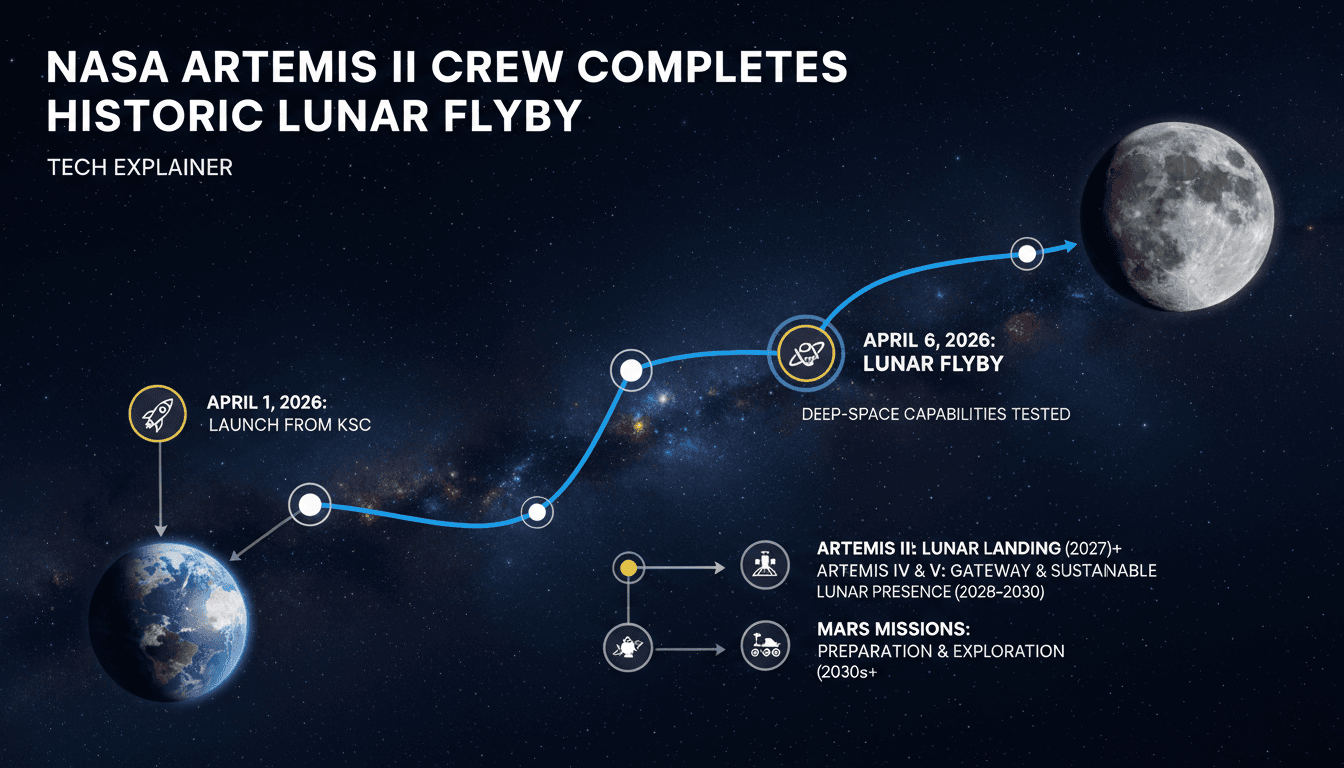
Here's what it means for you.
As space exploration advances, industries related to technology, education, and international collaboration may see new opportunities.
Why it matters
The Artemis II mission is a significant step toward establishing a sustainable human presence on the Moon, which could drive technological advancements and economic growth.
What happened (in 30 seconds)
- NASA's Artemis II crew completed a historic lunar flyby on April 6, 2026, marking the first crewed mission to approach the Moon since 1972.
- The crew traveled 252,756 miles from Earth, surpassing the Apollo 13 distance record and conducting observations of the lunar far side.
- The mission tested deep-space capabilities, paving the way for future lunar landings and Mars missions, with a planned splashdown in the Pacific Ocean on April 10, 2026.
The context you actually need
- Artemis II follows the uncrewed Artemis I mission, which validated the Space Launch System and Orion spacecraft for crewed operations.
- The mission's objectives include testing life support, navigation, and communication systems during a 10-day trajectory without lunar orbit insertion or landing.
- NASA's Artemis program aims to establish a sustainable lunar presence, which is crucial for future Mars exploration and international collaboration in space.
What's really happening
NASA's Artemis II mission represents a pivotal moment in human space exploration, marking the first crewed lunar flyby since the Apollo program. Launched on April 1, 2026, from Kennedy Space Center, the mission is part of a broader strategy to return humans to the Moon and eventually send them to Mars. The Artemis program is designed to establish a sustainable human presence on the Moon, which will serve as a testing ground for technologies and systems necessary for longer-duration missions to Mars.
The crew, consisting of Commander Reid Wiseman, Pilot Victor Glover, Mission Specialist Christina Koch, and Mission Specialist Jeremy Hansen, executed a translunar injection burn that propelled the Orion spacecraft toward the Moon. On April 6, they approached within 4,067 miles of the lunar surface, surpassing the Apollo 13 distance record of 248,655 miles. This achievement not only showcases advancements in spacecraft technology but also highlights the potential for human exploration beyond low Earth orbit.
During the mission, the crew conducted critical tests of life support and navigation systems, which are essential for future lunar landings and Mars missions. The observations made during the flyby, including views of the lunar far side and Earthrise, contribute to our understanding of the Moon's geology and environment. The mission also included a communication blackout, simulating the challenges of deep-space communication, which is vital for planning future missions.
As the crew prepares for their splashdown in the Pacific Ocean, the implications of this mission extend beyond NASA. The success of Artemis II can inspire international collaboration in space exploration and stimulate interest in STEM fields. Countries like the UAE, with their own lunar ambitions, may find new opportunities for partnerships and advancements in technology. The Artemis program also emphasizes the importance of sustainable practices in space exploration, which could influence how future missions are planned and executed.
Who feels it first (and how)
- Aerospace engineers: Increased demand for skilled professionals in spacecraft design and technology development.
- STEM educators: Opportunities to inspire students through new educational programs and resources related to space exploration.
- Investors in space tech: Potential growth in stocks related to space exploration companies, driven by increased public interest and government funding.
- International space agencies: Enhanced collaboration opportunities with NASA and other countries pursuing lunar missions.
What to watch next
- Future Artemis missions: Keep an eye on the timeline for Artemis III, which aims to land astronauts on the Moon, as it will further define the trajectory of lunar exploration.
- International partnerships: Watch for announcements regarding collaborations between NASA and other space agencies, which could lead to shared missions and technology development.
- Private sector involvement: Monitor investments and advancements from private companies in the space sector, as they may play a crucial role in supporting NASA's objectives and expanding commercial opportunities.
The Artemis II mission successfully completed a lunar flyby, surpassing previous distance records.
Increased interest in STEM education and careers as a result of heightened public engagement with space exploration.
The long-term impact of Artemis II on international collaboration in space and its influence on future missions to Mars.
Frequently Asked Questions
- Why it matters?
- The Artemis II mission is a significant step toward establishing a sustainable human presence on the Moon, which could drive technological advancements and economic growth.
- What happened (in 30 seconds)?
- NASA's Artemis II crew completed a historic lunar flyby on April 6, 2026, marking the first crewed mission to approach the Moon since 1972. The crew traveled 252,756 miles from Earth, surpassing the Apollo 13 distance record and conducting observations of the lunar far side. The mission tested deep-space capabilities, paving the way for future lunar landings and Mars missions, with a planned splashdown in the Pacific Ocean on April 10, 2026.
- What's really happening?
- NASA's Artemis II mission represents a pivotal moment in human space exploration, marking the first crewed lunar flyby since the Apollo program. Launched on April 1, 2026, from Kennedy Space Center, the mission is part of a broader strategy to return humans to the Moon and eventually send them to Mars. The Artemis program is designed to establish a sustainable human presence on the Moon, which will serve as a testing ground for technologies and systems necessary for longer-duration missions to M
- Who feels it first (and how)?
- Aerospace engineers: Increased demand for skilled professionals in spacecraft design and technology development. STEM educators: Opportunities to inspire students through new educational programs and resources related to space exploration. Investors in space tech: Potential growth in stocks related to space exploration companies, driven by increased public interest and government funding. International space agencies: Enhanced collaboration opportunities with NASA and other countries pursu
- What to watch next?
- Future Artemis missions: Keep an eye on the timeline for Artemis III, which aims to land astronauts on the Moon, as it will further define the trajectory of lunar exploration. International partnerships: Watch for announcements regarding collaborations between NASA and other space agencies, which could lead to shared missions and technology development. Private sector involvement: Monitor investments and advancements from private companies in the space sector, as they may play a crucial role
Technology business and AI-related headlines.
"Data-driven tech newsroom with global scope."
— A47 Editor
NASA Crew Loops Moon and Heads Home
NASA's Artemis II mission has successfully completed its historic journey around the Moon and is now returning to Earth, marking a significant achievement in space exploration. The crew, which includes four astronauts, has set a new record for the di...
Technology business news, market impacts, and innovation trends.
"Bloomberg is a premier financial and tech news provider, respected for its in-depth reporting and analytical rigor."
— A47 Editor
NASA Crew Loops Moon and Heads Home
NASA's Artemis II mission has successfully completed its historic journey around the Moon and is now returning to Earth, marking a significant achievement in space exploration. The crew, which includes four astronauts, has set a new record for the di...
English-language reporting on Saudi politics, policy, and society.
"Saudi Gazette reflects mainstream Saudi institutional perspectives."
— A47 Editor
Artemis II astronauts head toward Earth after completing record-breaking lunar flyby
Four astronauts from NASA's Artemis II mission are returning to Earth after successfully completing a historic lunar flyby, marking the first crewed lunar mission in over 50 years. The crew experienced a temporary communication blackout as they passe...
National headlines across the United States including breaking stories and societal issues.
"NBC News is a mainstream media outlet known for comprehensive national and international news coverage with a centrist to slightly left-leaning editorial tone."
— A47 Editor
Artemis II crew set to return home after lunar journey
The Artemis II crew is set to return home after a historic lunar journey that saw them travel farther from Earth than any humans before, having successfully completed a flyby of the moon on April 6, 2026. This mission, which launched on April 1, 2026...