
KelpDAO Exploit Results in $292 Million Loss and $236 Million Bad Debt on Aave
Here's what it means for you.
If you're involved in DeFi, this incident underscores the critical importance of security in cross-chain protocols.
Why it matters
This exploit highlights vulnerabilities in decentralized finance (DeFi) systems, potentially shaking investor confidence and impacting market stability.
What happened (in 30 seconds)
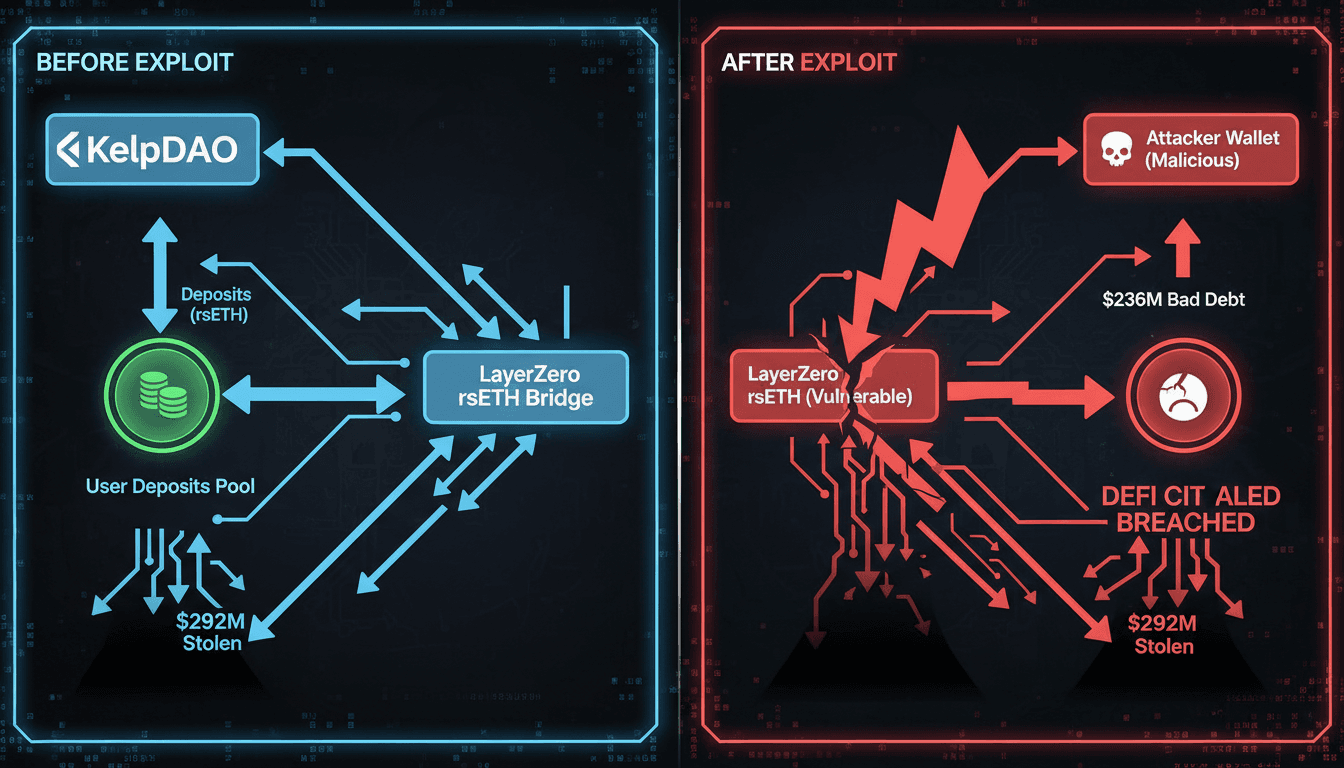
- KelpDAO was exploited for $292 million on April 18, 2026, via its LayerZero rsETH bridge.
- An attacker minted 116,500 unbacked rsETH tokens and borrowed approximately $236 million in WETH on Aave.
- Immediate actions were taken to pause core contracts and freeze rsETH markets, leading to an 18% drop in AAVE token price.
The context you actually need
- KelpDAO is a liquid restaking protocol under KernelDAO, boasting over $1 billion in total value locked (TVL).
- The exploit stemmed from a single-signer Decentralized Verifier Network (DVN) configuration, allowing the attacker to spoof mint transactions.
- This incident is part of a broader trend of rising DeFi exploits in 2026, with significant hacks occurring earlier in the month, indicating persistent security risks.
What's really happening
On April 18, 2026, at 17:35 UTC, KelpDAO's LayerZero rsETH bridge was exploited, resulting in the minting of 116,500 unbacked rsETH tokens valued at approximately $292 million. The attacker, linked to a Tornado Cash wallet, deposited these tokens as collateral on Aave V3, allowing them to borrow around 106,467 WETH, which is valued at $236 million. This created substantial bad debt on Aave, raising alarms across the DeFi ecosystem.
The exploit's timing was critical; KelpDAO's emergency multisig paused core contracts at 18:21 UTC, just 46 minutes after the initial breach. This swift action prevented two additional attempts to drain 40,000 rsETH each. However, the damage was already done, leading to a significant market reaction. Aave and other protocols, including Compound and Morpho, froze rsETH markets, while KelpDAO publicly acknowledged the incident at 20:10 UTC, initiating a collaboration with LayerZero, Unichain, auditors, and security experts for a root cause analysis.
The aftermath saw whale liquidations contributing to an 18% decline in the AAVE token price, with sales fluctuating between $99 and $103. Ethereum also experienced a brief dip of 3% before stabilizing. Withdrawals from Aave exceeded $140 million, with notable funds like Pegasus Capital pulling out. In response, Aave governance considered slashing Umbrella to cover the bad debt, contingent on maintaining a TVL above $40 billion.
This incident is emblematic of the ongoing vulnerabilities in DeFi, particularly concerning bridge security and oracle dependencies. The exploit not only affected KelpDAO but also raised concerns about the broader DeFi landscape, as users began to withdraw funds from various protocols, leading to a notable outflow of TVL from bridges like Stargate, which saw $400 million in withdrawals.
Who feels it first (and how)
- DeFi investors: Those holding rsETH or AAVE tokens are directly impacted by the loss of value and liquidity.
- Protocol developers: Teams behind KelpDAO and Aave face scrutiny and pressure to enhance security measures.
- Regulators: Increased attention on DeFi security may prompt regulatory discussions and potential oversight.
- Cross-chain users: Individuals utilizing LayerZero and similar protocols may reconsider their risk exposure.
What to watch next
- Governance proposals from Aave: Watch for decisions regarding the Umbrella slashing to cover bad debt, which could influence investor confidence.
- Security audits and upgrades: Monitor KelpDAO and LayerZero for updates on security enhancements and protocol changes post-exploit.
- Market reactions: Keep an eye on the AAVE token price and overall DeFi TVL trends, as these will indicate the market's recovery or further decline.
The exploit resulted in $292 million in stolen funds and $236 million in bad debt on Aave.
Increased scrutiny on DeFi protocols will lead to enhanced security measures and potential regulatory discussions.
The long-term impact on investor confidence in DeFi and cross-chain protocols remains uncertain.
Frequently Asked Questions
- Why it matters?
- This exploit highlights vulnerabilities in decentralized finance (DeFi) systems, potentially shaking investor confidence and impacting market stability.
- What happened (in 30 seconds)?
- KelpDAO was exploited for $292 million on April 18, 2026, via its LayerZero rsETH bridge. An attacker minted 116,500 unbacked rsETH tokens and borrowed approximately $236 million in WETH on Aave. Immediate actions were taken to pause core contracts and freeze rsETH markets, leading to an 18% drop in AAVE token price.
- What's really happening?
- On April 18, 2026, at 17:35 UTC, KelpDAO's LayerZero rsETH bridge was exploited, resulting in the minting of 116,500 unbacked rsETH tokens valued at approximately $292 million. The attacker, linked to a Tornado Cash wallet, deposited these tokens as collateral on Aave V3, allowing them to borrow around 106,467 WETH, which is valued at $236 million. This created substantial bad debt on Aave, raising alarms across the DeFi ecosystem. The exploit's timing was critical; KelpDAO's emergency multisig
- Who feels it first (and how)?
- DeFi investors: Those holding rsETH or AAVE tokens are directly impacted by the loss of value and liquidity. Protocol developers: Teams behind KelpDAO and Aave face scrutiny and pressure to enhance security measures. Regulators: Increased attention on DeFi security may prompt regulatory discussions and potential oversight. Cross-chain users: Individuals utilizing LayerZero and similar protocols may reconsider their risk exposure.
- What to watch next?
- Governance proposals from Aave: Watch for decisions regarding the Umbrella slashing to cover bad debt, which could influence investor confidence. Security audits and upgrades: Monitor KelpDAO and LayerZero for updates on security enhancements and protocol changes post-exploit. Market reactions: Keep an eye on the AAVE token price and overall DeFi TVL trends, as these will indicate the market's recovery or further decline.
Research, news, and analysis on blockchain startups, DeFi, and regulations.
"Crypto Briefing provides research, news, and analysis on blockchain startups, DeFi, and crypto regulations with investor-focused coverage."
— A47 Editor
KelpDAO exploit triggers $236M bad debt, $AAVE drops 18%
The KelpDAO exploit has triggered a staggering $236 million in bad debt, leading to an 18% drop in the value of AAVE. This incident underscores the vulnerabilities within decentralized finance (DeFi) platforms, raising alarms about their security and...
Covers blockchain, cryptocurrency news, project analysis, and market insights.
"CoinDesk is a well-established cryptocurrency and blockchain news provider, offering comprehensive insights, market data, and industry research."
— A47 Editor
2026's biggest crypto exploit: $292 million gets drained from Kelp DAO with wrapped ether stranded across 20 chains
An attacker exploited Kelp DAO's LayerZero-powered bridge on Saturday, draining approximately $292 million, including 116,500 rsETH, which constitutes about 18% of the circulating supply. This incident triggered emergency freezes across several platf...
Covers Bitcoin plus altcoin news, market updates, and educational resources.
"Bitcoin.com provides news, market data, and guides focused on Bitcoin and the wider crypto industry."
— A47 Editor
ZachXBT Flags $280M+ KelpDAO Exploit Hitting Ethereum DeFi Lending Markets
ZachXBT has flagged a significant exploit involving KelpDAO, which has reportedly led to over $280 million in losses within Ethereum's decentralized finance (DeFi) lending markets. This incident raises alarms about the security vulnerabilities presen...