
iShares MSCI India ETF Faces Record $220 Million Outflow Amid Energy Crisis
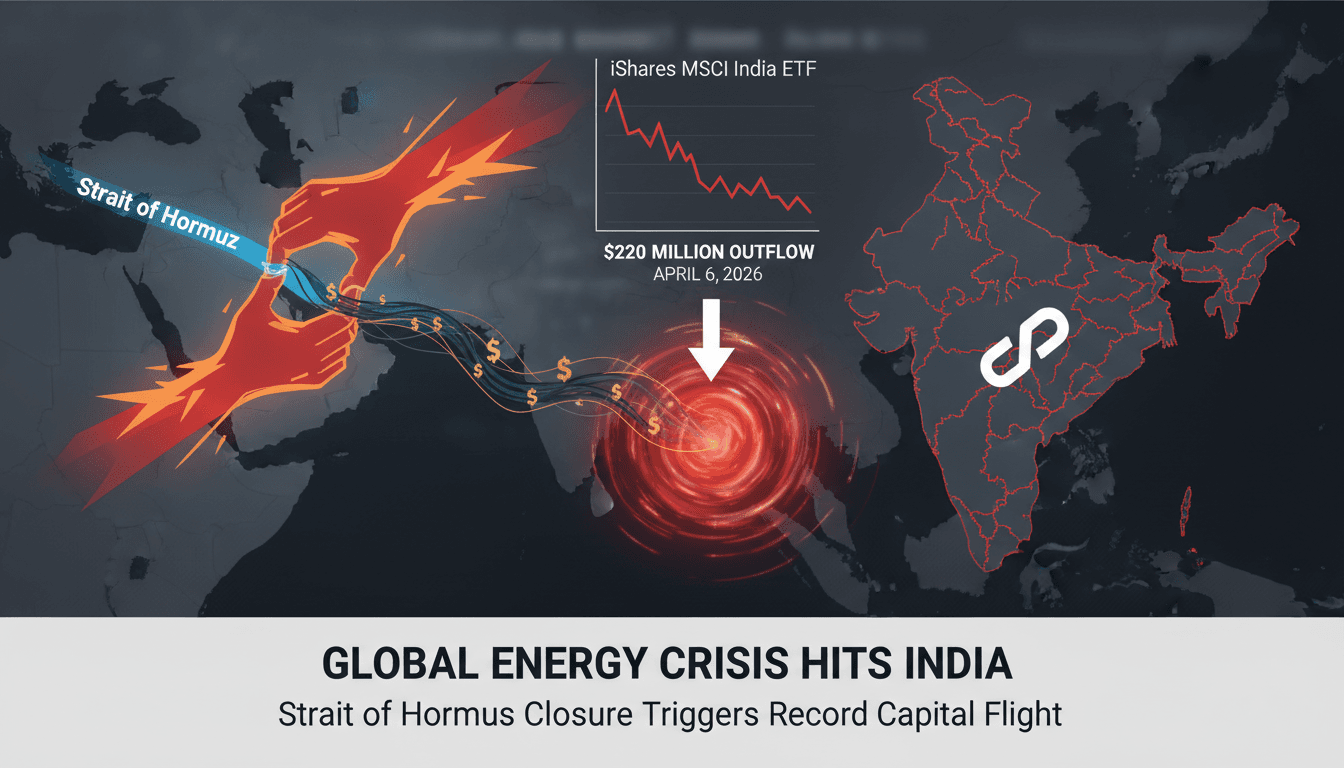
Here's what it means for you.
If you’re invested in Indian markets or depend on remittances from India, the ongoing energy crisis could impact your financial stability.
Why it matters
The disruption in energy supply through the Strait of Hormuz is triggering significant capital flight from Indian equities, affecting global investors and the broader economy.
What happened (in 30 seconds)
- Record outflow: The iShares MSCI India ETF saw over $220 million withdrawn on April 6, 2026, marking its largest single-day outflow since April 2025.
- Energy crisis: The closure of the Strait of Hormuz due to the Iran war has raised concerns over India's energy supply, as it imports 90% of its crude oil through this chokepoint.
- Market decline: The NSE Nifty 50 index dropped over 11% in March, with the rupee depreciating more than 4% against the U.S. dollar, reflecting investor anxiety.
The context you actually need
- Geopolitical tensions: The Iran war, which began on February 28, 2026, has led to the effective closure of the Strait of Hormuz, disrupting global energy flows.
- Investor sentiment: Foreign portfolio investors have withdrawn a staggering $12.14 billion from Indian equities since late February, exacerbating market declines.
- Energy dependency: India relies heavily on the Strait for its energy needs, making it particularly vulnerable to disruptions in supply.
What's really happening
The recent outflows from the iShares MSCI India ETF are a direct response to escalating geopolitical tensions in the Middle East, particularly the Iran war that commenced on February 28, 2026. This conflict has led to the effective closure of the Strait of Hormuz, a critical maritime route through which approximately 90% of India's crude oil imports and over 50% of its liquefied petroleum gas (LPG) pass. As oil prices surged past $120 per barrel, concerns about energy supply vulnerabilities intensified among investors.
In the wake of these developments, foreign portfolio investors began to exit the Indian market at an alarming rate. By late March, they had pulled out a total of $12.14 billion from Indian equities, with the iShares MSCI India ETF alone experiencing outflows of $1.4 billion. The NSE Nifty 50 index reflected this turmoil, plummeting over 11% in March, while the Indian rupee depreciated by more than 4% against the U.S. dollar.
The April 6 outflow of $220 million from the iShares MSCI India ETF is not just a standalone event; it is part of a broader trend of capital flight driven by fears of an energy crisis in India. The Indian government has attempted to reassure the public by stating that there is no immediate power crisis, citing sufficient coal reserves for 88 days and plans to increase coal utilization. However, the ongoing capital outflows suggest that investor confidence remains shaky, and the market is bracing for further volatility.
Moreover, the implications extend beyond just the financial markets. The UAE, home to a significant Indian expatriate population, is also feeling the ripple effects. Disrupted remittances and exposure to Indian equities could impact the economic stability of many families reliant on these funds. As the situation unfolds, the Indian government is activating nationwide energy and maritime measures and joining global efforts to reopen the Strait of Hormuz, but the long-term effects on investor sentiment and market stability remain uncertain.
Who feels it first (and how)
- Foreign Portfolio Investors: Experiencing significant losses and potential shifts in investment strategies.
- Indian Expatriates in UAE: Facing disrupted remittances and financial uncertainty.
- Energy Sector Stakeholders: Companies reliant on stable energy supplies are likely to see increased operational risks.
- General Indian Public: Potential for increased energy costs and economic instability affecting daily life.
What to watch next
- Investor sentiment: Monitor trends in foreign portfolio investment in Indian equities to gauge market confidence.
- Energy prices: Keep an eye on global oil prices and their impact on India's import costs and inflation rates.
- Government measures: Watch for any new policies or agreements aimed at stabilizing energy supplies and restoring investor confidence.
The iShares MSCI India ETF experienced a record outflow of $220 million on April 6, 2026.
Continued volatility in Indian markets and further capital outflows as investor sentiment remains cautious.
The long-term impact of the Iran war on India's energy security and economic stability.
Frequently Asked Questions
- Why it matters?
- The disruption in energy supply through the Strait of Hormuz is triggering significant capital flight from Indian equities, affecting global investors and the broader economy.
- What happened (in 30 seconds)?
- Record outflow: The iShares MSCI India ETF saw over $220 million withdrawn on April 6, 2026, marking its largest single-day outflow since April 2025. Energy crisis: The closure of the Strait of Hormuz due to the Iran war has raised concerns over India's energy supply, as it imports 90% of its crude oil through this chokepoint. Market decline: The NSE Nifty 50 index dropped over 11% in March, with the rupee depreciating more than 4% against the U.S. dollar, reflecting investor anxiety.
- What's really happening?
- The recent outflows from the iShares MSCI India ETF are a direct response to escalating geopolitical tensions in the Middle East, particularly the Iran war that commenced on February 28, 2026. This conflict has led to the effective closure of the Strait of Hormuz, a critical maritime route through which approximately 90% of India's crude oil imports and over 50% of its liquefied petroleum gas (LPG) pass. As oil prices surged past $120 per barrel, concerns about energy supply vulnerabilities inte
- Who feels it first (and how)?
- Foreign Portfolio Investors: Experiencing significant losses and potential shifts in investment strategies. Indian Expatriates in UAE: Facing disrupted remittances and financial uncertainty. Energy Sector Stakeholders: Companies reliant on stable energy supplies are likely to see increased operational risks. General Indian Public: Potential for increased energy costs and economic instability affecting daily life.
- What to watch next?
- Investor sentiment: Monitor trends in foreign portfolio investment in Indian equities to gauge market confidence. Energy prices: Keep an eye on global oil prices and their impact on India's import costs and inflation rates. Government measures: Watch for any new policies or agreements aimed at stabilizing energy supplies and restoring investor confidence.
Market-moving headlines impacting equities, bonds, and related risk assets.
"Real-time catalysts and volatility drivers across indices and sectors."
— A47 Editor
Indian equity ETF sees record $220 million outflow amid energy crisis
The Indian equity exchange-traded fund (ETF) has experienced a significant outflow of $220 million, attributed to ongoing energy crises affecting investor sentiment. This marks a notable shift in the market as investors withdraw from Indian equities ...
Global markets, investing, and macroeconomics from a premier financial newsroom.
"Bloomberg is respected for in-depth financial reporting and data-driven analysis."
— A47 Editor
Billions Flow Out of BlackRock’s India ETF as Iran War Escalates
Investors are increasingly withdrawing funds from BlackRock's India ETF as the ongoing conflict in Iran raises concerns about a global energy crisis, which is expected to adversely affect the Indian economy. This trend reflects a significant shift in...