
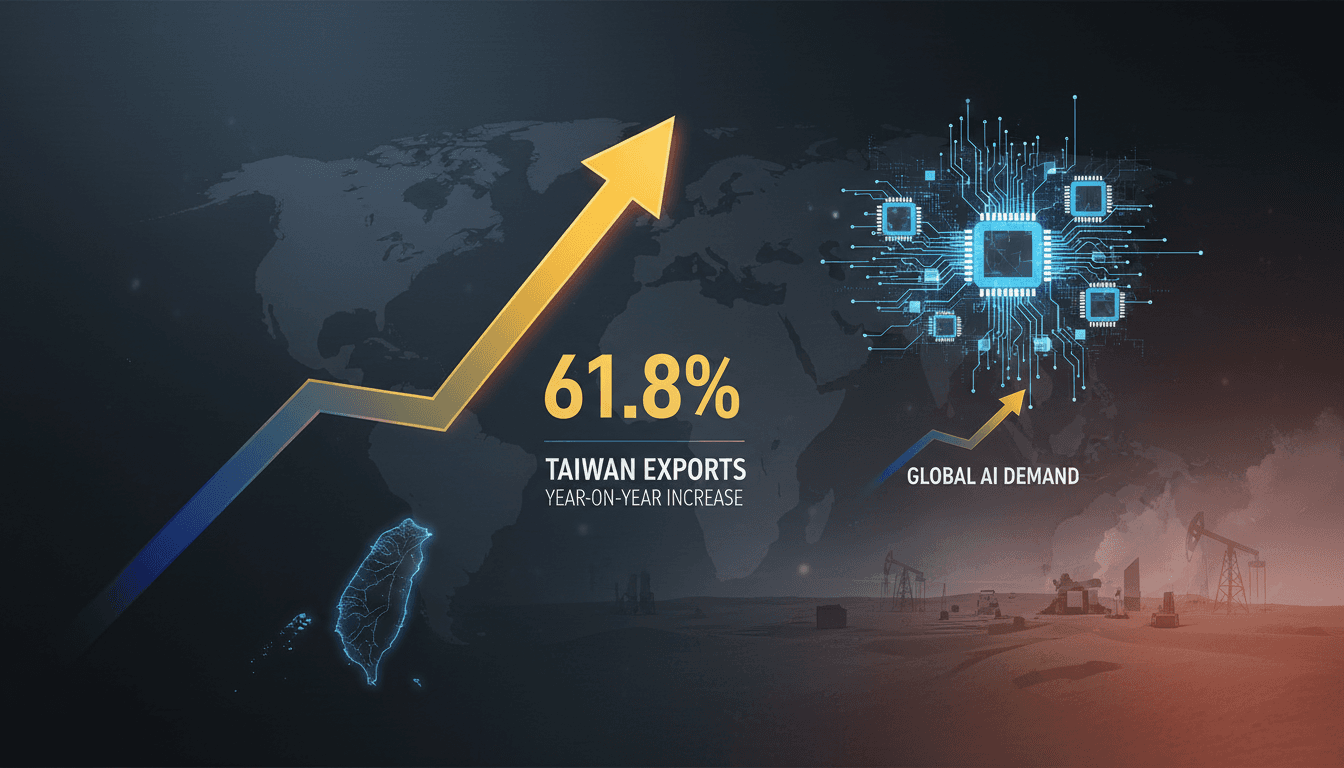
Taiwan's Exports Increase 61.8% Year-on-Year Amid Middle East Tensions
Here's what it means for you.
If you’re in tech or finance, Taiwan's export growth could signal opportunities for investment and supply chain adjustments.
Why it matters
Taiwan's export performance highlights the resilience of the semiconductor sector amid global geopolitical disruptions.
What happened (in 30 seconds)
- Exports surged 61.8% year-on-year in March 2026, reaching approximately $80.2 billion.
- Imports increased by 38.3%, with a notable decline in petroleum imports by 43%.
- Trade surplus stood at $21.27 billion, reflecting strong demand for AI-related products.
The context you actually need
- Global AI boom: Since 2023, Taiwan has benefited from a surge in demand for artificial intelligence applications, particularly in semiconductors.
- Middle East tensions: Ongoing conflicts, especially those related to Iran, have disrupted oil shipments and increased shipping costs, yet Taiwan's trade remains robust.
- Previous growth trends: Taiwan's exports had already achieved a record $640.75 billion in 2025, marking a 34.9% increase year-on-year.
What's really happening
Taiwan's export surge in March 2026 is primarily driven by the semiconductor sector, which has become a cornerstone of the global technology supply chain. The Taiwan Ministry of Finance reported a remarkable 61.8% year-on-year increase in exports, significantly surpassing the median forecast of 35% from economists surveyed by the Wall Street Journal. This growth is largely attributed to the sustained global demand for artificial intelligence applications, which has propelled the semiconductor industry forward.
Despite escalating tensions in the Middle East, particularly concerning Iran and the Strait of Hormuz, Taiwan's trade dynamics have remained resilient. The geopolitical situation has led to disruptions in oil shipments and elevated shipping costs, yet these factors have not significantly hindered Taiwan's semiconductor-led trade. In fact, the decline in petroleum imports by 43% suggests a strategic pivot towards technology exports, which are less susceptible to the fluctuations of global oil markets.
The Taiwanese economy has shown remarkable adaptability in the face of external pressures. The growth in imports, which rose by 38.3%, indicates a robust domestic demand for goods that support the export sector, including machinery and raw materials essential for semiconductor manufacturing. The resulting trade surplus of $21.27 billion underscores the strength of Taiwan's economic position, even as other regions face economic uncertainty due to geopolitical tensions.
Investors and policymakers alike are closely monitoring these developments. Taiwanese equities have demonstrated resilience, rebounding sharply after previous dips caused by Middle East volatility. This suggests that market confidence in Taiwan's economic fundamentals remains strong, despite external pressures. As the global economy continues to evolve, Taiwan's ability to leverage its semiconductor expertise will be critical in maintaining its competitive edge.
Who feels it first (and how)
- Tech companies: Increased demand for AI-related semiconductors boosts revenue and investment opportunities.
- Investors: Opportunities for capital growth in Taiwanese equities as market confidence strengthens.
- Logistics firms: Adjustments in shipping routes and costs due to Middle East tensions may impact operational strategies.
What to watch next
- Global AI demand: Continued growth in AI applications will likely drive further demand for Taiwanese semiconductors, impacting global supply chains.
- Middle East geopolitical developments: Any escalation in tensions could affect shipping costs and trade routes, influencing Taiwan's export dynamics.
- Taiwanese monetary policy: Watch for potential adjustments in response to sustained trade surpluses and economic growth projections.
Taiwan's export growth is primarily driven by the semiconductor sector and AI applications.
Continued resilience in Taiwanese equities amid global economic uncertainty.
The long-term impact of Middle East tensions on global shipping costs and trade routes.
Frequently Asked Questions
- Why it matters?
- Taiwan's export performance highlights the resilience of the semiconductor sector amid global geopolitical disruptions.
- What happened (in 30 seconds)?
- Exports surged 61.8% year-on-year in March 2026, reaching approximately $80.2 billion. Imports increased by 38.3%, with a notable decline in petroleum imports by 43%. Trade surplus stood at $21.27 billion, reflecting strong demand for AI-related products.
- What's really happening?
- Taiwan's export surge in March 2026 is primarily driven by the semiconductor sector, which has become a cornerstone of the global technology supply chain. The Taiwan Ministry of Finance reported a remarkable 61.8% year-on-year increase in exports, significantly surpassing the median forecast of 35% from economists surveyed by the Wall Street Journal. This growth is largely attributed to the sustained global demand for artificial intelligence applications, which has propelled the semiconductor in
- Who feels it first (and how)?
- Tech companies: Increased demand for AI-related semiconductors boosts revenue and investment opportunities. Investors: Opportunities for capital growth in Taiwanese equities as market confidence strengthens. Logistics firms: Adjustments in shipping routes and costs due to Middle East tensions may impact operational strategies.
- What to watch next?
- Global AI demand: Continued growth in AI applications will likely drive further demand for Taiwanese semiconductors, impacting global supply chains. Middle East geopolitical developments: Any escalation in tensions could affect shipping costs and trade routes, influencing Taiwan's export dynamics. Taiwanese monetary policy: Watch for potential adjustments in response to sustained trade surpluses and economic growth projections.
Social/economic commentary and analysis relevant to business and markets.
"WSJ blends data-driven economic insight with commentary on policy and society."
— A47 Editor
Taiwan Exports Accelerate Sharply in March Despite Mideast Tensions
Taiwan's exports experienced a significant increase in March, driven by robust demand for artificial intelligence applications, despite ongoing geopolitical tensions in the Middle East. This surge highlights Taiwan's resilience in the face of externa...
Global markets, investing, and macroeconomics from a premier financial newsroom.
"Bloomberg is respected for in-depth financial reporting and data-driven analysis."
— A47 Editor
Taiwan Exports, US Surplus Hit Records as AI Outweighs War
Taiwan's exports surged to a record high, driven by strong global demand for artificial intelligence chips, overshadowing supply chain uncertainties linked to the ongoing US-Iran conflict. This growth reflects Taiwan's strategic position in the tech ...