
China's Producer Price Index Ends 41-Month Deflation Amid Iran War Energy Crisis
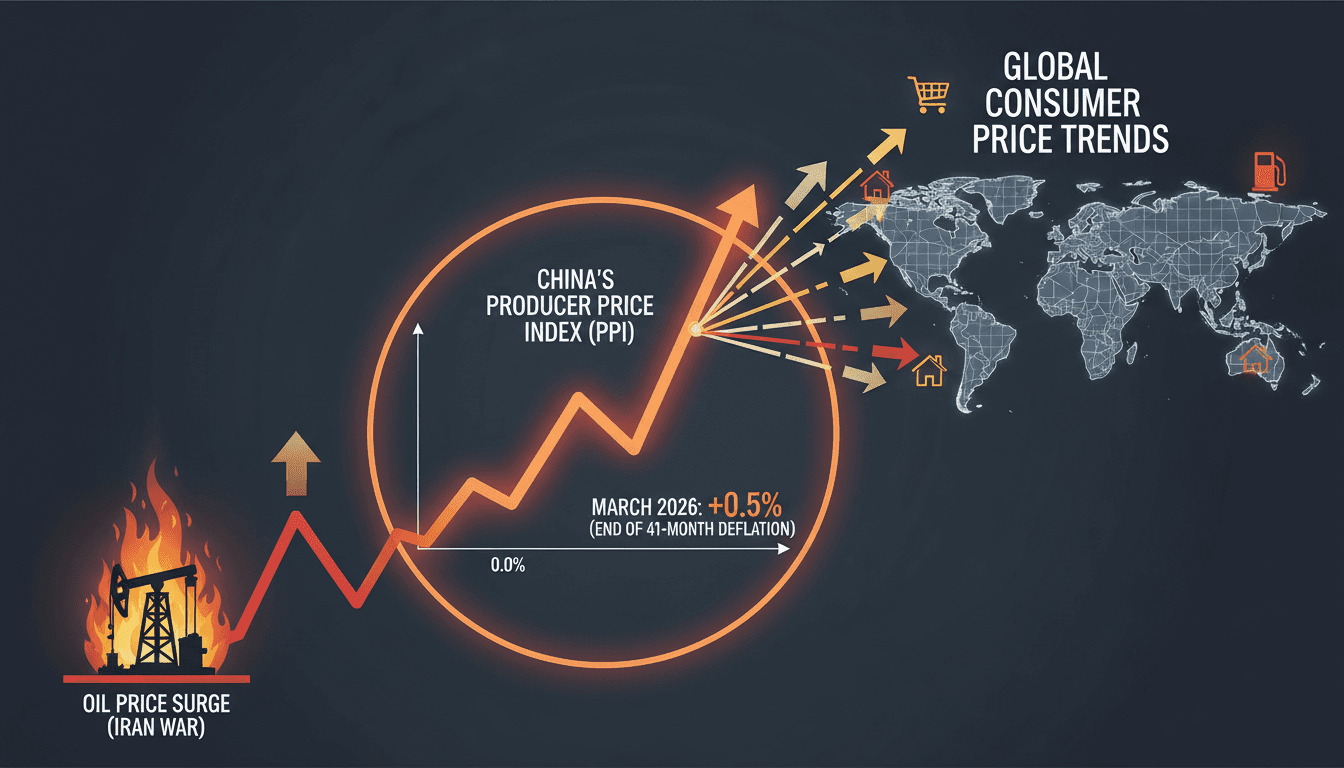
Here's what it means for you.
Rising production costs in China could lead to higher prices for goods globally, impacting your purchasing power.
Why it matters
This shift marks the end of a prolonged deflationary period in China, signaling potential inflationary pressures that could ripple through global markets.
What happened (in 30 seconds)
- China's Producer Price Index (PPI) rose by 0.5% year-on-year in March 2026, breaking a 41-month streak of deflation.
- Imported energy inflation from the ongoing Iran war, particularly after the closure of the Strait of Hormuz, has driven up production costs.
- Consumer prices in China increased by 1% year-on-year, as authorities implemented measures to cap domestic fuel price hikes.
The context you actually need
- China's deflationary streak lasted 41 months, primarily due to overcapacity, weak domestic demand, and competitive price undercutting.
- The Iran war, which escalated in late February 2026, led to significant disruptions in global oil supply, affecting China as the largest oil importer.
- Brent crude prices surged past $100 per barrel, exacerbating inflationary pressures in energy-intensive sectors within China.
What's really happening
The recent uptick in China's Producer Price Index (PPI) is a direct consequence of geopolitical tensions in the Middle East, particularly the Iran war that began in late February 2026. This conflict has led to the closure of the Strait of Hormuz, a critical chokepoint for global oil shipments, disrupting approximately 20% of the world's oil supply. As a result, Brent crude prices have surged, crossing the $100 per barrel threshold, which has had a cascading effect on production costs across various sectors in China.
For 41 consecutive months, China's PPI had been in deflation, a situation largely attributed to overcapacity in manufacturing, sluggish domestic demand, and a phenomenon known as "involution," where companies undercut each other's prices to remain competitive. This prolonged deflationary environment had created a challenging landscape for Chinese manufacturers, who faced shrinking margins and a lack of pricing power.
However, the energy shock from the Iran conflict has reversed this trend, as the costs of energy-intensive inputs have skyrocketed. The National Bureau of Statistics of China reported a 0.5% increase in PPI for March 2026, marking the first positive reading in over three years. This shift is significant not just for China but for global markets, as rising production costs could lead to higher prices for a wide range of goods.
In response to these pressures, Chinese regulators have acted to limit domestic fuel price increases to protect consumers from the brunt of rising costs. Despite these measures, economists warn that the cost-push inflation could compress manufacturer margins, complicating any stimulus efforts aimed at bolstering economic growth. The Shanghai Composite index has shown resilience, exceeding 4,000 points, while the yuan has appreciated against the dollar, indicating some investor confidence amidst the turmoil.
As the situation evolves, analysts are closely monitoring the potential for sustained high oil prices, especially if the Strait of Hormuz remains closed for an extended period. The implications of this energy shock extend beyond China's borders, affecting global supply chains and consumer prices worldwide.
Who feels it first (and how)
- Manufacturers in China: Face increased production costs, potentially leading to reduced profit margins.
- Consumers globally: May experience higher prices for goods as inflationary pressures spread.
- Energy-dependent sectors: Such as transportation and manufacturing, will feel the immediate impact of rising fuel costs.
- Investors: In commodities and energy markets will need to navigate increased volatility and potential price surges.
What to watch next
- Oil prices: Continued fluctuations in Brent crude prices will indicate the extent of the energy crisis's impact on global markets.
- Chinese economic policies: Watch for further regulatory measures aimed at controlling inflation and supporting manufacturers.
- Global supply chains: Monitor disruptions that could arise from sustained high energy costs and geopolitical tensions.
China's PPI has increased for the first time in 42 months due to energy inflation.
Global consumer prices will rise as a result of increased production costs.
The duration of the Iran conflict and its long-term effects on oil supply and prices.
Frequently Asked Questions
- Why it matters?
- This shift marks the end of a prolonged deflationary period in China, signaling potential inflationary pressures that could ripple through global markets.
- What happened (in 30 seconds)?
- China's Producer Price Index (PPI) rose by 0.5% year-on-year in March 2026, breaking a 41-month streak of deflation. Imported energy inflation from the ongoing Iran war, particularly after the closure of the Strait of Hormuz, has driven up production costs. Consumer prices in China increased by 1% year-on-year, as authorities implemented measures to cap domestic fuel price hikes.
- What's really happening?
- The recent uptick in China's Producer Price Index (PPI) is a direct consequence of geopolitical tensions in the Middle East, particularly the Iran war that began in late February 2026. This conflict has led to the closure of the Strait of Hormuz, a critical chokepoint for global oil shipments, disrupting approximately 20% of the world's oil supply. As a result, Brent crude prices have surged, crossing the $100 per barrel threshold, which has had a cascading effect on production costs across vari
- Who feels it first (and how)?
- Manufacturers in China: Face increased production costs, potentially leading to reduced profit margins. Consumers globally: May experience higher prices for goods as inflationary pressures spread. Energy-dependent sectors: Such as transportation and manufacturing, will feel the immediate impact of rising fuel costs. Investors: In commodities and energy markets will need to navigate increased volatility and potential price surges.
- What to watch next?
- Oil prices: Continued fluctuations in Brent crude prices will indicate the extent of the energy crisis's impact on global markets. Chinese economic policies: Watch for further regulatory measures aimed at controlling inflation and supporting manufacturers. Global supply chains: Monitor disruptions that could arise from sustained high energy costs and geopolitical tensions.
Social/economic commentary and analysis relevant to business and markets.
"WSJ blends data-driven economic insight with commentary on policy and society."
— A47 Editor
A surge in energy costs triggered by the war in Iran pushed up producer prices in China, snapping a streak of factory deflation in the country that lasted more than three years
Factory-gate prices in China have increased for the first time in over three years, marking a significant shift in the country's economic landscape as it emerges from a deflationary period. This change is attributed to rising energy prices driven by ...
Global political, business, and cultural coverage from WSJ international desks.
"The Wall Street Journal offers extensive international reporting with a reputation for financial insight and a center-right editorial stance."
— A47 Editor
Middle East Energy Shock Snaps China’s Deflationary Streak
Factory-gate prices in China have increased for the first time in over three years, marking a significant shift in the country's economic landscape as it emerges from a deflationary period. This change is attributed to rising energy prices driven by ...
Macro commentary, policy analysis, growth/inflation themes, and global outlooks.
"Contextual macro coverage that complements day-to-day market headlines."
— A47 Editor
China’s factories jolts back to inflation on Iran war price shock
China's factories are experiencing a resurgence in inflation due to price shocks stemming from the ongoing conflict in Iran, which has disrupted global energy supplies. This situation has led to a notable increase in the Producer Price Index (PPI) fo...