
NASA's Artemis II Mission Achieves Historic Lunar Flyby with Crewed Spacecraft
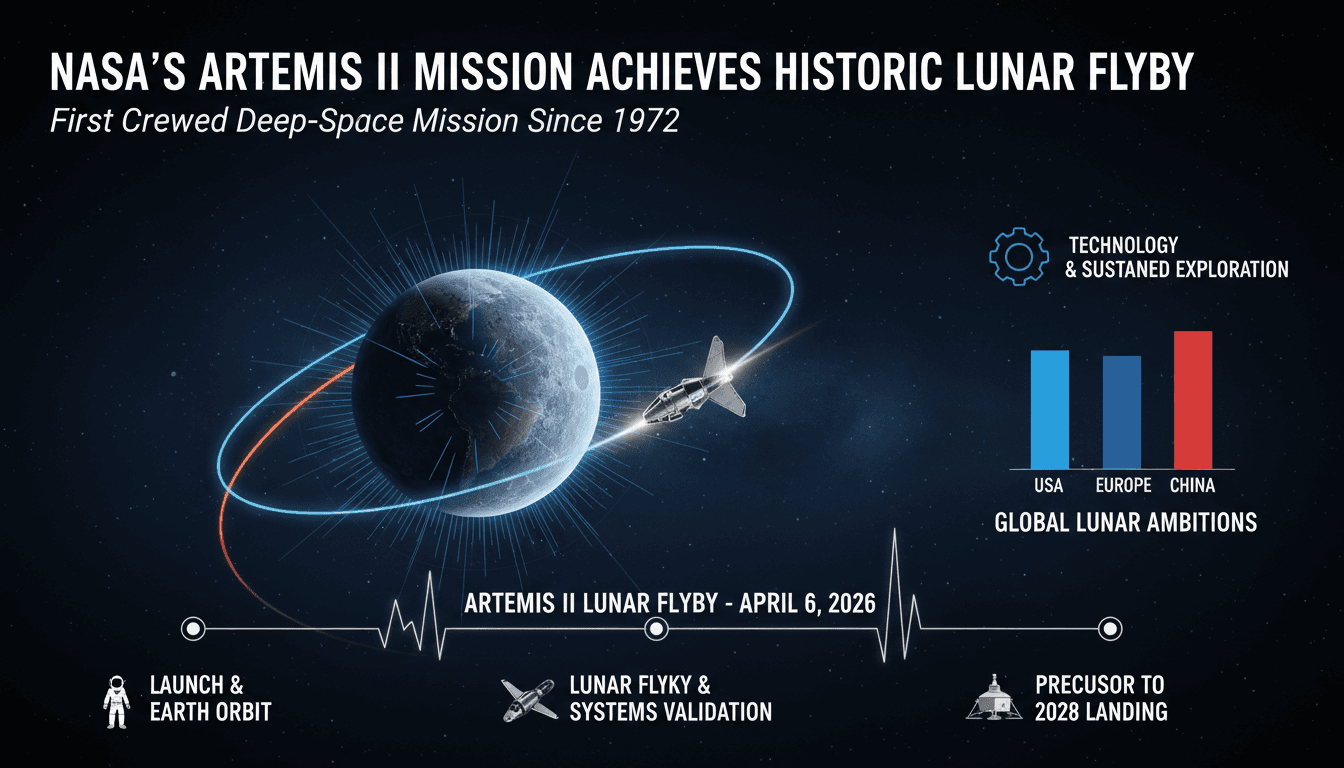
Here's what it means for you.
The Artemis II mission's successful lunar flyby paves the way for advancements in space exploration that could influence technology and investment opportunities globally.
Why it matters
The Artemis program represents a significant step in reestablishing human presence on the Moon, with implications for international collaboration and competition in space.
What happened (in 30 seconds)
- Artemis II launched on April 1, 2026, from Kennedy Space Center, marking the first crewed deep-space mission since Apollo 17.
- The Orion spacecraft executed a lunar flyby on April 6, 2026, capturing high-resolution images of the Moon's far side at a closest approach of 4,067 miles.
- NASA released images on April 7, 2026, showcasing lunar details and generating global media coverage, while the crew began trans-Earth maneuvers.
The context you actually need
- The Artemis program aims to establish a sustainable human presence on the Moon, following the uncrewed Artemis I mission in 2022.
- Geopolitical factors include competition with China's lunar ambitions and collaborative efforts like the Gateway station involving international partners.
- The mission's success is crucial for future Artemis III plans, which aim for a lunar landing in 2028, enhancing human exploration capabilities.
What's really happening
The Artemis II mission is a pivotal moment in NASA's Artemis program, which seeks to return humans to the Moon and lay the groundwork for future Mars missions. Launched on April 1, 2026, the Orion spacecraft carried a diverse crew of four astronauts, including representatives from NASA and the Canadian Space Agency. This mission is not merely a nostalgic return to lunar exploration; it serves as a critical test of technologies and systems necessary for sustained human presence on the Moon.
During the flyby on April 6, 2026, Orion entered the Moon's sphere of influence, surpassing Apollo 13's distance record and capturing stunning images of the lunar far side. The closest approach at 4,067 miles allowed for unprecedented observations of craters, lava flows, and even Earthset views. These images are not just for scientific interest; they symbolize a renewed commitment to human space exploration and inspire public engagement.
The Artemis program is driven by multiple incentives. Firstly, there is a strong geopolitical motivation to maintain leadership in space exploration, especially in light of China's growing ambitions. The United States aims to foster international partnerships, as seen with the Canadian Space Agency's involvement, to create a collaborative approach to lunar exploration. This collaboration is essential for developing the Gateway, a lunar orbiting outpost that will support long-term missions.
Moreover, the Artemis II mission serves as a precursor to Artemis III, which aims to land astronauts on the Moon by 2028. The successful execution of Artemis II validates the Orion spacecraft's capabilities for deep-space operations, which will be crucial for future missions to Mars. As the aerospace sector continues to evolve, the technological advancements derived from these missions will likely spill over into commercial applications, impacting industries ranging from telecommunications to materials science.
The public's reaction to the mission has been overwhelmingly positive, with NASA's release of flyby images generating excitement and awe. This enthusiasm is reflected in minor upticks in aerospace stocks, indicating a growing investor interest in the sector. As the mission progresses towards splashdown on April 10, 2026, the implications for future exploration and technology development remain significant.
Who feels it first (and how)
- Aerospace companies: Increased investment opportunities and potential contracts for future missions.
- Tech developers: Innovations stemming from space exploration technologies may lead to new products and services.
- Educational institutions: Enhanced interest in STEM fields as students engage with the excitement of space exploration.
- Global citizens: Public engagement through events and media coverage fosters a sense of connection to space exploration.
What to watch next
- Artemis III preparations: Monitoring developments leading to the planned lunar landing in 2028 will indicate the program's trajectory and success.
- International partnerships: Watch for announcements regarding collaborations with other space agencies, which could enhance mission capabilities and funding.
- Technological advancements: Innovations emerging from the Artemis program may have broader applications, influencing sectors beyond aerospace.
The Artemis II mission successfully executed a lunar flyby and captured high-resolution images.
The mission will lead to increased investment in the aerospace sector and foster international collaboration in space exploration.
The long-term impact of the Artemis program on global space policy and commercial space ventures remains to be seen.
Frequently Asked Questions
- Why it matters?
- The Artemis program represents a significant step in reestablishing human presence on the Moon, with implications for international collaboration and competition in space.
- What happened (in 30 seconds)?
- Artemis II launched on April 1, 2026, from Kennedy Space Center, marking the first crewed deep-space mission since Apollo 17. The Orion spacecraft executed a lunar flyby on April 6, 2026, capturing high-resolution images of the Moon's far side at a closest approach of 4,067 miles. NASA released images on April 7, 2026, showcasing lunar details and generating global media coverage, while the crew began trans-Earth maneuvers.
- What's really happening?
- The Artemis II mission is a pivotal moment in NASA's Artemis program, which seeks to return humans to the Moon and lay the groundwork for future Mars missions. Launched on April 1, 2026, the Orion spacecraft carried a diverse crew of four astronauts, including representatives from NASA and the Canadian Space Agency. This mission is not merely a nostalgic return to lunar exploration; it serves as a critical test of technologies and systems necessary for sustained human presence on the Moon. Duri
- Who feels it first (and how)?
- Aerospace companies: Increased investment opportunities and potential contracts for future missions. Tech developers: Innovations stemming from space exploration technologies may lead to new products and services. Educational institutions: Enhanced interest in STEM fields as students engage with the excitement of space exploration. Global citizens: Public engagement through events and media coverage fosters a sense of connection to space exploration.
- What to watch next?
- Artemis III preparations: Monitoring developments leading to the planned lunar landing in 2028 will indicate the program's trajectory and success. International partnerships: Watch for announcements regarding collaborations with other space agencies, which could enhance mission capabilities and funding. Technological advancements: Innovations emerging from the Artemis program may have broader applications, influencing sectors beyond aerospace.
Discoveries, research, environment, and health innovations.
"New Scientist is a well-respected publication offering accessible science news, commentary, and expert analysis."
— A47 Editor
The most stunning pictures from Artemis II’s flyby of the moon
NASA's Artemis II mission has successfully completed a historic lunar flyby, capturing stunning images of the moon, including close-ups of its far side and a breathtaking solar eclipse. The crew aboard the Orion spacecraft expressed overwhelming emot...
Capitol Hill news, legislation, and policy insight.
"The Hill specializes in U.S. politics and policy, with a focus on Capitol Hill developments and a reputation for insider reporting."
— A47 Editor
Photos: Artemis II visits the far side of the moon, sees 'Earthset'
NASA's Artemis II mission successfully completed a historic flyby of the moon on April 6, 2026, allowing the crew to capture thousands of images, including a stunning view of 'Earthset' from the moon's far side. This mission marks a significant miles...
Science and technology stories including AI.
"Longstanding science magazine with thoughtful AI coverage."
— A47 Editor
See NASA’s Artemis II mission’s first incredible photos of the moon, Earth and a total solar eclipse
NASA's Artemis II mission has successfully launched, marking the first crewed flight to the Moon in over 50 years. The mission, which began on April 1, 2026, features four astronauts aboard the Orion spacecraft, who have captured stunning images of E...
Scientific research, technology, environment, and society.
"Scientific American is one of the oldest and most authoritative science magazines, known for deep dives into science, technology, and society."
— A47 Editor
See NASA’s Artemis II mission’s first incredible photos of the moon, Earth and a total solar eclipse
NASA's Artemis II mission has successfully launched, marking the first crewed flight to the Moon in over 50 years. The mission, which began on April 1, 2026, features four astronauts aboard the Orion spacecraft, who have captured stunning images of E...