
Study Reveals Microgravity Disrupts Mammalian Sperm Function and Fertilization Rates
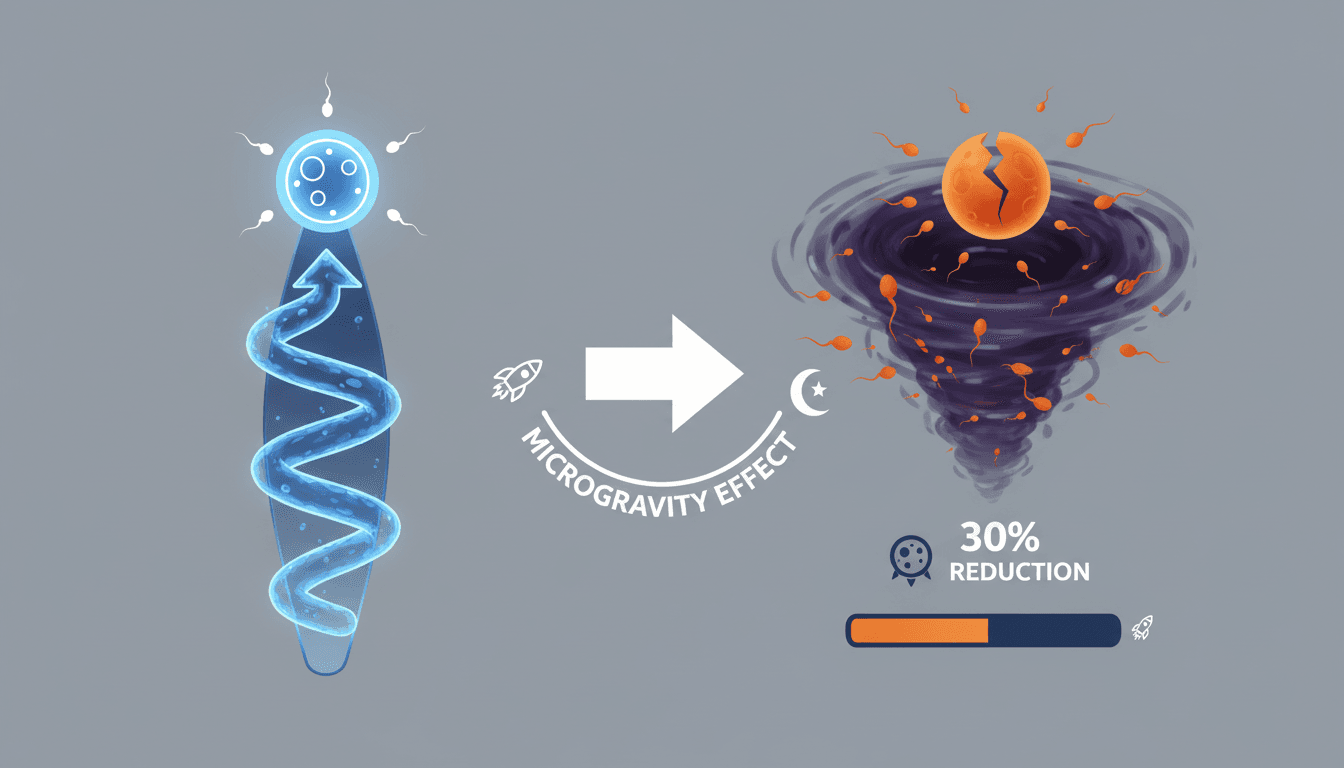
Here's what it means for you.
Understanding the challenges of reproduction in space is crucial for professionals involved in space exploration and biotechnology.
What happened
On March 26, 2026, a study revealed that simulated microgravity significantly disrupts sperm navigation and fertilization rates in mammals.
The Context
- Critical for space missions: As private and governmental space programs aim for long-term human presence on other planets, understanding reproductive viability in microgravity is essential.
- Significant findings: The research showed a 30% reduction in fertilization rates for sperm after exposure to simulated microgravity, raising concerns for future space colonization.
- Call for further research: Experts are advocating for in-orbit validation and partial-gravity tests to better understand these reproductive challenges.
The Number
— This reduction in fertilization rates for mouse and pig sperm highlights the urgent need to address reproductive health in space environments.
Takeaway
Future space exploration endeavors will require innovative solutions to ensure sustainable reproduction in microgravity settings.
Space science news, astronomy updates, and spaceflight developments.
"Space.com delivers space science news, astronomy updates, and spaceflight developments with engaging coverage."
— A47 Editor
Can humans have babies in space? It may be harder than expected
Recent research indicates that human reproduction in space may face significant challenges, as sperm struggles to navigate towards an egg in microgravity environments. This finding raises questions about the feasibility of mammalian reproduction beyo...
Scientific discoveries, health, technology, and natural phenomena.
"Live Science reports on scientific discoveries, health, technology, and natural phenomena with a popular science tone."
— A47 Editor
Astronauts may struggle to reproduce in outer space, study suggests — what does that mean for the future of space colonization?
A new study indicates that microgravity conditions, simulated on Earth, negatively affect sperm cell movement, egg fertilization, and embryo development, raising concerns about reproductive capabilities for astronauts in space.
Science and technology stories including AI.
"Longstanding science magazine with thoughtful AI coverage."
— A47 Editor
Human sperm get lost in space, pioneering study finds
A recent study conducted by researchers revealed that human sperm placed in a uterus-like simulation under microgravity conditions did not perform as expected, indicating significant challenges for reproductive health in space environments.
Scientific research, technology, environment, and society.
"Scientific American is one of the oldest and most authoritative science magazines, known for deep dives into science, technology, and society."
— A47 Editor
Human sperm get lost in space, pioneering study finds
A recent study conducted by researchers revealed that human sperm placed in a uterus-like simulation under microgravity conditions did not perform as expected, indicating significant challenges for reproductive health in space environments.
News in science and technology, with a focus on consumer and innovation stories.
"Popular Science simplifies complex scientific topics for general audiences and celebrates innovation."
— A47 Editor
Sperm loses its sense of direction in space
Recent research indicates that sperm lose their sense of direction in microgravity environments, complicating the potential for fertilization in space. This study highlights the challenges of reproductive biology in extraterrestrial settings, as sper...