
US Strategic Petroleum Reserve reaches lowest level since December 1982
Here's what it means for you.
Rising oil prices and potential supply disruptions could impact your energy costs and economic stability.
Why it matters
The depletion of the Strategic Petroleum Reserve (SPR) signals heightened geopolitical risks and market volatility in global oil supply.
What happened (in 30 seconds)
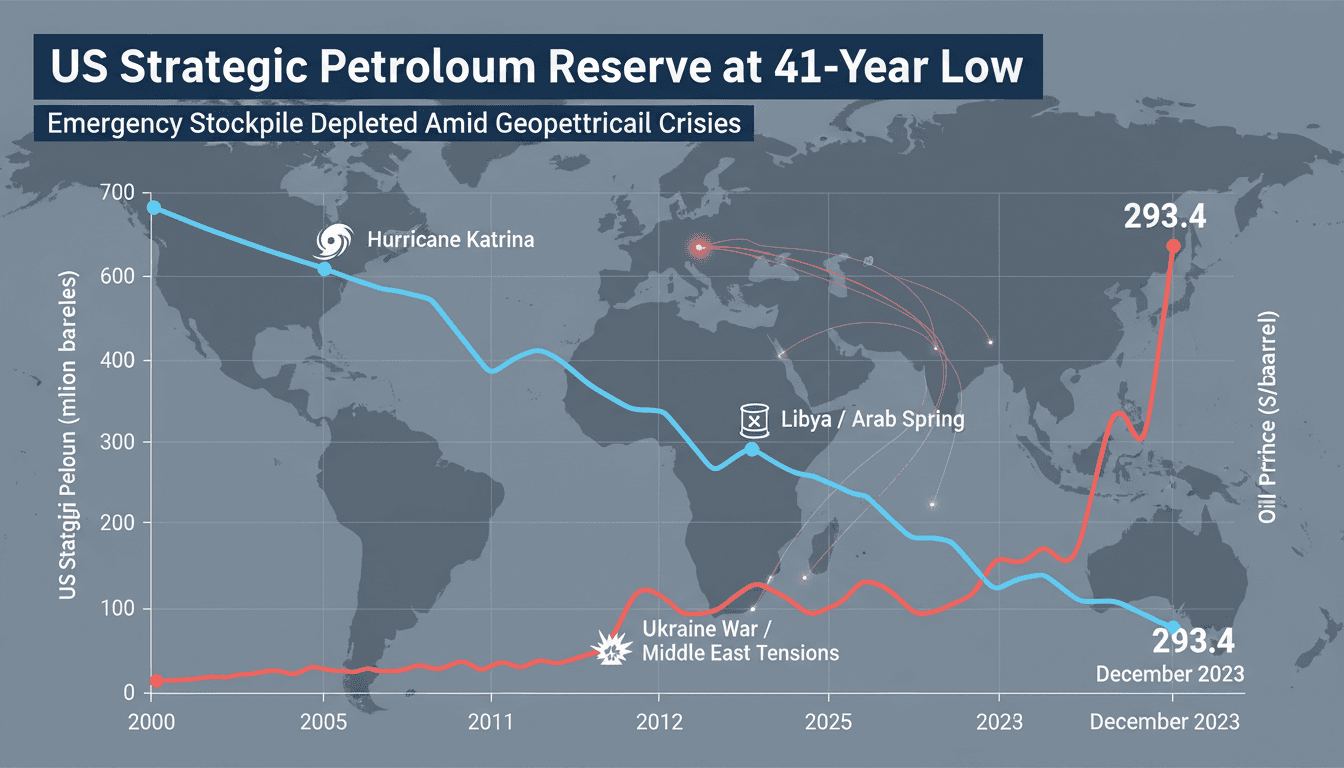
- US SPR holdings fell to 293.4 million barrels, the lowest since December 1982.
- Drawdown was part of a coordinated release of 400 million barrels by the International Energy Agency to address supply disruptions.
- Oil prices increased by over $2 per barrel amid ongoing tensions in the Middle East.
The context you actually need
- Geopolitical tensions involving the US, Israel, and Iran have disrupted oil tanker movements through the Strait of Hormuz, a critical shipping lane.
- Emergency exchanges from the SPR require repayment with premiums, indicating a strategic approach to managing reserves.
- Commercial crude inventories in the US rose to 424.4 million barrels, partially offsetting the impact of the SPR drawdown.
What's really happening
The US Strategic Petroleum Reserve, established to provide a buffer against severe petroleum supply interruptions, has seen its holdings dwindle significantly in recent months. As of August 14, 2026, the SPR stood at 293.4 million barrels, marking the lowest level since December 1982. This decline is primarily attributed to a series of withdrawals initiated in response to escalating geopolitical tensions in the Middle East, particularly involving the US, Israel, and Iran. The conflict has disrupted tanker movements through the Strait of Hormuz, a vital artery for global oil transport, leading to concerns over supply stability.
In March 2026, the International Energy Agency (IEA) coordinated a historic release of 400 million barrels from emergency stocks, with the US committing to contribute 172 million barrels. This unprecedented action was designed to cushion the economic impacts of supply volatility and rising oil prices. The drawdown has been systematic, with stocks decreasing from approximately 415 million barrels in early March to 293.4 million barrels by mid-August. This rapid depletion raises questions about the adequacy of the US's emergency capacity in the face of persistent geopolitical risks.
As the SPR diminishes, commercial crude inventories have risen, reaching 424.4 million barrels by early August. This increase provides a partial offset to the market, but the overall sentiment remains cautious. Oil prices have reacted to the uncertainty, climbing more than $2 per barrel amid fears of further supply disruptions. The administration has indicated that the exchanged barrels will be returned, potentially aiding in reserve recovery without necessitating a full repurchase.
The implications of this drawdown extend beyond immediate supply concerns. It reflects a strategic balancing act by the US administration, weighing the need for immediate market stabilization against the long-term sustainability of emergency reserves. As global oil prices remain elevated due to these supply concerns, the economic landscape could shift, affecting everything from consumer energy costs to broader economic activity.
Who feels it first (and how)
- Consumers: Higher energy prices could lead to increased costs for gasoline and heating.
- Businesses: Industries reliant on oil may face rising operational costs, impacting profit margins.
- Investors: Market volatility could affect stock prices in energy sectors and related industries.
- Geopolitical analysts: Increased focus on Middle Eastern stability and US foreign policy implications.
What to watch next
- Oil price trends: Continued fluctuations in oil prices will indicate market reactions to geopolitical developments.
- SPR recovery plans: Monitoring the administration's strategies for replenishing the SPR will reveal long-term energy security measures.
- Geopolitical developments: Any escalation or de-escalation in Middle Eastern tensions will directly impact oil supply and prices.
The SPR is at its lowest level since 1982, impacting US energy security.
Oil prices will remain volatile as geopolitical tensions persist.
The long-term strategy for replenishing the SPR and its implications for future energy policy.
Frequently Asked Questions
- Why it matters?
- The depletion of the Strategic Petroleum Reserve (SPR) signals heightened geopolitical risks and market volatility in global oil supply.
- What happened (in 30 seconds)?
- US SPR holdings fell to 293.4 million barrels, the lowest since December 1982. Drawdown was part of a coordinated release of 400 million barrels by the International Energy Agency to address supply disruptions. Oil prices increased by over $2 per barrel amid ongoing tensions in the Middle East.
- What's really happening?
- The US Strategic Petroleum Reserve, established to provide a buffer against severe petroleum supply interruptions, has seen its holdings dwindle significantly in recent months. As of August 14, 2026, the SPR stood at 293.4 million barrels, marking the lowest level since December 1982. This decline is primarily attributed to a series of withdrawals initiated in response to escalating geopolitical tensions in the Middle East, particularly involving the US, Israel, and Iran. The conflict has disrup
- Who feels it first (and how)?
- Consumers: Higher energy prices could lead to increased costs for gasoline and heating. Businesses: Industries reliant on oil may face rising operational costs, impacting profit margins. Investors: Market volatility could affect stock prices in energy sectors and related industries. Geopolitical analysts: Increased focus on Middle Eastern stability and US foreign policy implications.
- What to watch next?
- Oil price trends: Continued fluctuations in oil prices will indicate market reactions to geopolitical developments. SPR recovery plans: Monitoring the administration's strategies for replenishing the SPR will reveal long-term energy security measures. Geopolitical developments: Any escalation or de-escalation in Middle Eastern tensions will directly impact oil supply and prices.
English-language digital publication covering business, politics, technology, and current affairs.
"The Arabian Post mixes original and syndicated-style coverage with a broad regional and global business-news orientation."
— A47 Editor
US emergency oil reserve sinks to 1982 low
The United States' Strategic Petroleum Reserve has fallen below 300 million barrels for the first time since 1982, with a significant withdrawal of approximately 5.3 million barrels reported for the week ending August 14. This decline reflects ongoin...
Corporate leadership, finance, technology, and market trends.
"Fortune covers financial trends, leadership, and innovation with a pragmatic editorial approach."
— A47 Editor
U.S. strategic reserves are getting so low the drawdown threatens to damage the 60 underground salt caverns storing American oil
The U.S. is facing a critical situation as its strategic petroleum reserves are depleting, raising concerns about the structural integrity of the 60 underground salt caverns that store American oil. A petroleum engineering professor has warned that c...
English-language digital publication covering business, politics, technology, and current affairs.
"The Arabian Post mixes original and syndicated-style coverage with a broad regional and global business-news orientation."
— A47 Editor
US oil reserve sinks towards four-decade low
The US Strategic Petroleum Reserve has dropped below 300 million barrels, reaching its lowest level since 1983, following a significant weekly withdrawal of approximately 6.1 million barrels. This decline raises alarms regarding the adequacy of the n...
Global business headlines with AI angles.
"General business outlet that frequently covers AI."
— A47 Editor
The U.S. Strategic Petroleum Reserve Keeps Dwindling. Experts Are Warning Its Facing Structural Peril.
The U.S. Strategic Petroleum Reserve (SPR) has fallen below 300 million barrels for the first time since its establishment over four decades ago, raising alarms among experts about its structural integrity. This depletion follows significant withdraw...
Sports reporting with a focus on Saudi and regional competitions.
"Okaz sports coverage is broad and audience-friendly, with strong attention to Saudi teams and leagues."
— A47 Editor
هل يتعرض مخزون نفط الطوارئ الأمريكي لأضرار هيكلية؟
Energy experts have warned that the extensive withdrawal from the U.S. Strategic Petroleum Reserve in response to the impacts of the war with Iran could lead to structural damage to the salt caverns storing crude oil, as reserves have dropped to thei...