
U.S. National Debt Exceeds $40 Trillion Amid Rising Fiscal Concerns
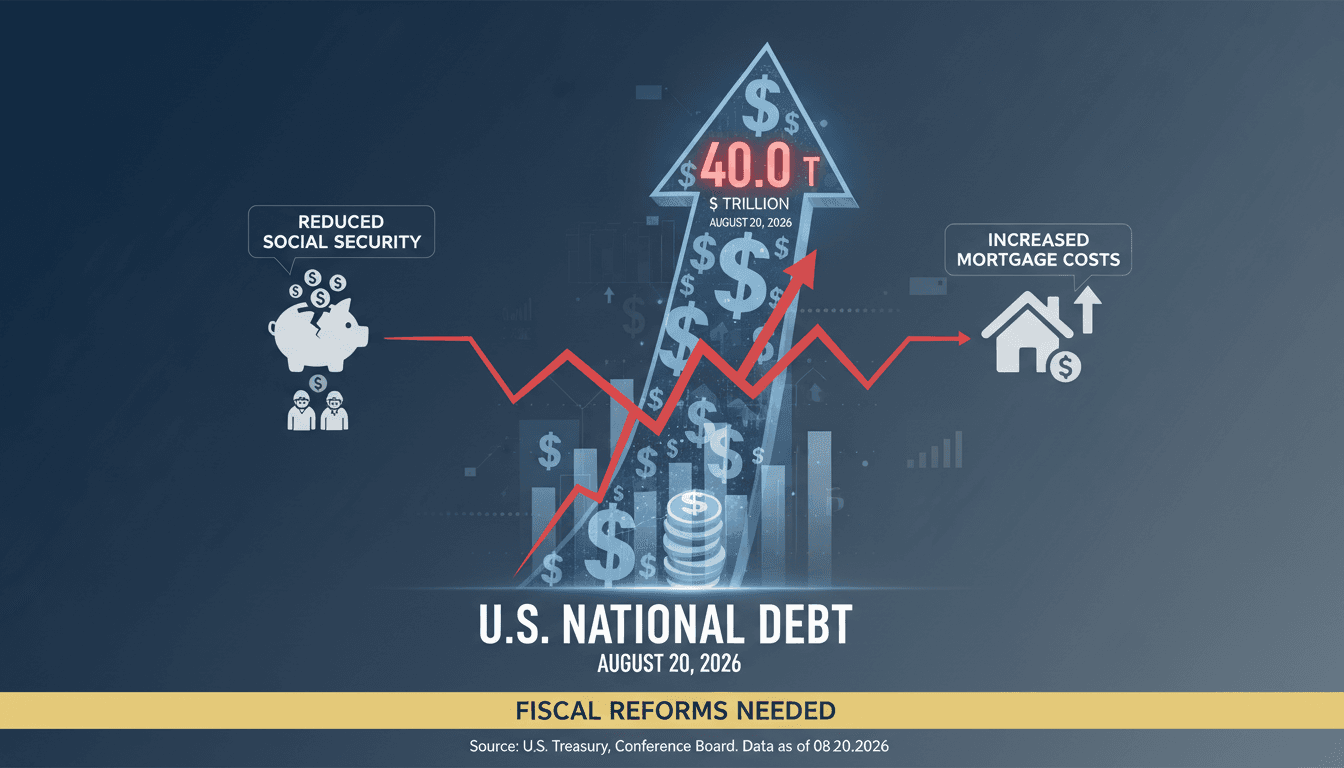
Here's what it means for you.
Your future financial stability may be at risk as national debt impacts Social Security and mortgage costs.
Why it matters
The escalating U.S. national debt directly affects household finances, influencing retirement benefits and housing affordability.
What happened (in 30 seconds)
- On August 20, 2026, the U.S. national debt surpassed $40 trillion, confirmed by Treasury data.
- A Conference Board report projected that high deficits could lead to a $700 monthly reduction in Social Security benefits for future retirees by 2033.
- Mortgage payments for families purchasing a $600,000 home could increase by $53,000 under current fiscal conditions compared to improved scenarios.
The context you actually need
- Persistent federal budget deficits of 6-7% of GDP have driven the national debt accumulation, with interest expenses exceeding $1 trillion in fiscal year 2026.
- Social Security and Medicare trust funds are projected to face insolvency by 2032-2033, necessitating potential general fund transfers estimated at $2.7 trillion.
- Public discourse around fiscal sustainability has intensified ahead of the 2026 midterms, with economists warning of the long-term implications of rising debt.
What's really happening
The U.S. national debt reaching $40 trillion is not just a number; it signifies a critical juncture in American fiscal policy and its implications for households. The Treasury's confirmation of this milestone coincides with a report from the Conference Board, which models various fiscal scenarios and their potential impacts on American families. The report highlights that if the current trajectory of high deficits continues, households could face significant financial burdens.
For instance, the projected $700 monthly reduction in Social Security benefits for future retirees by 2033 underscores the direct impact of national debt on individual financial security. This reduction is not merely a statistic; it translates to real-life consequences for millions of Americans who rely on Social Security as a primary source of income in retirement. The implications extend beyond retirement, affecting housing affordability as well. Families looking to purchase homes could see their total mortgage payments increase by $53,000 when compared to scenarios where fiscal conditions improve.
The underlying mechanism driving these changes is the relationship between national debt, interest rates, and inflation. As the national debt grows, the government must allocate a larger portion of its budget to interest payments, which are projected to exceed $1 trillion annually. This creates upward pressure on interest rates, making borrowing more expensive for consumers. Higher interest rates can lead to increased costs for mortgages and student loans, further straining household budgets.
Moreover, the projected insolvency of Social Security and Medicare trust funds adds another layer of urgency to the situation. Without intervention, the government may need to divert funds from other areas, exacerbating the fiscal challenges faced by future retirees. Economists, including those from the Peterson Institute, have linked higher national debt to increased household expenses, emphasizing the need for a sustainable fiscal policy that prioritizes long-term economic stability.
In summary, the $40 trillion national debt milestone is a wake-up call for American households. It highlights the interconnectedness of government fiscal policy and individual financial health, with potential repercussions that could affect generations to come.
Who feels it first (and how)
- Future retirees: Likely to see reduced Social Security benefits impacting their financial security.
- Homebuyers: Families purchasing homes may face significantly higher mortgage payments.
- Low- to middle-income households: More vulnerable to rising costs associated with debt-driven inflation and interest rates.
- Economists and policymakers: Increased pressure to address fiscal sustainability and its implications for the economy.
What to watch next
- Interest rate trends: Monitor Federal Reserve actions and their impact on borrowing costs, which will affect mortgage and loan rates.
- Legislative responses: Watch for any proposed fiscal reforms aimed at reducing the national debt and their potential effects on household finances.
- Public sentiment: Keep an eye on voter attitudes toward fiscal policy as the midterms approach, which could influence future government actions.
The U.S. national debt has surpassed $40 trillion, with interest payments exceeding $1 trillion annually.
Future retirees will face reduced Social Security benefits if current fiscal trends continue.
The exact legislative measures that will be taken to address the national debt and their effectiveness.
Frequently Asked Questions
- Why it matters?
- The escalating U.S. national debt directly affects household finances, influencing retirement benefits and housing affordability.
- What happened (in 30 seconds)?
- On August 20, 2026, the U.S. national debt surpassed $40 trillion, confirmed by Treasury data. A Conference Board report projected that high deficits could lead to a $700 monthly reduction in Social Security benefits for future retirees by 2033. Mortgage payments for families purchasing a $600,000 home could increase by $53,000 under current fiscal conditions compared to improved scenarios.
- What's really happening?
- The U.S. national debt reaching $40 trillion is not just a number; it signifies a critical juncture in American fiscal policy and its implications for households. The Treasury's confirmation of this milestone coincides with a report from the Conference Board, which models various fiscal scenarios and their potential impacts on American families. The report highlights that if the current trajectory of high deficits continues, households could face significant financial burdens. For instance, the
- Who feels it first (and how)?
- Future retirees: Likely to see reduced Social Security benefits impacting their financial security. Homebuyers: Families purchasing homes may face significantly higher mortgage payments. Low- to middle-income households: More vulnerable to rising costs associated with debt-driven inflation and interest rates. Economists and policymakers: Increased pressure to address fiscal sustainability and its implications for the economy.
- What to watch next?
- Interest rate trends: Monitor Federal Reserve actions and their impact on borrowing costs, which will affect mortgage and loan rates. Legislative responses: Watch for any proposed fiscal reforms aimed at reducing the national debt and their potential effects on household finances. Public sentiment: Keep an eye on voter attitudes toward fiscal policy as the midterms approach, which could influence future government actions.
Corporate leadership, finance, technology, and market trends.
"Fortune covers financial trends, leadership, and innovation with a pragmatic editorial approach."
— A47 Editor
As U.S. debt hits $40 trillion, Americans will foot the bill: $700 a month for retirees, and homebuyers could take a $53,000 hit, report finds
The U.S. national debt has surpassed $40 trillion, a significant milestone that reflects ongoing government borrowing and spending, raising concerns about fiscal sustainability. This alarming figure indicates that Americans may face increased financi...
Global business headlines with AI angles.
"General business outlet that frequently covers AI."
— A47 Editor
The U.S. National Debt Has More Than Doubled In Less Than a Decade, Hitting $40 Trillion For The First Time
The U.S. national debt has surpassed $40 trillion for the first time, more than doubling in less than a decade, as bond yields rebounded following the Treasury's announcement of increased debt repurchases.
Jordanian news and regional updates.
"Roya News is a Jordanian outlet focused on breaking news and local affairs."
— A47 Editor
تجاوز الـ 40 تريليون دولار.. كيف يؤثر حجم الدين الأمريكي على الأسواق العالمية؟
Recent data from the U.S. Treasury indicates that the federal debt has surpassed $40 trillion, raising concerns about its implications for global markets. This significant milestone highlights the growing financial obligations of the United States an...
Pan-Arab news coverage spanning politics, business, sports, and regional affairs.
"Asharq Al-Awsat reflects a broad Arab editorial perspective with strong attention to regional geopolitics."
— A47 Editor
40 تريليون دولار... الدين الأميركي يدخل منطقة الخطر
The U.S. national debt has surpassed $40 trillion, marking a significant milestone that reflects a deeper shift in the country's borrowing relationship. This figure is no longer just a record in the Treasury's books but indicates growing financial ch...
Global news coverage with extensive reporting on Middle Eastern conflicts and geopolitics.
"Al Jazeera is a Qatar-based broadcaster known for wide regional coverage and alternative perspectives."
— A47 Editor
US debt hits $40 trillion: Who does Washington owe and why does it matter?
The US national debt has surpassed $40 trillion, a significant milestone that reflects heavy borrowing and increased spending across both Democratic and Republican administrations. This figure has doubled over the past decade, highlighting ongoing fi...
Comprehensive coverage of Middle Eastern and global issues.
"Al Jazeera is a prominent voice from the Global South, especially the Middle East, with an emphasis on underreported stories."
— A47 Editor
US debt hits $40 trillion: Who does Washington owe and why does it matter?
The US national debt has surpassed $40 trillion, a significant milestone that reflects heavy borrowing and increased spending across both Democratic and Republican administrations. This figure has doubled over the past decade, highlighting ongoing fi...