
Global Economy Shows Resilience Against Iran War Energy Shock According to IMF
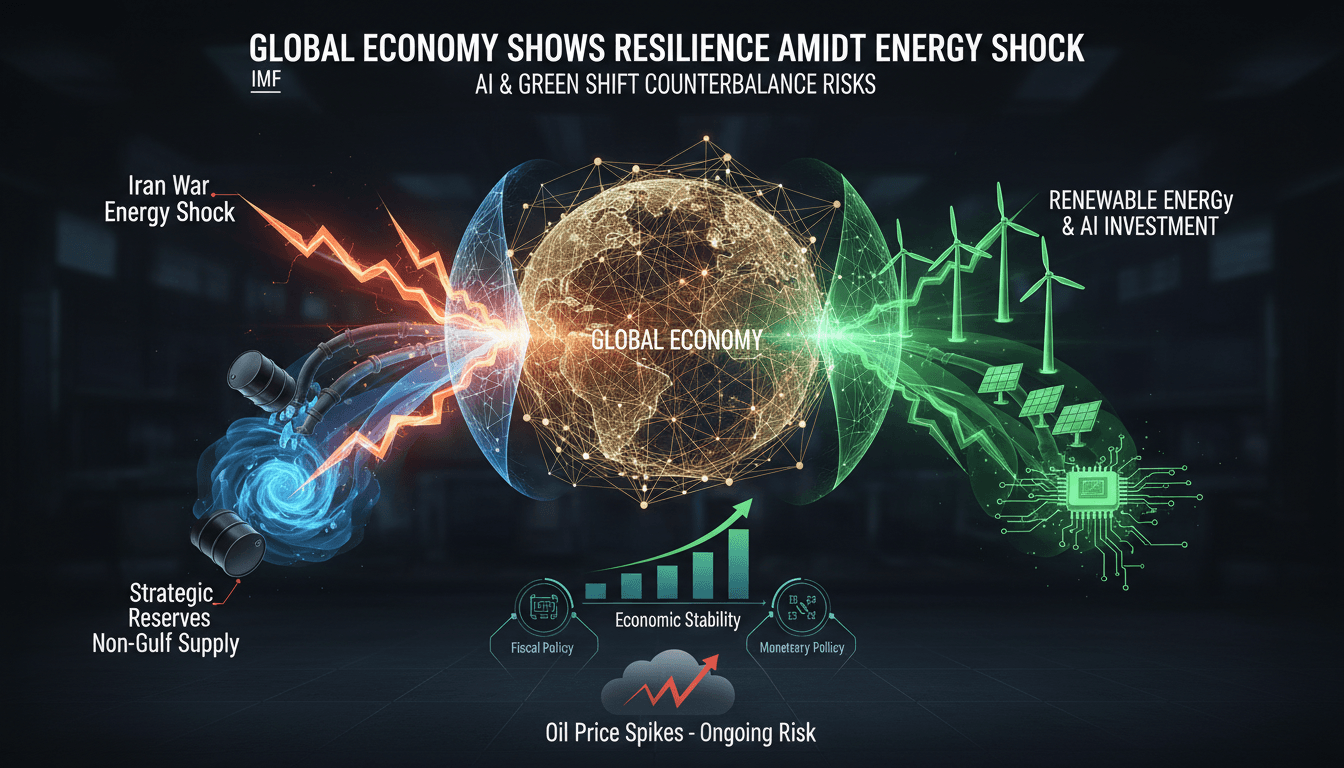
Here's what it means for you.
Your business strategies may need to adapt to ongoing energy price fluctuations and inflationary pressures.
Why it matters
The global economy's ability to withstand energy shocks directly impacts inflation, borrowing costs, and consumer spending.
What happened (in 30 seconds)
- IMF Managing Director Kristalina Georgieva reported that the global economy has weathered the energy shock from the Iran war better than expected.
- Strategic reserve drawdowns and increased non-Gulf supplies have helped mitigate the impact of the energy crisis.
- Risks remain, including potential oil price spikes that could reignite inflation and strain debt servicing.
The context you actually need
- The Iran war and the closure of the Strait of Hormuz disrupted Gulf energy supplies, leading to a global energy price shock.
- High debt levels and persistent inflation were already straining economies before the conflict escalated.
- AI-driven investments have emerged as a counterbalancing force, supporting growth across various sectors beyond the U.S.
What's really happening
The global economy is currently navigating a complex landscape shaped by the recent Iran war and the subsequent closure of the Strait of Hormuz, which has significantly disrupted energy supplies from the Gulf. Despite these challenges, IMF Managing Director Kristalina Georgieva's recent briefing indicates that the global economy has shown remarkable resilience. This resilience can be attributed to several key factors.
First, strategic reserve drawdowns have played a crucial role in stabilizing energy supplies. Countries have tapped into their reserves to mitigate immediate shortages, which has helped to prevent a more severe economic downturn. Additionally, there has been an increase in non-Gulf energy supplies, which has diversified the sources of energy available to global markets. This diversification is critical in reducing dependency on any single region, particularly one as volatile as the Gulf.
Moreover, reduced demand for energy in certain sectors has contributed to easing the pressure on prices. As businesses and consumers adjust to the new economic realities, energy consumption patterns are shifting, leading to a decrease in overall demand. This trend is further supported by the expansion of renewable energy sources, which are becoming increasingly viable alternatives to traditional fossil fuels.
Interestingly, some regions are reverting to coal power as a stopgap measure, which reflects the ongoing tug-of-war between energy supply shocks and the push for greener alternatives. This reversion, while not ideal from an environmental perspective, highlights the immediate need for energy security in the face of geopolitical instability.
On the investment front, AI has emerged as a significant growth driver, sustaining corporate earnings and consumer spending. The technology sector is experiencing a boom, with investments in data centers and hardware spurring economic activity. This AI-driven growth is not limited to the U.S.; it is extending its influence globally, providing a counterbalance to the fiscal pressures stemming from high debt and inflation.
However, Georgieva cautioned that the energy shock is not entirely resolved. The potential for renewed oil price spikes remains a significant risk, which could reignite inflation and complicate debt servicing for many countries. Central banks may need to maintain tight monetary policies to combat these inflationary pressures, which could further strain economic growth.
In summary, while the global economy has shown resilience in the face of the Iran war energy shock, the underlying risks and structural challenges remain. The interplay between energy supply disruptions, AI investments, and fiscal pressures will continue to shape the economic landscape in the coming months.
Who feels it first (and how)
- Consumers: Higher energy prices may lead to increased costs for goods and services.
- Businesses: Companies reliant on energy-intensive processes may face rising operational costs.
- Investors: Market volatility could impact investment strategies, particularly in energy and tech sectors.
- Governments: Fiscal pressures may lead to tighter monetary policies, affecting public spending and services.
What to watch next
- Oil price trends: Monitoring fluctuations in oil prices will be crucial, as spikes could reignite inflation.
- Central bank policies: Watch for signals from central banks regarding interest rate adjustments in response to inflationary pressures.
- AI investment growth: Continued investment in AI technologies could indicate resilience in corporate earnings and consumer spending.
The global economy has shown resilience against the energy shock.
Central banks will maintain tight monetary policies to combat inflation.
The long-term impact of AI investments on economic stability remains to be seen.
Frequently Asked Questions
- Why it matters?
- The global economy's ability to withstand energy shocks directly impacts inflation, borrowing costs, and consumer spending.
- What happened (in 30 seconds)?
- IMF Managing Director Kristalina Georgieva reported that the global economy has weathered the energy shock from the Iran war better than expected. Strategic reserve drawdowns and increased non-Gulf supplies have helped mitigate the impact of the energy crisis. Risks remain, including potential oil price spikes that could reignite inflation and strain debt servicing.
- What's really happening?
- The global economy is currently navigating a complex landscape shaped by the recent Iran war and the subsequent closure of the Strait of Hormuz, which has significantly disrupted energy supplies from the Gulf. Despite these challenges, IMF Managing Director Kristalina Georgieva's recent briefing indicates that the global economy has shown remarkable resilience. This resilience can be attributed to several key factors. First, strategic reserve drawdowns have played a crucial role in stabilizing
- Who feels it first (and how)?
- Consumers: Higher energy prices may lead to increased costs for goods and services. Businesses: Companies reliant on energy-intensive processes may face rising operational costs. Investors: Market volatility could impact investment strategies, particularly in energy and tech sectors. Governments: Fiscal pressures may lead to tighter monetary policies, affecting public spending and services.
- What to watch next?
- Oil price trends: Monitoring fluctuations in oil prices will be crucial, as spikes could reignite inflation. Central bank policies: Watch for signals from central banks regarding interest rate adjustments in response to inflationary pressures. AI investment growth: Continued investment in AI technologies could indicate resilience in corporate earnings and consumer spending.
Sports reporting with a focus on Saudi and regional competitions.
"Okaz sports coverage is broad and audience-friendly, with strong attention to Saudi teams and leagues."
— A47 Editor
هل تجاوز الاقتصاد العالمي صدمة الطاقة؟ غورغييفا تجيب
Kristalina Georgieva, the Managing Director of the International Monetary Fund, stated that the global economy is navigating the energy shock from the Iran conflict better than expected, despite concerns over deteriorating financial conditions in som...
Oil, metals, and agriculture: supply/demand headlines, OPEC chatter, inventories, and price action.
"Solid tape for energy and metals traders tracking macro and micro catalysts."
— A47 Editor
IMF’s Georgieva says global economy weathering energy shock, sees fiscal concerns
Kristalina Georgieva, Managing Director of the International Monetary Fund (IMF), stated that the global economy has successfully weathered the recent energy shock, although fiscal concerns remain prevalent. This assessment reflects the IMF's ongoing...
UAE-based English-language newspaper covering regional politics, economics, and global affairs.
"The National reflects Emirati policy perspectives while maintaining international editorial standards."
— A47 Editor
Global economy so far resisting Iran war energy shock, IMF chief says
The International Monetary Fund (IMF) chief has stated that the global economy is currently managing to resist the energy shock caused by the ongoing conflict in Iran, despite significant geopolitical tensions.