
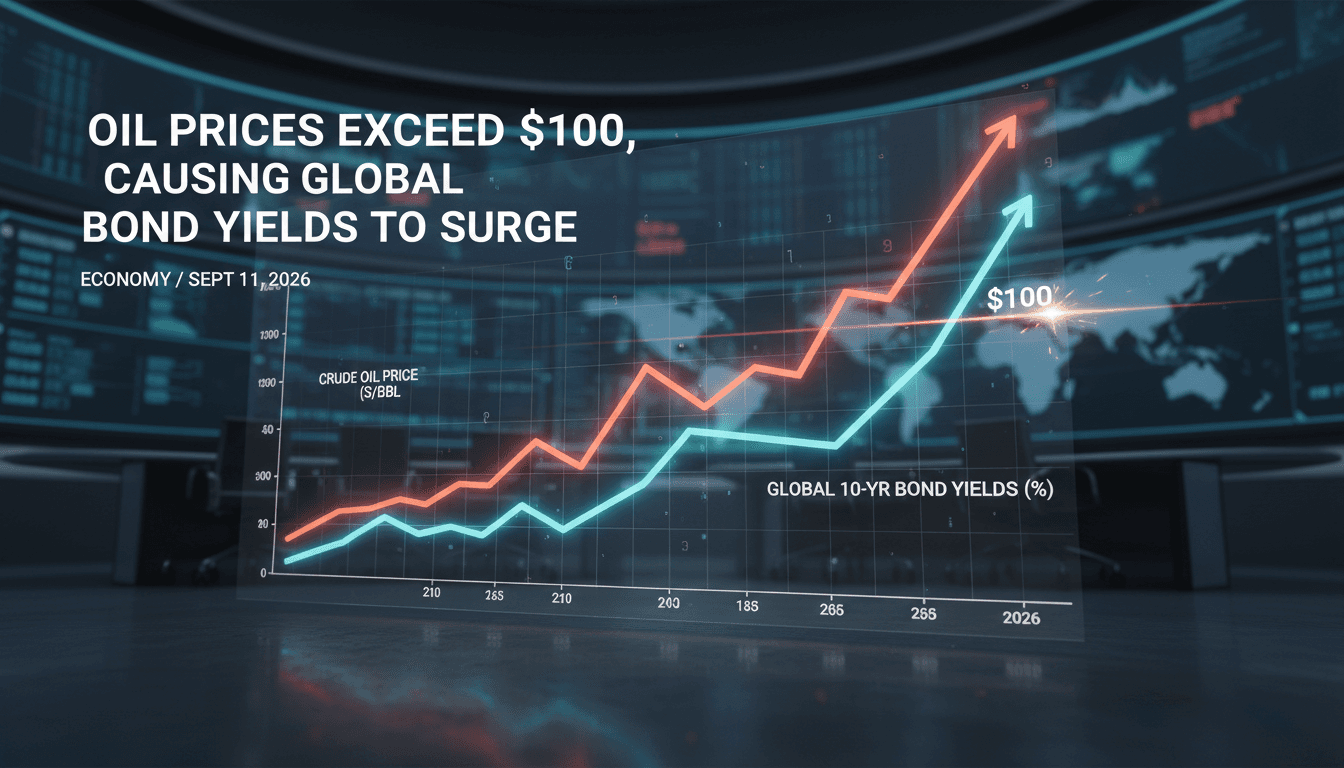
Oil Prices Exceed $100 Per Barrel Causing Surge in Global Bond Yields
Here's what it means for you.
If you’re in finance, energy, or global trade, expect increased costs and tighter monetary policies impacting your operations.
Why it matters
The surge in oil prices and bond yields signals a potential shift towards prolonged inflation and economic stagnation, affecting global markets.
What happened (in 30 seconds)
- Oil prices exceeded $100 per barrel on September 11, 2026, driven by Middle East supply disruptions.
- Global bond yields surged, with Germany's 10-year yield hitting 3.5% and U.S. Treasuries exceeding 4.9%.
- Central banks reacted with tighter monetary policies, raising concerns about stagflation and subdued economic growth.
The context you actually need
- Geopolitical tensions in the Middle East, particularly involving Iran, have led to significant disruptions in oil supply routes.
- Saudi Arabia's reduced output and shipping issues in the Strait of Hormuz and Red Sea have shifted oil prices from temporary spikes to persistent concerns.
- The European Central Bank's recent rate hike reflects a broader strategy to combat inflation, projecting 3% inflation for 2026 while downgrading growth forecasts.
What's really happening
On September 11, 2026, Brent crude oil prices hovered around $105 per barrel, while West Texas Intermediate (WTI) was near $103. This price surge is primarily attributed to ongoing geopolitical tensions in the Middle East, particularly conflicts involving Iran, which have disrupted critical oil supply routes through the Strait of Hormuz and the Red Sea. Additionally, reduced production from Saudi Arabia has compounded these supply issues, leading to sustained elevated prices.
The immediate market reaction was pronounced. Global bond markets responded sharply, with Germany's 10-year government bond yield reaching 3.5%, the highest level since April 2011. U.S. 10-year Treasuries also saw a significant rise, surpassing 4.9%. Asian markets followed suit, with yields in Japan, Australia, and South Korea increasing by 6-12 basis points. This surge in bond yields reflects investor concerns about persistent inflation and the potential for subdued economic growth, commonly referred to as stagflation.
The European Central Bank (ECB) had raised interest rates by 25 basis points just a day prior, signaling its commitment to combating inflation. The ECB's projections indicated a 3% inflation rate for 2026, while France's growth forecast was downgraded to a mere 0.4%. These developments have prompted warnings from economists about the risks of mildly restrictive monetary policies if energy costs remain high.
The implications of these shifts are significant. Higher oil prices typically lead to increased costs for consumers and businesses alike, which can dampen economic activity. As borrowing costs rise due to elevated bond yields, sectors reliant on financing, such as construction and consumer goods, may face challenges. Moreover, the interconnectedness of global markets means that these trends could ripple through various economies, affecting trade dynamics and investment flows.
In summary, the current situation reflects a complex interplay of geopolitical tensions, monetary policy adjustments, and market reactions, all of which are contributing to a landscape of heightened uncertainty and potential economic stagnation.
Who feels it first (and how)
- Investors: Increased borrowing costs and market volatility impact investment strategies.
- Energy Sector: Higher oil prices affect profitability and operational costs.
- Consumers: Rising fuel prices lead to increased costs of goods and services.
- Construction and Finance: Elevated bond yields result in higher borrowing costs, impacting project financing.
- Travel and Tourism: Higher energy costs may reduce global travel demand, affecting related sectors.
What to watch next
- Central Bank Policies: Monitor further rate hikes from the ECB and other central banks, as they will influence borrowing costs and economic growth.
- Oil Supply Developments: Keep an eye on geopolitical developments in the Middle East that could affect oil supply and prices.
- Inflation Indicators: Watch for inflation data releases that could signal whether current trends are temporary or indicative of a longer-term issue.
Oil prices are currently elevated due to geopolitical tensions and supply disruptions.
Central banks will continue to tighten monetary policy in response to rising inflation.
The long-term impact of these trends on global economic growth remains uncertain.
Frequently Asked Questions
- Why it matters?
- The surge in oil prices and bond yields signals a potential shift towards prolonged inflation and economic stagnation, affecting global markets.
- What happened (in 30 seconds)?
- Oil prices exceeded $100 per barrel on September 11, 2026, driven by Middle East supply disruptions. Global bond yields surged, with Germany's 10-year yield hitting 3.5% and U.S. Treasuries exceeding 4.9%. Central banks reacted with tighter monetary policies, raising concerns about stagflation and subdued economic growth.
- What's really happening?
- On September 11, 2026, Brent crude oil prices hovered around $105 per barrel, while West Texas Intermediate (WTI) was near $103. This price surge is primarily attributed to ongoing geopolitical tensions in the Middle East, particularly conflicts involving Iran, which have disrupted critical oil supply routes through the Strait of Hormuz and the Red Sea. Additionally, reduced production from Saudi Arabia has compounded these supply issues, leading to sustained elevated prices. The immediate mark
- Who feels it first (and how)?
- Investors: Increased borrowing costs and market volatility impact investment strategies. Energy Sector: Higher oil prices affect profitability and operational costs. Consumers: Rising fuel prices lead to increased costs of goods and services. Construction and Finance: Elevated bond yields result in higher borrowing costs, impacting project financing. Travel and Tourism: Higher energy costs may reduce global travel demand, affecting related sectors.
- What to watch next?
- Central Bank Policies: Monitor further rate hikes from the ECB and other central banks, as they will influence borrowing costs and economic growth. Oil Supply Developments: Keep an eye on geopolitical developments in the Middle East that could affect oil supply and prices. Inflation Indicators: Watch for inflation data releases that could signal whether current trends are temporary or indicative of a longer-term issue.
Global business headlines with AI angles.
"General business outlet that frequently covers AI."
— A47 Editor
$100 Oil Fuels a Global Bond Surge. Investors Fear Higher Inflation and Slower Growth.
The ongoing tensions around the Strait of Hormuz and the Red Sea, coupled with reduced oil production from Saudi Arabia, have led to a surge in oil prices, surpassing $100 per barrel. This situation raises concerns that elevated energy prices may per...
UK and international business news, economics, and corporate coverage.
"The Guardian’s business section covers finance and markets with a progressive editorial tone."
— A47 Editor
Global bond sell-off resumes as surging oil prices stoke fears about inflation
A global sell-off of government bonds has resumed as crude oil prices surged above $107 a barrel, driven by escalating tensions in the Middle East and concerns over inflation. Investors are reacting to fears that advances by Houthi rebels in Yemen co...
News from the United States including domestic politics, society, and culture.
"The Guardian is known for its progressive editorial stance and in-depth analysis, often advocating for social justice, environmental issues, and liberal values."
— A47 Editor
Global bond sell-off resumes as surging oil prices stoke fears about inflation
A global sell-off of government bonds has resumed as crude oil prices surged above $107 a barrel, driven by escalating tensions in the Middle East and concerns over inflation. Investors are reacting to fears that advances by Houthi rebels in Yemen co...
European coverage of Middle East politics and security issues.
"France 24 offers international reporting with a European editorial perspective."
— A47 Editor
Oil spike past $100 dampens stock prices, fans inflation fears
Oil prices have surged past $100 a barrel, driven by escalating tensions in the Middle East, particularly between the United States and Iran, which have led to military strikes in the Strait of Hormuz and increased attacks by Yemen's Houthi rebels on...
Coverage of current events and conflicts in the Middle East.
"France 24 is viewed as a globally focused outlet with balanced coverage and a European perspective."
— A47 Editor
Oil spike past $100 dampens stock prices, fans inflation fears
Oil prices have surged past $100 a barrel, driven by escalating tensions in the Middle East, particularly between the United States and Iran, which have led to military strikes in the Strait of Hormuz and increased attacks by Yemen's Houthi rebels on...