
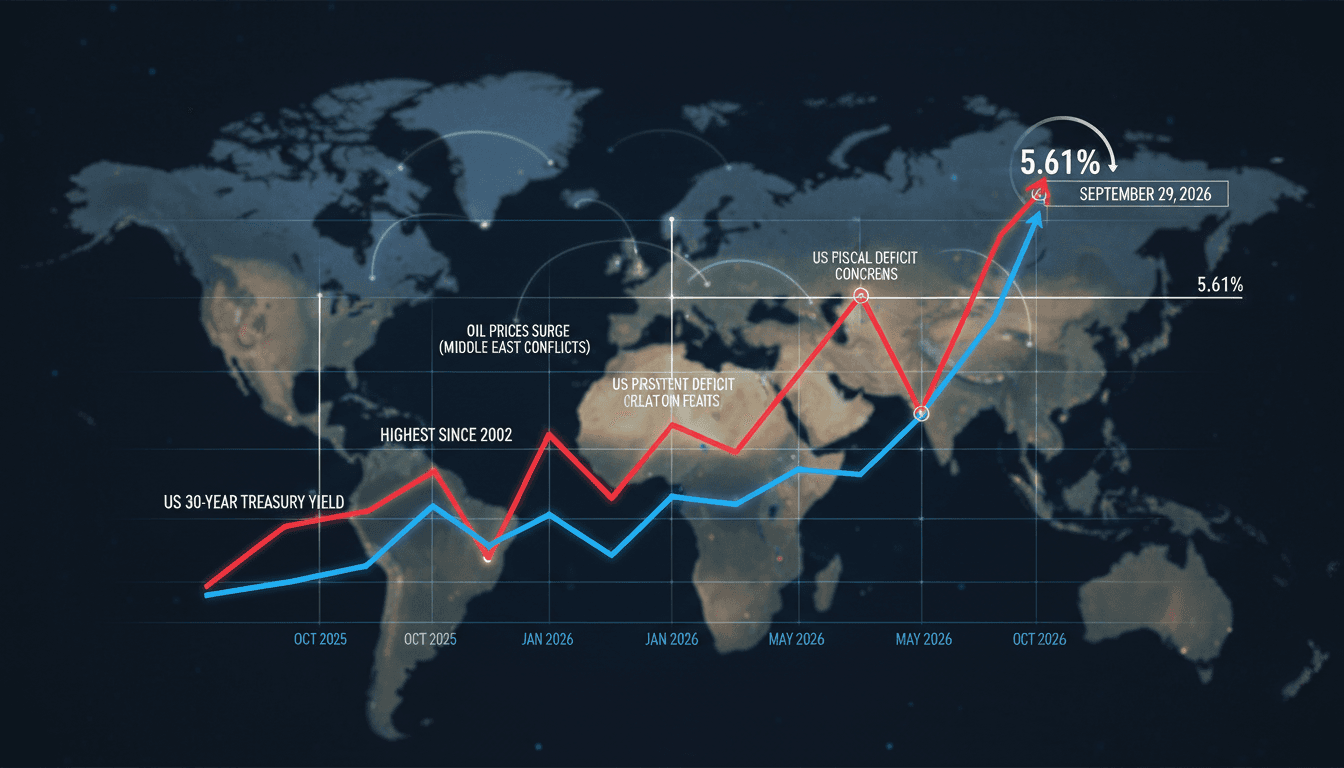
US 30-Year Treasury Yield Reaches 5.61 Percent, Highest Since 2002
Why it matters
The surge in US Treasury yields signals a shift in global debt markets, impacting borrowing costs and investment strategies worldwide.
What happened (in 30 seconds)
- On September 29, 2026, the US 30-year Treasury yield surpassed 5.61 percent, the highest since 2002.
- This increase reflects ongoing inflationary pressures, high oil prices, and concerns over US fiscal deficits.
- Global bond markets are experiencing a selloff, with the 10-year yield nearing multi-year highs.
The context you actually need
- Persistent inflation has kept yields climbing, with rates above the Federal Reserve's target.
- Geopolitical tensions, particularly in the Middle East, have driven oil prices higher, further complicating economic stability.
- Heavy corporate debt issuance has coincided with investor expectations of sustained or increased interest rates.
What's really happening
The recent rise in the US 30-year Treasury yield to 5.61 percent is a culmination of various economic pressures that have been building throughout 2026. Persistent inflation, which has remained above the Federal Reserve's target, has forced investors to reassess the value of long-term government debt. As inflation erodes purchasing power, the yields on these bonds must rise to attract buyers, leading to a repricing of risk in the fixed-income market.
Additionally, geopolitical tensions, particularly in the Middle East, have contributed to elevated oil prices, which in turn exacerbate inflationary pressures. The combination of these factors has led to a significant selloff in global debt markets, with investors increasingly wary of holding long-dated securities that may not keep pace with rising prices.
The US Treasury Department has been issuing a substantial amount of debt to finance record government borrowing, further complicating the landscape. As the supply of Treasuries increases, yields must rise to entice buyers, creating a feedback loop that drives rates higher. This environment has led to a six-day advance in yields, with the 10-year yield also approaching 5.25 percent, reflecting a broader trend in the bond market.
The implications of these rising yields are profound. For investors, higher yields mean that the cost of borrowing increases, which can dampen economic growth as both consumers and businesses face higher interest payments. For governments and corporations, the cost of financing projects and operations rises, potentially leading to cutbacks in spending or investment.
Moreover, the interconnectedness of global markets means that these changes in US Treasury yields will have ripple effects worldwide. For instance, countries in the Gulf Cooperation Council (GCC), which peg their currencies to the US dollar, will see their borrowing costs rise in tandem with US yields. This could impact infrastructure projects and initiatives like Saudi Arabia's Vision 2030, as financing becomes more expensive.
In summary, the rise in US Treasury yields is not just a domestic issue; it has global ramifications that affect borrowing costs, investment strategies, and economic growth across various sectors.
Who feels it first (and how)
- Borrowers: Individuals and businesses facing higher mortgage and loan rates.
- Investors: Those holding long-term bonds will see declines in bond prices.
- Governments: Regional sovereigns in the GCC will experience increased debt servicing costs.
- Corporates: Companies reliant on debt financing for expansion will face higher costs.
- Infrastructure projects: Initiatives tied to government funding may see delays or cutbacks.
What to watch next
- Federal Reserve announcements: Any signals regarding interest rate changes will be crucial for market expectations.
- Inflation data releases: Upcoming reports will indicate whether inflation is stabilizing or continuing to rise, impacting yield trajectories.
- Geopolitical developments: Events in the Middle East could further influence oil prices and, consequently, inflation and yields.
US Treasury yields have surpassed 5.61 percent, the highest since 2002.
Continued pressure on yields as inflation remains a concern and fiscal deficits grow.
The timing and extent of any Federal Reserve policy responses to these rising yields.
Frequently Asked Questions
- Why it matters?
- The surge in US Treasury yields signals a shift in global debt markets, impacting borrowing costs and investment strategies worldwide.
- What happened (in 30 seconds)?
- On September 29, 2026, the US 30-year Treasury yield surpassed 5.61 percent, the highest since 2002. This increase reflects ongoing inflationary pressures, high oil prices, and concerns over US fiscal deficits. Global bond markets are experiencing a selloff, with the 10-year yield nearing multi-year highs.
- What's really happening?
- The recent rise in the US 30-year Treasury yield to 5.61 percent is a culmination of various economic pressures that have been building throughout 2026. Persistent inflation, which has remained above the Federal Reserve's target, has forced investors to reassess the value of long-term government debt. As inflation erodes purchasing power, the yields on these bonds must rise to attract buyers, leading to a repricing of risk in the fixed-income market. Additionally, geopolitical tensions, particu
- Who feels it first (and how)?
- Borrowers: Individuals and businesses facing higher mortgage and loan rates. Investors: Those holding long-term bonds will see declines in bond prices. Governments: Regional sovereigns in the GCC will experience increased debt servicing costs. Corporates: Companies reliant on debt financing for expansion will face higher costs. Infrastructure projects: Initiatives tied to government funding may see delays or cutbacks.
- What to watch next?
- Federal Reserve announcements: Any signals regarding interest rate changes will be crucial for market expectations. Inflation data releases: Upcoming reports will indicate whether inflation is stabilizing or continuing to rise, impacting yield trajectories. Geopolitical developments: Events in the Middle East could further influence oil prices and, consequently, inflation and yields.
Editor-curated FT homepage stories spanning markets, business, world, and opinion.
"The Financial Times is a globally respected business publication with a centrist/center-left tone and strong markets focus."
— A47 Editor
US 30-year Treasury yield hits highest since 2002
The U.S. 30-year Treasury yield has surged to its highest level since 2002, reflecting a significant decline in government debt as inflation and rising oil prices exert pressure on the market. This increase in yields is indicative of growing investor...
Global business headlines with AI angles.
"General business outlet that frequently covers AI."
— A47 Editor
Treasury Yields Keep Climbing. The 30-Year Note Just Hit The Highest Level In Over 20 Years.
The 30-year Treasury note yield has reached 5.609%, marking the highest level since 2002, reflecting ongoing trends in the bond market. This increase is part of a broader rise in Treasury yields, which have been influenced by inflationary pressures a...
Markets desk coverage, trading insights, and investor updates.
"WSJ’s markets reporting provides in-depth analysis and context for investors."
— A47 Editor
Stock Market News, Sept. 29, 2026: 10-Year Treasury Yield Pushes Higher Despite Oil-Price Decline
On September 29, 2026, the 10-Year Treasury yield rose above 5.1%, marking a significant increase despite a decline in oil prices. This rise in yield comes after a period of volatility in the bond market, where the 30-year yield also reached its high...
Markets desk coverage, trading insights, and investor updates.
"WSJ’s markets reporting provides in-depth analysis and context for investors."
— A47 Editor
Oil Prices and Bond Yields Keep Rising, Putting a Damper on Stocks
Oil prices and bond yields have continued to rise, causing concern on Wall Street as the yield on the benchmark 10-year U.S. Treasury note reached a 19-year high. This increase is largely attributed to ongoing tensions with Iran, which have reignited...
English-language digital publication covering business, politics, technology, and current affairs.
"The Arabian Post mixes original and syndicated-style coverage with a broad regional and global business-news orientation."
— A47 Editor
Global bond yields scale multi-decade highs
Global government bond yields have surged to multi-decade highs, with the US 10-year Treasury yield reaching approximately 5.16% and Japan's 10-year bond yield hitting 3.121%, the highest since 1996. This spike follows a significant sell-off in the b...