
IMF Projects 3.1 Percent Global Growth for 2026 Driven by AI Investment
Why it matters
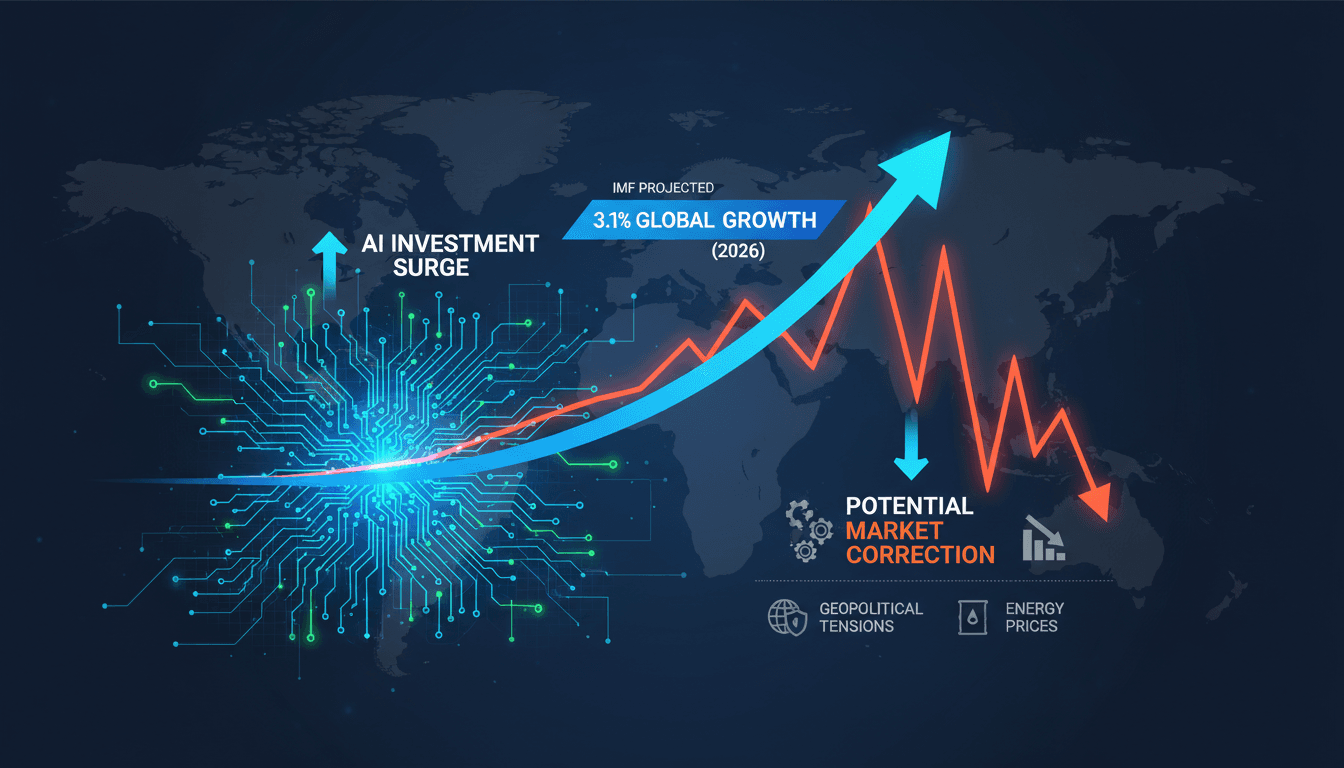
The IMF's revised growth forecast highlights the critical role of AI investments in shaping global economic dynamics amidst geopolitical tensions.
What happened (in 30 seconds)
- IMF raised its global growth forecast for 2026 to 3.1% due to a surge in AI investments.
- Warnings issued about diminishing resilience in the global economy and risks of a market correction.
- Concentrated growth benefits, with only 32 countries contributing to 95% of global expansion.
The context you actually need
- Ongoing conflicts in the Middle East are disrupting oil supplies and contributing to elevated energy prices.
- High public debt levels in advanced economies are limiting fiscal policy options, with debt projected to reach 115% of GDP by 2031.
- AI infrastructure investments are primarily benefiting technology exporters in Asia, creating a demand shock that is unevenly distributed globally.
What's really happening
The IMF's October 2026 World Economic Outlook report reveals a complex interplay between AI investment and global economic stability. The upward revision of the growth forecast to 3.1% for 2026 is largely attributed to a boom in artificial intelligence spending, which has provided a much-needed boost to economic activity. This surge in investment is particularly pronounced in sectors such as semiconductors, data centers, and power generation, which are essential for AI infrastructure.
However, this growth is not without its caveats. The IMF has cautioned that the global economy's capacity to absorb further shocks is nearing its limits. The report highlights several key risks, including a potential AI-driven market correction that could significantly impact global GDP. Specifically, a steep drop in AI investment could reduce global GDP by 1.1% by 2028 and trigger a 20% decline in U.S. stock markets.
Moreover, the benefits of this growth are highly concentrated, with only 32 countries accounting for 95% of global expansion. This concentration raises concerns about inequality and the sustainability of growth, as many regions may not experience the same level of economic uplift. The ongoing geopolitical tensions, particularly in the Middle East, further complicate the landscape, as they have led to disruptions in oil supplies and elevated energy prices, which could dampen growth prospects.
Inflation remains a persistent issue, with forecasts maintained at 4.7% for 2026 but raised for 2027. This inflationary pressure, coupled with rising public debt, limits the ability of policymakers to respond effectively to economic challenges. The IMF officials have urged governments to avoid complacency and tighten oversight of AI-related leverage, emphasizing the need for fiscal discipline and regulatory measures to mitigate financial stability risks.
In summary, while AI investments are driving growth, the IMF's report underscores the fragility of this recovery and the potential for significant market corrections if the current trajectory shifts.
Who feels it first (and how)
- Tech companies: Benefiting from increased demand for AI-related products and services.
- Investors: Facing potential volatility in stock markets, particularly in tech sectors.
- Consumers: Experiencing rising energy costs due to geopolitical tensions affecting oil supplies.
- Policymakers: Needing to navigate complex fiscal challenges amid high public debt and inflation.
What to watch next
- AI investment trends: Monitoring shifts in AI spending will be crucial for understanding future growth trajectories.
- Geopolitical developments: Ongoing conflicts, especially in the Middle East, could significantly impact global oil supplies and economic stability.
- Debt levels: Watch for changes in public debt management strategies as economies grapple with rising debt-to-GDP ratios.
AI investments are driving growth in specific sectors.
Continued volatility in global markets due to concentrated growth and geopolitical tensions.
The long-term sustainability of growth driven by AI investments amid rising public debt and inflation.
Frequently Asked Questions
- Why it matters?
- The IMF's revised growth forecast highlights the critical role of AI investments in shaping global economic dynamics amidst geopolitical tensions.
- What happened (in 30 seconds)?
- IMF raised its global growth forecast for 2026 to 3.1% due to a surge in AI investments. Warnings issued about diminishing resilience in the global economy and risks of a market correction. Concentrated growth benefits, with only 32 countries contributing to 95% of global expansion.
- What's really happening?
- The IMF's October 2026 World Economic Outlook report reveals a complex interplay between AI investment and global economic stability. The upward revision of the growth forecast to 3.1% for 2026 is largely attributed to a boom in artificial intelligence spending, which has provided a much-needed boost to economic activity. This surge in investment is particularly pronounced in sectors such as semiconductors, data centers, and power generation, which are essential for AI infrastructure. However,
- Who feels it first (and how)?
- Tech companies: Benefiting from increased demand for AI-related products and services. Investors: Facing potential volatility in stock markets, particularly in tech sectors. Consumers: Experiencing rising energy costs due to geopolitical tensions affecting oil supplies. Policymakers: Needing to navigate complex fiscal challenges amid high public debt and inflation.
- What to watch next?
- AI investment trends: Monitoring shifts in AI spending will be crucial for understanding future growth trajectories. Geopolitical developments: Ongoing conflicts, especially in the Middle East, could significantly impact global oil supplies and economic stability. Debt levels: Watch for changes in public debt management strategies as economies grapple with rising debt-to-GDP ratios.
Global business headlines with AI angles.
"General business outlet that frequently covers AI."
— A47 Editor
The AI Boom is Fueling the Global Economy but the IMF Warns of a Bumpy Road Ahead
The International Monetary Fund (IMF) has projected a global growth rate of 3.1% for this year, slightly above its previous estimate of 3%, attributing this growth to the ongoing boom in artificial intelligence (AI).
Global business headlines with AI angles.
"General business outlet that frequently covers AI."
— A47 Editor
Global Debt Is Near Historic Highs. The IMF Warns That Bond Markets Could Face a 'Disorderly' Spike.
The International Monetary Fund (IMF) has raised alarms regarding the potential for a significant increase in sovereign bond yields, which poses a serious threat to global financial stability as global debt levels approach historic highs.
News and guidance for IT pros on AI adoption.
"Enterprise-focused tips, explainers, and news for professionals."
— A47 Editor
IMF Says AI Is Boosting Global Growth but Could Affect 40% of Jobs
The International Monetary Fund (IMF) has reported that investments in artificial intelligence (AI) are contributing to global growth rates nearing 3%, while simultaneously warning that up to 40% of jobs could be impacted by this technological shift.
News and features on AI from The Guardian.
"Progressive-leaning international outlet with critical AI coverage."
— A47 Editor
Threat of AI share crash puts world financial stability at risk, says IMF
The International Monetary Fund (IMF) has issued a warning regarding the potential for an AI share price crash, which could destabilize global financial markets. In its Global Financial Stability Report, the IMF pointed to high valuations and increas...
News from the United States including domestic politics, society, and culture.
"The Guardian is known for its progressive editorial stance and in-depth analysis, often advocating for social justice, environmental issues, and liberal values."
— A47 Editor
Threat of AI share crash puts world financial stability at risk, says IMF
The International Monetary Fund (IMF) has issued a warning regarding the potential for an AI share price crash, which could destabilize global financial markets. In its Global Financial Stability Report, the IMF pointed to high valuations and increas...
Social/economic commentary and analysis relevant to business and markets.
"WSJ blends data-driven economic insight with commentary on policy and society."
— A47 Editor
IMF Warns of Global Economic Setbacks as Shocks Test Resilience
The International Monetary Fund (IMF) has issued a warning regarding potential global economic setbacks, emphasizing that unchecked borrowing costs and inflation could lead to a sharp slowdown in economic growth. This caution comes amid ongoing geopo...