
Saudi Royal Directive Establishes 500 Riyal Monthly Support and Phased Nitaqat Wage Thresholds Ahead of 2027 Utility Tariff Changes
Why it matters
The policy coordinates domestic social transfers with structural utility pricing reforms and higher Saudization wage benchmarks, forcing private-sector employers to absorb higher labor costs while household safety nets absorb updated municipal utility tariffs.
What happened (in 30 seconds)
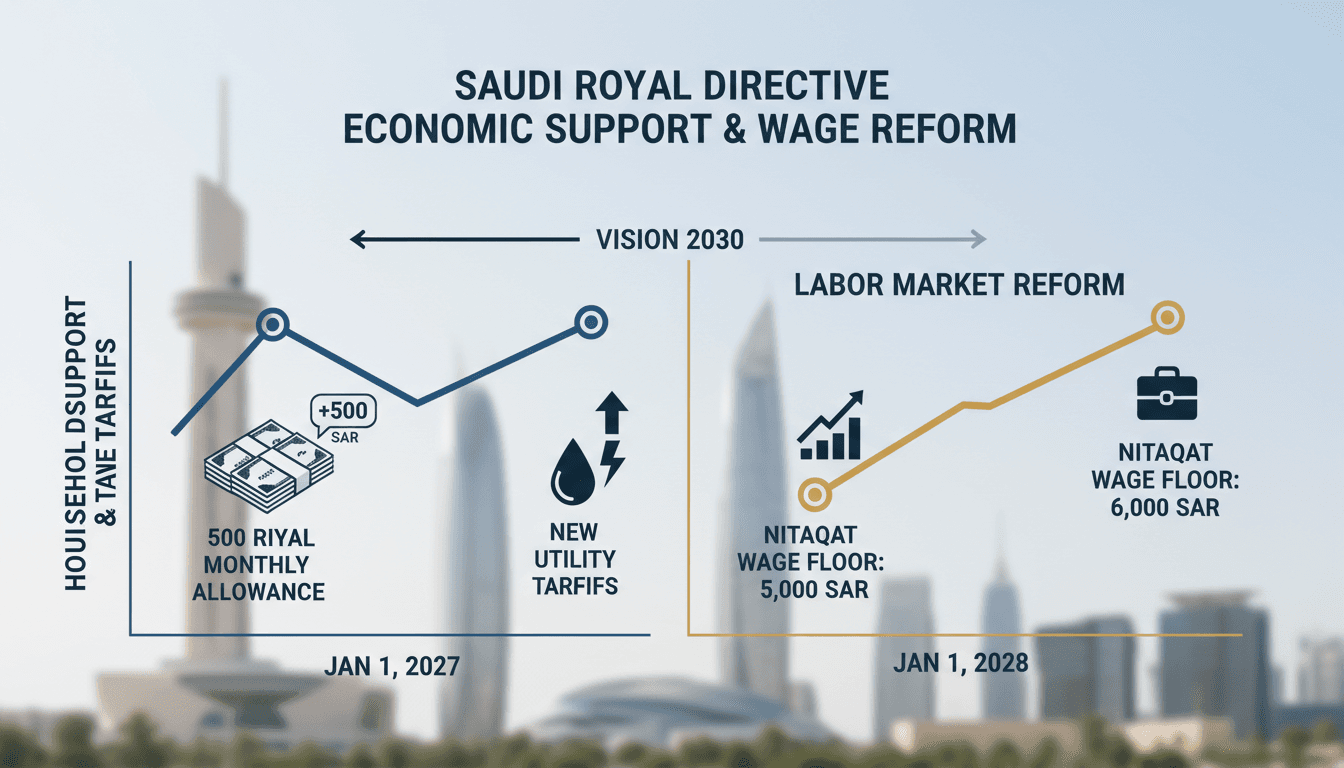
- Royal directive issues income support: On October 25, 2026, King Salman bin Abdulaziz announced a direct monthly allowance of 500 Saudi riyals for specified categories of public-sector employees, retirees, social insurance beneficiaries, and social security families starting January 1, 2027.
- Nitaqat salary floors schedule phased hikes: The minimum monthly salary required for a private-sector Saudi worker to count as a full unit under the Nitaqat Saudization system will climb to 5,000 riyals after six months, followed by an increase to 6,000 riyals twelve months after that.
- Utility billing structures overhaul fixed rates: Beginning January 1, 2027, the Saudi Energy Company and the National Water Company will alter consumer utility tariffs, replacing standard monthly meter service fees with fixed charges based on electrical circuit breaker capacity and water meter diameter.
The context you actually need
- Tariff reforms shift from consumption-only to capacity models: The restructuring of water and power charges by the Saudi Energy Company and National Water Company introduces physical infrastructure metrics—specifically breaker amperage and pipe diameter—into monthly service bills, altering baselines across residential and commercial connections.
- Nitaqat thresholds serve as market wage determinants: In Saudi Arabia's labor market framework, private-sector firms must maintain statutory nationalization quotas; altering the salary baseline required for a national employee to count as a full worker effectively sets an institutional wage floor across private enterprises.
- Coordinated fiscal buffering mitigates cost adjustments: The 500 riyal monthly cash transfer operates alongside scheduled resource adjustments, insulating state employees and lower-income households from anticipated increments in household operational expenses.
What's really happening
The simultaneous rollout of utility tariff structural changes and the Nitaqat wage adjustment reflects a precise economic realignment designed to modernize public resource consumption without compressing household balance sheets. By restructuring how water and electricity access is billed, state utility providers establish incentives for infrastructure efficiency. Moving from flat meter service fees to tiered fixed charges pegged directly to circuit breaker capacity and water meter diameter penalizes oversized, inefficient utility footprints and incentivizes property-level load optimization.
To balance the domestic financial friction of this utility overhaul, the royal directive introduces an immediate 500 riyal monthly baseline transfer for civil service personnel, military staff on operational program budgets, and welfare recipients. This liquidity injection acts as an economic buffer, shielding targeted domestic populations from recurring infrastructure fee increases.
Concurrently, the policy rebalances private-sector incentives through labor regulations. Rather than allowing the private sector to rely on legacy salary floors, the phased elevation of the Nitaqat wage requirement—from its current level up to 5,000 riyals, and eventually to 6,000 riyals—requires corporate entities to pay higher base compensation if they wish to maintain their regulatory localization ratios. This two-step escalation gives commercial operators an explicit timeline to restructure operational models, evaluate headcount productivity, and adjust their human capital budgets.
For enterprise operators in the Kingdom, the incentive structure is clear: regulatory compliance cannot be purchased through low-tier nominal wages. Because full credit under the Nitaqat system requires meeting the elevated wage thresholds, organizations facing tight quota compliance must allocate additional balance-sheet reserves to payroll or risk falling into non-compliant hiring bands. Rather than funding this private-sector labor transition through ongoing public-sector absorption, the regulatory design uses labor compliance mandates to push wage growth onto enterprise operating budgets.
This approach creates a synchronized economic shift: households receive targeted financial support against resource pricing updates, utilities rationalize recurring revenue against physical capacity footprints, and private employers assume the cost of upgrading local compensation levels to align with national workforce integration targets.
Who feels it first (and how)
- Private-sector corporate payroll managers: Human resources and finance leads across commercial sectors must budget for phased increases in minimum salary requirements to 5,000 riyals and subsequently 6,000 riyals to retain full Nitaqat compliance ratios for Saudi team members.
- Public-sector personnel and social security households: State civil and military employees, retirees, and registered welfare recipients receive direct liquidity injections via the monthly 500 riyal allowance starting January 1, 2027.
- Facility and property managers in Saudi Arabia: Real estate operators and asset owners face restructured monthly fixed utility tariffs based on circuit breaker amperage and water pipe diameter, requiring reviews of facility power specifications and utility intake systems.
- Regional Gulf entities outside the Kingdom: Regional hubs like Dubai experience no direct regulatory or administrative impact, as the policy applies strictly within Saudi borders.
What to watch next
- Corporate contract and compensation reviews: Monitor how mid-market and services-sector firms revise entry-level national employment contracts across late 2026 and early 2027 to prepare for the 5,000 riyal and 6,000 riyal Nitaqat deadlines.
- Utility bill restructuring breakdowns: Watch for detailed technical schedules from the Saudi Energy Company and National Water Company specifying exact recurring cost tiers per circuit breaker capacity and meter diameter before January 1, 2027.
- Private-sector Saudization retention data: Track labor data following the enforcement of the 6,000 riyal threshold to gauge whether companies adjust overall national headcount or elevate operational productivity to offset higher required salaries.
The 500 riyal monthly citizen allowance begins January 1, 2027; utility tariff structures shift to breaker-capacity and meter-diameter models on the same date; Nitaqat minimum full-counting thresholds rise to 5,000 riyals six months post-implementation and to 6,000 riyals twelve months later.
Private-sector employers operating on thin margins will accelerate automation or streamline lower-productivity roles to handle the required baseline salary increases for national employees.
The exact net household impact across varying residential income brackets once the new breaker and pipe diameter billing formulas are implemented alongside the 500 riyal allowance.
Frequently Asked Questions
- Why it matters?
- The policy coordinates domestic social transfers with structural utility pricing reforms and higher Saudization wage benchmarks, forcing private-sector employers to absorb higher labor costs while household safety nets absorb updated municipal utility tariffs.
- What happened (in 30 seconds)?
- Royal directive issues income support: On October 25, 2026, King Salman bin Abdulaziz announced a direct monthly allowance of 500 Saudi riyals for specified categories of public-sector employees, retirees, social insurance beneficiaries, and social security families starting January 1, 2027. Nitaqat salary floors schedule phased hikes: The minimum monthly salary required for a private-sector Saudi worker to count as a full unit under the Nitaqat Saudization system will climb to 5,000 riyals afte
- What's really happening?
- The simultaneous rollout of utility tariff structural changes and the Nitaqat wage adjustment reflects a precise economic realignment designed to modernize public resource consumption without compressing household balance sheets. By restructuring how water and electricity access is billed, state utility providers establish incentives for infrastructure efficiency. Moving from flat meter service fees to tiered fixed charges pegged directly to circuit breaker capacity and water meter diameter pena
- Who feels it first (and how)?
- Private-sector corporate payroll managers: Human resources and finance leads across commercial sectors must budget for phased increases in minimum salary requirements to 5,000 riyals and subsequently 6,000 riyals to retain full Nitaqat compliance ratios for Saudi team members. Public-sector personnel and social security households: State civil and military employees, retirees, and registered welfare recipients receive direct liquidity injections via the monthly 500 riyal allowance starting Janua
- What to watch next?
- Corporate contract and compensation reviews: Monitor how mid-market and services-sector firms revise entry-level national employment contracts across late 2026 and early 2027 to prepare for the 5,000 riyal and 6,000 riyal Nitaqat deadlines. Utility bill restructuring breakdowns: Watch for detailed technical schedules from the Saudi Energy Company and National Water Company specifying exact recurring cost tiers per circuit breaker capacity and meter diameter before January 1, 2027. Private-sector
Arabic-language coverage of Saudi, regional, and international affairs.
"Al Bilad offers mainstream Saudi newspaper coverage across domestic and broader Arab topics."
— A47 Editor
بناءً على ما عرضه ولي العهد.. خادم الحرمين يوجه ببدل شهري 500 ريال ورفع الحد الأدنى لـ”نطاقات” إلى 5 آلاف بدءاً من 1 يناير 2027
King Salman bin Abdulaziz, custodian of the two holy mosques, has directed a set of support measures for citizens, based on a proposal presented by Crown Prince and Prime Minister Mohammed bin Salman bin Abdulaziz, including a monthly allowance of 50...
UAE-based English-language newspaper covering regional politics, economics, and global affairs.
"The National reflects Emirati policy perspectives while maintaining international editorial standards."
— A47 Editor
Saudi Arabia announces support measures as electricity and water tariffs rise
Saudi Arabia has announced support measures as electricity and water tariffs rise, with the adjustments set to take effect on January 1, 2027. The move follows a directive from King Salman, under which eligible employees are to receive a monthly SR50...
English-language reporting on Saudi politics, policy, and society.
"Saudi Gazette reflects mainstream Saudi institutional perspectives."
— A47 Editor
King Salman orders SR5,000 minimum wage under Nitaqat
King Salman has ordered a monthly allowance of SR500 for Saudi employees to help them cope with adjustments to electricity and water consumption tariffs, which take effect January 1, 2027. The measures, issued in line with a recommendation from Crown...
English-language reporting focused on Saudi Arabia and regional affairs.
"Saudi Gazette provides English-language coverage that often aligns with mainstream Saudi news priorities."
— A47 Editor
King Salman orders SR500 allowance increase, raises minimum wage
King Salman has ordered a SR500 monthly increase in allowances for eligible civilian and military employees, retirees, and families under the Social Insurance Law, alongside higher Saudization wage thresholds under the Nitaqat program, with the measu...