
Dutch TTF Gas Benchmark Hits Four-Year High at 97 Euros per MWh on Low Storage and Gulf LNG Disruption
Why it matters
The convergence of sub-75% regional inventory cushions, early cold-weather withdrawals, and restricted transit across key maritime corridors has pushed European natural gas benchmarks to four-year highs, setting up cross-continental cargo competition and elevated input inflation.
What happened (in 30 seconds)
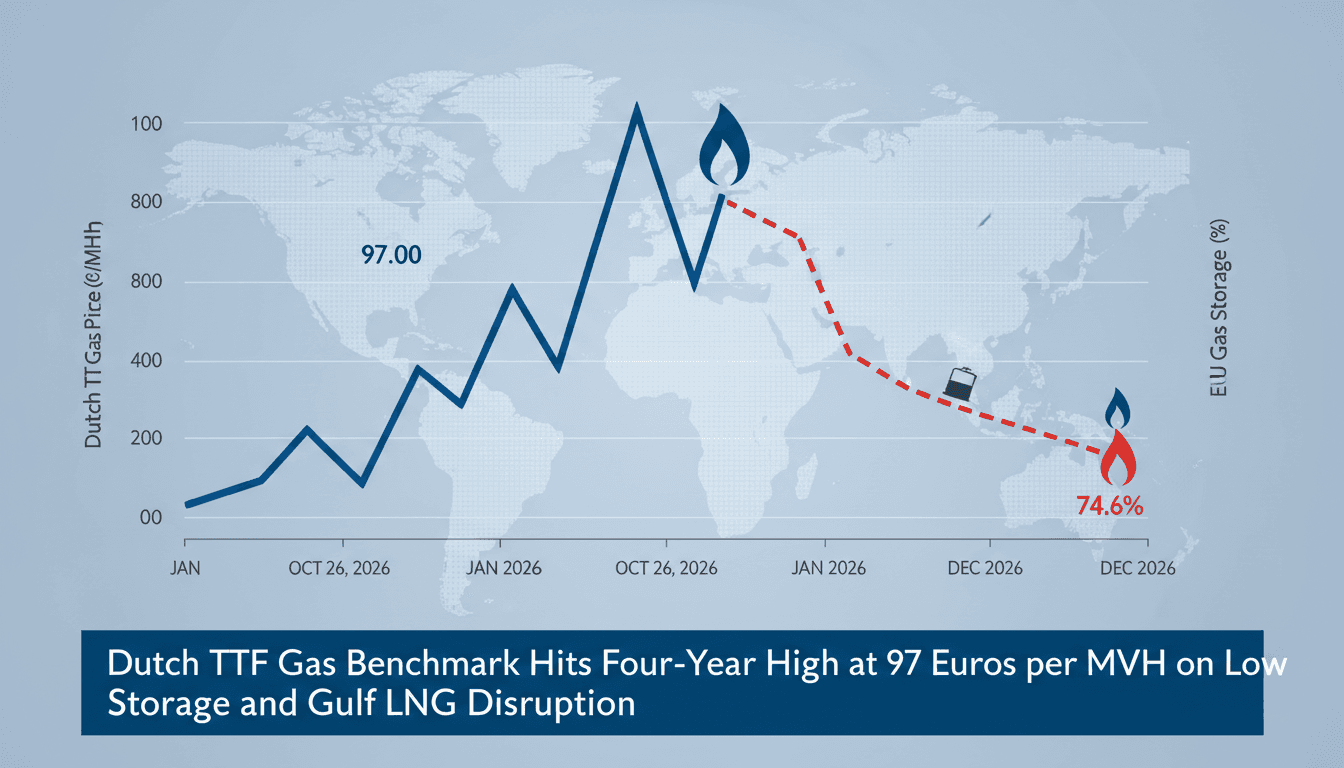
- Prices pierced four-year highs: The Dutch Title Transfer Facility (TTF) front-month benchmark traded briefly past 97.50 euros per megawatt-hour on October 26, 2026, before holding around 96.63 euros—its highest level since December 2022.
- Inventories began depleting early: European gas storage stood at approximately 74.6% to 75% capacity—the lowest seasonal level recorded in over a decade—as dropping temperatures prompted unseasonably early withdrawals.
- Power markets registered immediate contagion: French baseload power contracts for future delivery tracked natural gas higher, climbing past 200 euros per megawatt-hour.
The context you actually need
- The Strait of Hormuz bottleneck: Escalating conflict involving Iran, the United States, and Israel since late February 2026 disrupted commercial traffic through the Persian Gulf, a conduit responsible for roughly 20% of global liquefied natural gas (LNG) export volumes.
- Thin summer replenishment cushions: Europe entered the heating season structurally vulnerable after elevated summer power consumption and tighter global supplies prevented operators from refilling underground storage to historic seasonal norms.
- Competition for flexible seaborne cargoes: With pipeline alternatives from Russia largely constrained compared to pre-2022 norms, European buyers must actively outbid Asian utilities on spot markets to secure uncommitted Atlantic and Middle Eastern LNG vessels.
What's really happening
The price surge on October 26, 2026, is not an isolated market spike; it represents the structural fragility of an energy ecosystem running with diminished physical buffers. When the Dutch TTF front-month contract cleared 97 euros per megawatt-hour, it marked a cumulative 7% gain over five trading days, driven by three interlocking supply-and-demand mechanics.
First, the baseline arithmetic of European gas storage has shifted from a cushion to a risk multiplier. Typically, European utilities target storage levels near 90% or higher heading into November. Entering late October at 74.6% to 75% full means member states have roughly 15 percentage points less operating margin to absorb prolonged cold spells. Because withdrawals started ahead of schedule due to early sub-seasonal temperatures, traders are discounting the probability that storage can last through February without aggressive industrial demand curtailments or premium spot imports.
Second, the structural disruption of Persian Gulf LNG exports removes swing capacity from the international market. The Strait of Hormuz carries roughly one-fifth of the world’s seaborne LNG, primarily originating from Qatar and neighboring Gulf producers. Sustained military actions and strikes involving Iran have raised maritime risk profiles, restricted vessel movement, and stranded export volumes. In a balanced market, Atlantic basin shipments can compensate for regional shortfalls; in a tight market, Asian utilities facing their own winter load requirements compete dollar-for-dollar against European utilities. This dynamic forces TTF to price at a premium high enough to redirect spot vessels away from Pacific terminals.
Third, the downstream price transmission into power markets is immediate. European wholesale power pricing is fundamentally set by the marginal cost of generation. Because combined-cycle natural gas turbines regularly set the clearing price during peak hours, the Dutch TTF move directly propelled French power futures past 200 euros per megawatt-hour.
For commercial operators, this translates into immediate cost recalculations: industrial producers relying on electricity or thermal processing must absorb these rates or reduce production run-rates, while trade intermediaries face expanding margin requirements to finance fuel inventories.
Who feels it first (and how)
- European energy-intensive manufacturers: Chemical producers, glassmakers, and fertilizer plants in Western Europe encounter operating cost inflation as gas inputs approach 100 euros per megawatt-hour.
- Global logistics and cargo brokers: Intermediaries chartering vessels through Middle East corridors face higher war-risk insurance premiums, compounding the landed price of LNG.
- Multinational corporate finance desks: Treasury teams managing European subsidiaries face higher utility hedging requirements and widening working-capital requirements to maintain wholesale procurement.
- Dubai and Gulf-based import businesses: Companies importing European finished goods experience secondary price pressures as production surcharges take effect, even as the regional upstream hydrocarbon base shields domestic energy utilities from direct fuel shortages.
What to watch next
- European net withdrawal rates: Track Gas Infrastructure Europe data for daily drawdowns relative to seasonal injection averages; daily net withdrawals exceeding 0.5% of total capacity will accelerate TTF volatility.
- Middle East shipping transit metrics: Monitor commercial tanker passages through the Strait of Hormuz, as any sustained reduction below 80% of normal traffic maintains a structural floor under global spot LNG premiums.
- Asian benchmark spreads (JKM vs. TTF): Watch whether Asian LNG benchmarks trade at a widened premium over European contracts, signaling whether Pacific buyers will actively pull remaining uncontracted cargoes away from European receiving terminals.
Dutch TTF traded above 97 euros per megawatt-hour on October 26, 2026; European gas inventories stand between 74.6% and 75% capacity; French power futures have crossed 200 euros per megawatt-hour; Persian Gulf supply routes through the Strait of Hormuz remain severely curtailed.
European governments will reassess industrial demand-management protocols if early winter weather remains colder than historical averages throughout November.
Whether maritime security corridors can restore normal Gulf tanker flow rates before European storage declines below critical operating thresholds in late winter.
Frequently Asked Questions
- Why it matters?
- The convergence of sub-75% regional inventory cushions, early cold-weather withdrawals, and restricted transit across key maritime corridors has pushed European natural gas benchmarks to four-year highs, setting up cross-continental cargo competition and elevated input inflation.
- What happened (in 30 seconds)?
- Prices pierced four-year highs: The Dutch Title Transfer Facility (TTF) front-month benchmark traded briefly past 97.50 euros per megawatt-hour on October 26, 2026, before holding around 96.63 euros—its highest level since December 2022. Inventories began depleting early: European gas storage stood at approximately 74.6% to 75% capacity—the lowest seasonal level recorded in over a decade—as dropping temperatures prompted unseasonably early withdrawals. Power markets registered immediate contagio
- What's really happening?
- The price surge on October 26, 2026, is not an isolated market spike; it represents the structural fragility of an energy ecosystem running with diminished physical buffers. When the Dutch TTF front-month contract cleared 97 euros per megawatt-hour, it marked a cumulative 7% gain over five trading days, driven by three interlocking supply-and-demand mechanics. First, the baseline arithmetic of European gas storage has shifted from a cushion to a risk multiplier. Typically, European utilities ta
- Who feels it first (and how)?
- European energy-intensive manufacturers: Chemical producers, glassmakers, and fertilizer plants in Western Europe encounter operating cost inflation as gas inputs approach 100 euros per megawatt-hour. Global logistics and cargo brokers: Intermediaries chartering vessels through Middle East corridors face higher war-risk insurance premiums, compounding the landed price of LNG. Multinational corporate finance desks: Treasury teams managing European subsidiaries face higher utility hedging requirem
- What to watch next?
- European net withdrawal rates: Track Gas Infrastructure Europe data for daily drawdowns relative to seasonal injection averages; daily net withdrawals exceeding 0.5% of total capacity will accelerate TTF volatility. Middle East shipping transit metrics: Monitor commercial tanker passages through the Strait of Hormuz, as any sustained reduction below 80% of normal traffic maintains a structural floor under global spot LNG premiums. Asian benchmark spreads (JKM vs. TTF): Watch whether Asian LNG be
Markets desk coverage, trading insights, and investor updates.
"WSJ’s markets reporting provides in-depth analysis and context for investors."
— A47 Editor
European Gas at Four-Year High on Winter Supply Fears
European natural-gas prices rose above €97 per megawatt-hour for the first time since late 2022, as colder weather threatens higher heating demand across the continent while the Iran war continues to disrupt global gas supplies.
UK and international business news, economics, and corporate coverage.
"The Guardian’s business section covers finance and markets with a progressive editorial tone."
— A47 Editor
European gas prices soar to four-year high over winter supply fears
European wholesale gas prices jumped to €97 (£81) per megawatt-hour on Monday, their highest level since 2022, as temperatures fell across Europe and traders priced in stronger winter heating demand. The rally was fuelled by fears of further Middle E...
International coverage from The Guardian's global desks.
"The Guardian is known for its progressive editorial stance and in-depth analysis."
— A47 Editor
European gas prices soar to four-year high over winter supply fears
European wholesale gas prices jumped to €97 (£81) per megawatt-hour on Monday, their highest level since 2022, as falling temperatures across Europe raised expectations of stronger heating demand and fears grew over winter supply amid Middle East ten...
Oil, metals, and agriculture: supply/demand headlines, OPEC chatter, inventories, and price action.
"Solid tape for energy and metals traders tracking macro and micro catalysts."
— A47 Editor
European gas surges to fresh 2022 highs on Middle East war strain
European gas prices surged to fresh 2022 highs as strain from the Middle East war pushed the benchmark higher, according to Investing.com. The base report ties the rally to escalating regional hostilities that have raised fears of supply disruption i...