
Saudi Arabia Raises Nitaqat Saudi Wage Threshold to SR5,000 in 2027 and SR6,000 in 2028
Why it matters
The regulatory floor for full nationalisation credits is rising to SR6,000, resetting the financial calculus between expatriate hiring overheads and national workforce retention across Saudi private enterprises.
What happened (in 30 seconds)
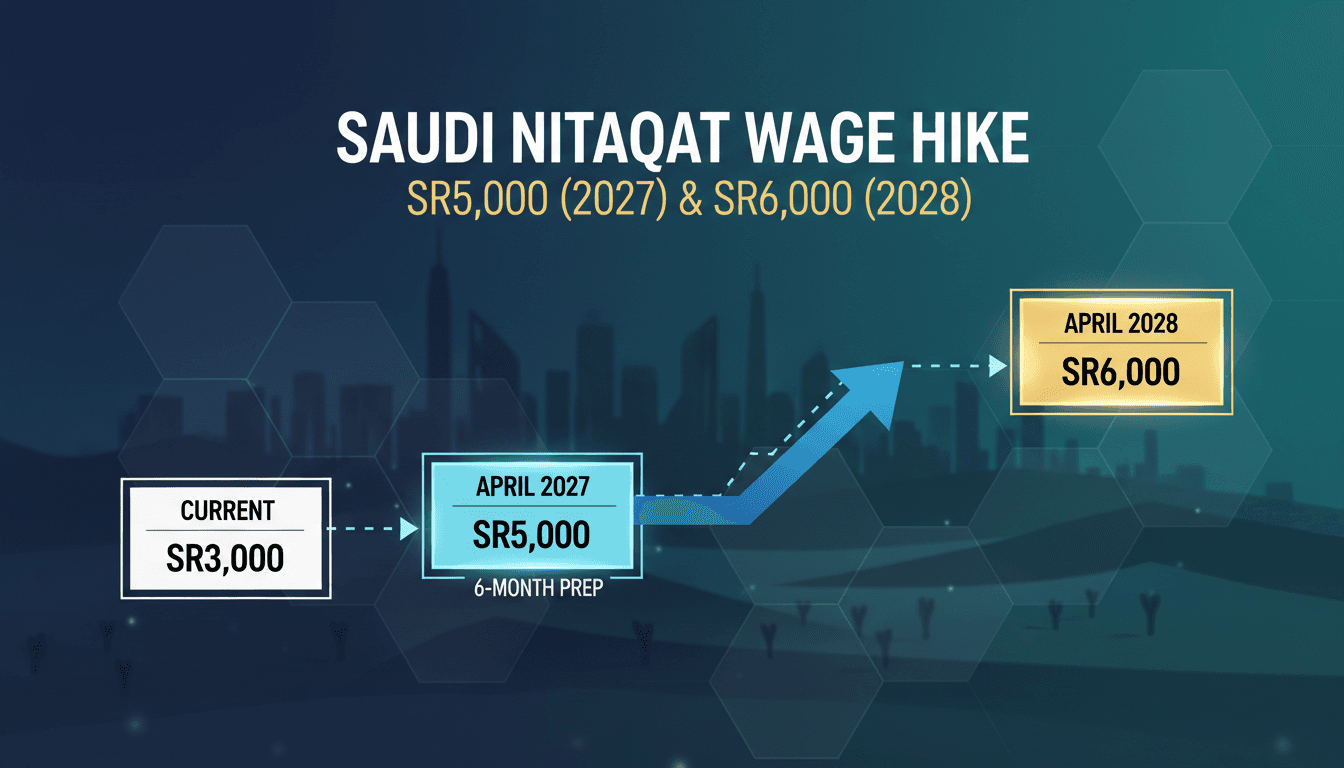
- A two-phase threshold hike: The Ministry of Human Resources and Social Development announced on October 25, 2026, that the monthly salary required for a Saudi employee to count fully toward Nitaqat quotas will rise to SR5,000 on April 25, 2027, and to SR6,000 on April 25, 2028.
- No statutory mandate on existing base pay: Regulators clarified that employers are not legally forced to raise current worker wages; rather, paying below the target levels reduces the proportionate credit an employee contributes toward an establishment's mandatory Saudisation ratio.
- Five employment categories included: The updated threshold framework applies across full-time staff, part-time personnel, flexible contract arrangements, working students, and capable persons with disabilities.
The context you actually need
- Evolution of the Nitaqat framework: Saudi Arabia's long-running quota system rates private firms on their proportion of national workers versus expatriates, using these tiers to govern commercial visa allocations, hiring permits, and operational standing.
- Alignment with Vision 2030 targets: The phased threshold adjustment coincides with wider structural economic programs designed to shift local participation away from low-wage administrative roles and toward higher-productivity, sustainable career paths.
- Parallel cost adjustments: The labor policy announcement arrived alongside domestic utility tariff revisions taking effect in January 2027, accompanied by an SR500 monthly allowance increase for eligible citizens to offset living costs.
What's really happening
The policy alters the private sector's compliance incentives by recalibrating the price of full Saudisation points. Under the Nitaqat system, private companies must maintain specific nationalisation percentages to preserve access to foreign work visas, permit renewals, and government contracting rights. Historically, some enterprises satisfied these quotas by registering national staff at lower wage bands. By establishing a phased escalator—moving first to SR5,000 in April 2027 and culminating at SR6,000 in April 2028—the Ministry of Human Resources and Social Development effectively changes the operational math behind quota maintenance.
Because the regulation explicitly states that employers do not face an immediate legal mandate to raise existing base salaries, corporate leadership faces a strategic decision. An enterprise can choose to maintain an employee's salary below the new threshold, but doing so dilutes that worker's weight in the company’s Nitaqat score. To retain a favorable tier and protect their visa pipeline, employers must either absorb higher payroll lines by bringing Saudi salaries up to the target levels, or expand the gross volume of national hires to compensate for fractional accounting.
This phased timeline provides corporate planners with a distinct runway. The six-month gap preceding the April 2027 implementation date, followed by an additional 12-month interval before the SR6,000 rate activates, aims to avert acute operational friction. Instead of absorbing a sharp single-date expenditure shock, human resource departments and chief financial officers are given structured room to reallocate headcount allowances, restructure roles, and phase out marginal positions.
At the macro level, this mechanism works directly on productivity incentives. When the regulatory price floor of national labor increases, firms are less incentivized to allocate national workers to non-essential functions purely for compliance. Instead, capital allocation shifts toward upskilling and embedding national staff in core operations where an SR6,000 compensation floor aligns with commercial value generation. The simultaneous introduction of utility tariff shifts in 2027 and accompanying SR500 income support measures illustrates a coordinated effort: local purchasing capacity is protected while the private market is incentivized to sustain professional baseline wages.
For regional operators tracking the Gulf Cooperation Council, this policy also subtly recalibrates labor market dynamics. While the immediate operational footprint rests inside the Kingdom, the widening wage floor alters the economic considerations for Saudi talent evaluating regional versus domestic roles, reinforcing the retention of skilled nationals within the domestic private sector.
Who feels it first (and how)
- Private-sector HR and finance directors in Saudi Arabia: Must recalculate multi-year compensation models, deciding whether to increase individual pay to meet the SR5,000 and SR6,000 floors or recruit additional headcount to preserve Nitaqat rating tiers.
- Saudi national employees in entry-level and flexible roles: Stand to see upward pressure on base entry compensation or increased formal training opportunities as employers adjust job scopes to match higher compliance spending.
- SMEs and margin-sensitive contractors: Face tighter capital allocation choices between higher direct payroll costs for national staff and potential compliance downgrades that restrict foreign visa allocations.
- Regional business hubs like Dubai: Experience secondary labor pool effects, as higher structural baseline salaries inside Saudi Arabia influence cross-border talent retention and the comparative attractiveness of regional relocations.
What to watch next
- Corporate budget cycles for 2027: Track how publicly listed and large private Saudi enterprises adjust their general and administrative expenditure forecasts during late-2026 planning to absorb the initial SR5,000 threshold.
- Nitaqat band movements post-April 2027: Observe whether overall private-sector compliance rates adjust smoothly or if specific industries face temporary quota downgrades following the implementation of fractional crediting.
- Cross-border Gulf talent movement: Monitor whether higher domestic baseline compensation alters the volume of mid-tier Saudi professionals seeking entry or intermediate roles in external GCC markets.
The Nitaqat wage threshold rises to SR5,000 on April 25, 2027, and to SR6,000 on April 25, 2028; employers are not legally obligated to raise salaries for staff who do not require full Nitaqat calculation; five specific worker classifications are governed by the rule.
Mid-sized and large enterprises will normalize entry-level national salaries upward to SR5,000 and SR6,000 to maintain uninterrupted access to expatriate work visas and public procurement privileges.
The exact magnitude of the operational cost burden on margin-compressed industries, and whether fractional compliance formulas will result in net workforce expansion or role consolidation.
Frequently Asked Questions
- Why it matters?
- The regulatory floor for full nationalisation credits is rising to SR6,000, resetting the financial calculus between expatriate hiring overheads and national workforce retention across Saudi private enterprises.
- What happened (in 30 seconds)?
- A two-phase threshold hike: The Ministry of Human Resources and Social Development announced on October 25, 2026, that the monthly salary required for a Saudi employee to count fully toward Nitaqat quotas will rise to SR5,000 on April 25, 2027, and to SR6,000 on April 25, 2028. No statutory mandate on existing base pay: Regulators clarified that employers are not legally forced to raise current worker wages; rather, paying below the target levels reduces the proportionate credit an employee cont
- What's really happening?
- The policy alters the private sector's compliance incentives by recalibrating the price of full Saudisation points. Under the Nitaqat system, private companies must maintain specific nationalisation percentages to preserve access to foreign work visas, permit renewals, and government contracting rights. Historically, some enterprises satisfied these quotas by registering national staff at lower wage bands. By establishing a phased escalator—moving first to SR5,000 in April 2027 and culminating a
- Who feels it first (and how)?
- Private-sector HR and finance directors in Saudi Arabia: Must recalculate multi-year compensation models, deciding whether to increase individual pay to meet the SR5,000 and SR6,000 floors or recruit additional headcount to preserve Nitaqat rating tiers. Saudi national employees in entry-level and flexible roles: Stand to see upward pressure on base entry compensation or increased formal training opportunities as employers adjust job scopes to match higher compliance spending. SMEs and margin-se
- What to watch next?
- Corporate budget cycles for 2027: Track how publicly listed and large private Saudi enterprises adjust their general and administrative expenditure forecasts during late-2026 planning to absorb the initial SR5,000 threshold. Nitaqat band movements post-April 2027: Observe whether overall private-sector compliance rates adjust smoothly or if specific industries face temporary quota downgrades following the implementation of fractional crediting. Cross-border Gulf talent movement: Monitor whether
UAE-based newspaper covering Gulf politics, society, and international developments.
"Gulf News is one of the UAE’s most prominent English-language publications."
— A47 Editor
Saudi Arabia raises minimum wage thresholds to SR5,000 in 2027 and SR6,000 in 2028
Saudi Arabia's Ministry of Human Resources and Social Development announced that the minimum monthly wage for Saudi private-sector employees counting as full-time under the Nitaqat Saudization program will rise to SR5,000 from April 25, 2027, and to ...
A curated Gulf News feed featuring major stories across news, business, opinion, and lifestyle.
"Gulf News is a major UAE newspaper whose featured stories feed reflects a broad editorial mix shaped for a Gulf audience."
— A47 Editor
Saudi Arabia raises minimum wage thresholds to SR5,000 in 2027 and SR6,000 in 2028
Saudi Arabia's Ministry of Human Resources and Social Development announced that the minimum monthly wage for Saudi private-sector employees counting as full-time under the Nitaqat Saudization program will rise to SR5,000 from April 25, 2027, and to ...
English-language reporting on Saudi politics, policy, and society.
"Saudi Gazette reflects mainstream Saudi institutional perspectives."
— A47 Editor
Saudi Arabia to raise minimum wage threshold to SR5,000 in April 2027, and SR6,000 in April, 2028
Saudi Arabia's Ministry of Human Resources and Social Development announced that the minimum monthly wage for Saudi private-sector employees to count as full-time under the Nitaqat Saudization program will rise to SR5,000 from April 25, 2027, and to ...
English-language reporting focused on Saudi Arabia and regional affairs.
"Saudi Gazette provides English-language coverage that often aligns with mainstream Saudi news priorities."
— A47 Editor
Saudi Arabia to raise minimum wage threshold to SR5,000 in April 2027, and SR6,000 in April, 2028
Saudi Arabia's Ministry of Human Resources and Social Development announced that the minimum monthly wage for Saudi private-sector employees to count as full-time under the Nitaqat Saudization program will rise to SR5,000 from April 25, 2027, and to ...
English-language reporting on Saudi politics, policy, and society.
"Saudi Gazette reflects mainstream Saudi institutional perspectives."
— A47 Editor
King Salman orders SR500 allowance increase, raises minimum wage
King Salman has ordered a SR500 monthly allowance increase for eligible civilian and military employees, retirees, and families under the Social Insurance Law, alongside higher wage thresholds for Saudi employees under the Nitaqat Saudization program...
English-language reporting focused on Saudi Arabia and regional affairs.
"Saudi Gazette provides English-language coverage that often aligns with mainstream Saudi news priorities."
— A47 Editor
King Salman orders SR500 allowance increase, raises minimum wage
King Salman has ordered a SR500 monthly increase in allowances for eligible civilian and military employees, retirees, and families under the Social Insurance Law, alongside higher Saudization wage thresholds under the Nitaqat program, with the measu...