
UK Chancellor Healey Unveils Cautious October 2026 Budget Centred on Energy Bill Relief and Delinking Reform
Why it matters
By re-engineering retail utility billing rather than deploying direct public borrowing, the UK Treasury is attempting to shield consumers from geopolitical energy inflation without triggering sovereign debt volatility.
What happened (in 30 seconds)
* Chancellor John Healey delivered his first Autumn Budget on October 28, 2026, under Prime Minister Andy Burnham, prioritizing retail energy relief within a cautious "do no harm" fiscal approach. * The Treasury eliminated gas standing charges, delivering an estimated £22 to £50 in annual savings per household, while extending electricity VAT cuts and introducing a levy control framework to transfer green surcharges to general taxation. * Major fiscal overhauls were postponed, with Healey freezing fuel duty and deferring large-scale tax and spending revisions for defense, welfare, and social care until 2027 to protect sovereign borrowing limits.
The context you actually need
* External supply pressures drove retail utility increases, with geopolitical instability linked to the Iran conflict lifting average UK domestic bills by 4% to approximately £1,723 annually in late 2026. * Fiscal constraints sharply limited public intervention, leaving the Treasury with minimal fiscal headroom under self-imposed borrowing rules and high debt-servicing costs. * Structural reform debates reached a tipping point, as energy regulator Ofgem and domestic leadership targeted fixed daily utility fees and the pricing mechanism that links wholesale electricity rates to marginal natural gas generation.
What's really happening
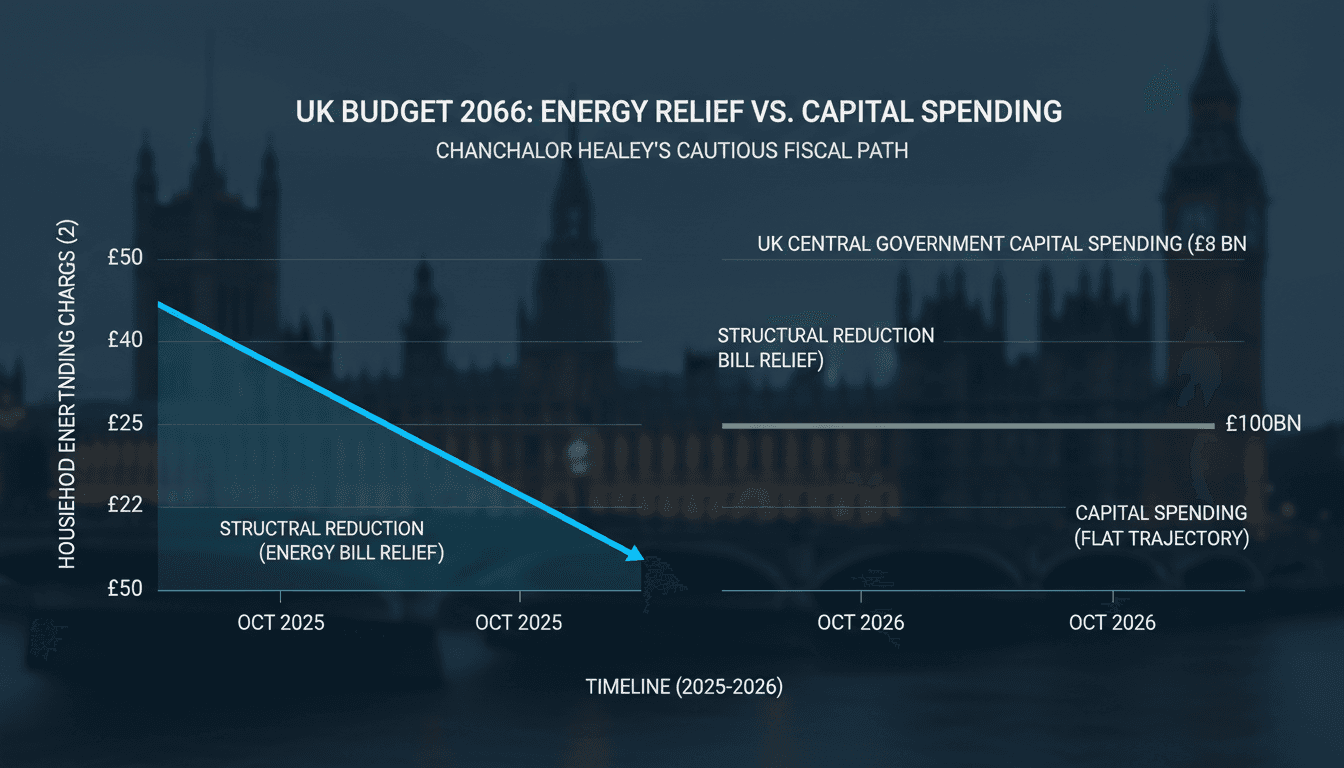
The Treasury's maneuver addresses a persistent structural flaw in UK utility design: fixed costs penalizing low-consumption users and volatile fossil fuel prices dictating renewable electricity costs. Rather than deploying capital subsidies through expanded government borrowing, Chancellor John Healey restructured the consumer billing architecture. Scrapping gas standing charges reduces non-discretionary baseline costs by £22 to £50 annually per household. This policy change directly reduces retail exposure without requiring an injection of unfunded public capital into energy markets.
Simultaneously, establishing a Treasury-led levy control framework shifts environmental and social policy costs off retail utility bills and into general taxation. Historically, green levies functioned as a regressive flat tax collected via kilowatt-hour consumption. Transferring these obligations to central government receipts removes an operational drag on household balance sheets, though it steadily increases demands on the central exchequer. To prevent market friction during an inflationary period shaped by the Iran conflict, the Chancellor kept broader balance sheet interventions minimal, preserving debt headroom and avoiding market volatility across domestic bond markets.
The decision to freeze fuel duty while avoiding major structural overhauls in social care, welfare, and defense demonstrates a targeted operational trade-off. The Burnham administration aims to engineer household "breathing space" while containing sovereign gilt yields. Long-term reform is oriented around delinking gas and power prices over time. Because marginal pricing models price all electricity at the rate of the most expensive generator required to meet demand—typically combined-cycle gas turbines—consumers fail to capture the low marginal costs of domestic renewable generation.
By prioritizing energy market delinking and bill restructuring over direct fiscal outlays, the UK government is attempting to stabilize domestic inflation expectations. The policy avoids broad structural tax adjustments until 2027, accepting an interim plateau in public service funding in exchange for macro stability and low bond market volatility.
Who feels it first (and how)
* UK Households and Energy Consumers: Experience immediate non-discretionary savings between £22 and £50 annually through the removal of fixed gas standing charges, alongside reduced electricity rates via extended VAT cuts and winter support for benefit recipients. * Sovereign Debt and Bond Investors: Gain asset stability as the Treasury avoids unfunded fiscal expansion, maintaining low volatility across UK gilts through disciplined expenditure control. * Industrial and Commercial Energy Buyers: Face flat pricing trajectories until the Treasury and Energy Secretary Miatta Fahnbulleh execute the structural delinking of wholesale gas and electricity markets. * Public Sector and Defense Planners: Experience capital allocation delays, operating under current budgetary ceilings while major structural spending decisions remain frozen until the 2027 budget cycle.
What to watch next
* The 2027 Fiscal Review: Tracks whether deferred funding for welfare, social care, and defense resurfaces as direct tax hikes once immediate energy volatility subsides. * Wholesale Market Delinking Progress: Monitors Department for Energy Security and Net Zero legislative timelines to verify how quickly green generation decoupled from gas prices lowers industrial power costs. * Levy Control Balance Sheet Absorption: Observes the scale of environmental program costs moved into central tax receipts and its long-term impact on the Treasury's fiscal headroom.
Gas standing charges are eliminated, providing £22 to £50 in yearly domestic relief; electricity VAT cuts remain extended; major fiscal spending decisions outside energy are deferred until 2027.
Bond markets will maintain stable pricing for UK debt assets in the short term due to the absence of aggressive public borrowing.
Whether market delinking can fully shield UK domestic energy pricing from ongoing international shocks, such as the Iran conflict, without substantial capital spending in 2027.
Frequently Asked Questions
- Why it matters?
- By re-engineering retail utility billing rather than deploying direct public borrowing, the UK Treasury is attempting to shield consumers from geopolitical energy inflation without triggering sovereign debt volatility.
- What happened (in 30 seconds)?
- Chancellor John Healey delivered his first Autumn Budget on October 28, 2026, under Prime Minister Andy Burnham, prioritizing retail energy relief within a cautious "do no harm" fiscal approach. The Treasury eliminated gas standing charges, delivering an estimated £22 to £50 in annual savings per household, while extending electricity VAT cuts and introducing a levy control framework to transfer green surcharges to general taxation. Major fiscal overhauls were postponed, with Healey freezing fue
- What's really happening?
- The Treasury's maneuver addresses a persistent structural flaw in UK utility design: fixed costs penalizing low-consumption users and volatile fossil fuel prices dictating renewable electricity costs. Rather than deploying capital subsidies through expanded government borrowing, Chancellor John Healey restructured the consumer billing architecture. Scrapping gas standing charges reduces non-discretionary baseline costs by £22 to £50 annually per household. This policy change directly reduces ret
- Who feels it first (and how)?
- UK Households and Energy Consumers: Experience immediate non-discretionary savings between £22 and £50 annually through the removal of fixed gas standing charges, alongside reduced electricity rates via extended VAT cuts and winter support for benefit recipients. Sovereign Debt and Bond Investors: Gain asset stability as the Treasury avoids unfunded fiscal expansion, maintaining low volatility across UK gilts through disciplined expenditure control. Industrial and Commercial Energy Buyers: Face
- What to watch next?
- The 2027 Fiscal Review: Tracks whether deferred funding for welfare, social care, and defense resurfaces as direct tax hikes once immediate energy volatility subsides. Wholesale Market Delinking Progress: Monitors Department for Energy Security and Net Zero legislative timelines to verify how quickly green generation decoupled from gas prices lowers industrial power costs. Levy Control Balance Sheet Absorption: Observes the scale of environmental program costs moved into central tax receipts and
Editor-curated FT homepage stories spanning markets, business, world, and opinion.
"The Financial Times is a globally respected business publication with a centrist/center-left tone and strong markets focus."
— A47 Editor
Healey puts UK energy reform at centre of his ‘do no harm’ Budget
Chancellor John Healey has placed UK energy reform at the centre of his first Budget, due to be delivered on October 28, which the Financial Times reports is designed as a 'do no harm' package offering extra support for businesses, entrepreneurs and ...
International coverage from The Guardian's global desks.
"The Guardian is known for its progressive editorial stance and in-depth analysis."
— A47 Editor
Chancellor targets cost of living crisis in budget for a ‘difficult moment’
Chancellor John Healey is set to deliver his first Budget on Wednesday, acknowledging the UK faces a "difficult moment" amid a turbulent global economic backdrop. The Guardian reports he aims to offer households breathing space from rising cost of li...
Political developments, policy debates, elections, and government affairs in the UK.
"BBC News is widely regarded as a reputable international news organization, known for its impartial tone and public service mandate."
— A47 Editor
Chris Mason: Budget needs to go some way towards delivering PM's promises
Chris Mason reports that the forthcoming UK Budget, the first under Chancellor John Healey, is expected to focus on cost of living support, particularly energy bills, and announcements on devolution, with the BBC News analysis suggesting the Budget n...
Political developments, policy debates, elections, and government affairs in the UK.
"BBC News is widely regarded as a reputable international news organization, known for its impartial tone and public service mandate."
— A47 Editor
What do we know about Chancellor John Healey?
Chancellor John Healey, a Labour veteran who previously served as Defence Secretary, is preparing to deliver his first Budget, with the base report from BBC News noting the forthcoming fiscal announcement and the questions surrounding his role.
Corporate news, economic trends, and markets with UK and global scope.
"BBC News is widely regarded as reputable and impartial, with a public service mandate."
— A47 Editor
Minimum wage set to rise but 18-20 year-olds will not get bigger increase
Chancellor John Healey will announce new national minimum wage rates in the Budget, with the rise for 18-20 year-olds smaller than the increase for older workers, alongside measures to help households with the cost of living.
United Kingdom-focused news including local politics, business, and social issues.
"BBC News is widely regarded as a reputable international news organization, known for its impartial tone and public service mandate."
— A47 Editor
Minimum wage set to rise but 18-20 year-olds will not get bigger increase
Chancellor John Healey will announce new national minimum wage rates in the Budget, with the rise for 18-20 year-olds smaller than the increase for older workers, alongside measures to help households with the cost of living.
Practical investing ideas, macro commentary, and market strategy.
"MoneyWeek is a UK-based investment magazine focused on actionable insights."
— A47 Editor
Autumn Budget live: Will chancellor John Healey raise taxes?
Chancellor John Healey is set to deliver his first Autumn Budget on Wednesday, 28 October, and questions are mounting over whether he will raise taxes; the base coverage frames the outcome as uncertain, with the political and fiscal debate centred on...
UAE-based English-language newspaper covering regional politics, economics, and global affairs.
"The National reflects Emirati policy perspectives while maintaining international editorial standards."
— A47 Editor
Can John Healey conjure a budget to keep investors’ money in Britain?
John Healey, Britain's Chancellor, faces the task of framing a budget that can keep investors' money in the country, according to The National's reporting on the base story. The Chancellor's decision to retain the mansion tax threshold at £2 million,...
Corporate news, economic trends, and markets with UK and global scope.
"BBC News is widely regarded as reputable and impartial, with a public service mandate."
— A47 Editor
Healey's Budget needs to sustain the stronger economy through gathering clouds
The UK economy is currently showing positive momentum, but the Labour government faces more difficult conditions from January, according to the base article. Chancellor John Healey's upcoming Budget must sustain this stronger economy through what the...
Political developments, policy debates, elections, and government affairs in the UK.
"BBC News is widely regarded as a reputable international news organization, known for its impartial tone and public service mandate."
— A47 Editor
Healey's Budget needs to sustain the stronger economy through gathering clouds
The UK economy is currently showing positive momentum, but the Labour government faces more difficult conditions from January, according to the base article. Chancellor John Healey's upcoming Budget must sustain this stronger economy through what the...