
US Gasoline Average Under Trump Second Term Edges Above Biden Era Amid Iran Conflict Supply Disruptions
Why it matters
Sustained disruption across critical shipping corridors demonstrates how geopolitical volatility in energy supply chains swiftly overrides domestic political rhetoric and administrative levers.
What happened (in 30 seconds)
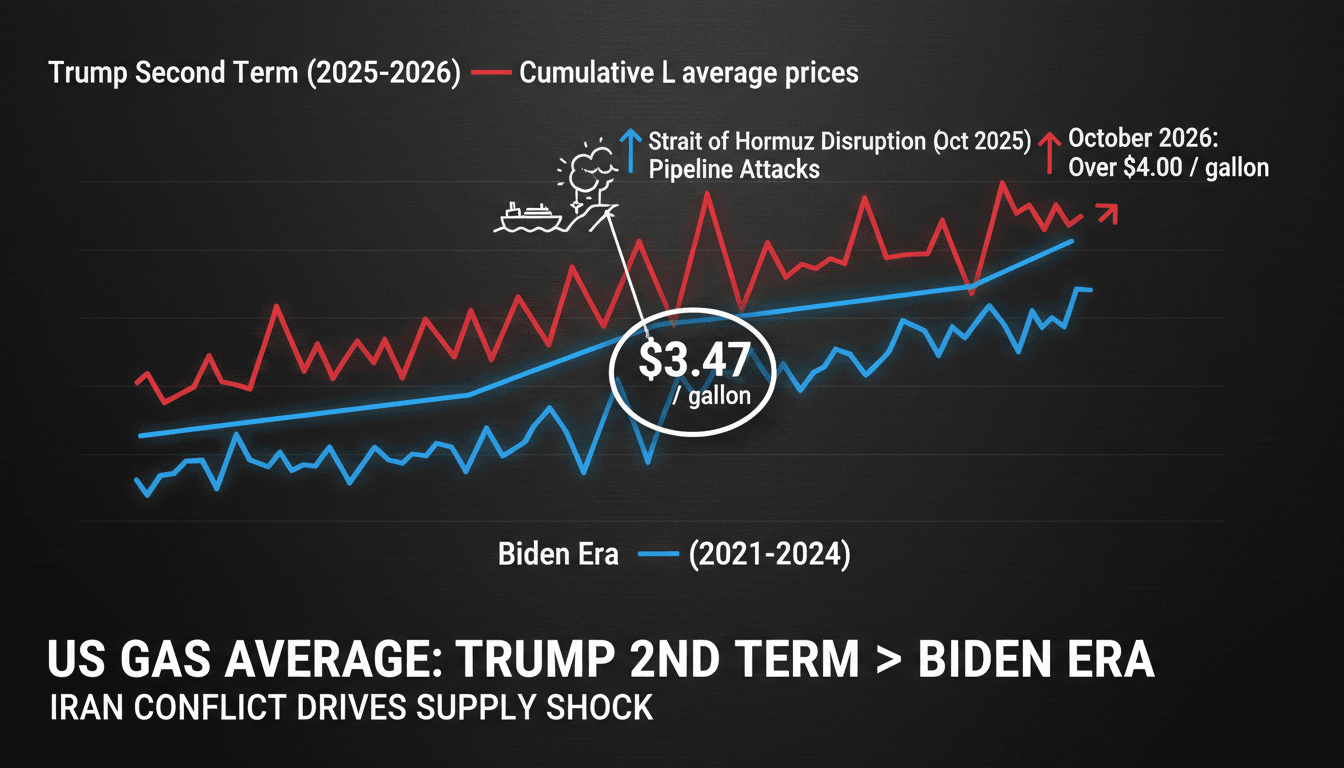
- Cumulative price parity reversed: Data published in late October 2026 shows the cumulative average price for U.S. regular gasoline under President Donald Trump’s second term reached $3.472 per gallon, edging out former President Joe Biden’s full-term average of $3.471 per gallon.
- October broke autumn records: National pump prices surged to $4.36 per gallon, marking the first time October retail fuel averages pushed past the $4 mark and defying typical seasonal post-summer price declines.
- Geopolitical supply shocks drove the spike: The price acceleration stems directly from the ongoing conflict involving Iran, which triggered critical shipping and infrastructure risks around the Strait of Hormuz alongside regional strikes on energy networks.
The context you actually need
- A campaign staple collided with regional conflict: Throughout the 2024 election and early in his second administration, Trump systematically highlighted high gasoline costs as a policy vulnerability of the Biden term, during which prices had eased to roughly $3.10 to $3.12 per gallon before his departure.
- Supply friction compounded globally: The upward trend took hold following the escalation of Middle East hostilities in late February 2026, combining with persistent European disruptions from Russia's war in Ukraine and regional pipeline and maritime vulnerabilities.
- Domestic voters shifted against the outcome: Recent polling reveals a 73% voter disapproval level regarding the handling of retail fuel prices as retail costs maintain elevated levels ahead of midterms.
What's really happening
The shift in retail fuel price averages reveals the strict structural limits of presidential agency over globally integrated commodities. During typical market cycles, autumnal refinery transitions and diminished post-summer driving demand create downward pressure on retail gasoline. In 2026, this seasonal drop failed to materialize entirely. The governing structural mechanism is the physical security of energy transit corridors, primarily the Strait of Hormuz.
Crude oil pricing reflects immediate risk premiums attached to transport continuity. When conflict involves Iran directly, market participants price in potential bottlenecks through the Persian Gulf, a transit chokepoint through which approximately one-fifth of global petroleum consumption flows. The combination of active threats to navigation, insurance rate hikes on maritime logistics, Houthi strikes on Saudi energy infrastructure, and pipeline disruptions effectively neutralizes domestic administrative policy measures.
The structural response from energy markets underscores how global supply systems adapt under stress. Commercial crude flows are attempting structural recalibration rather than relying on short-term political assurances. For instance, Saudi Arabia’s strategic initiatives to position crude reserves in Singapore, coupled with regional security overtures such as Egypt offering defense measures against Houthi threats, illustrate a private and public sector shift toward insulation against maritime bottlenecks.
Domestically, the political calculation has met mathematical reality. While the White House, through spokespersons like Taylor Rogers, points to active U.S. military operations designed to secure Persian Gulf shipping lanes and restore oil flow, military escorting and naval deterrence operate on lag times. They cannot instantaneously undo the pricing mechanisms set by global futures markets.
Furthermore, international crude price appreciation ripples beyond domestic retail pumps into global trade. While consumer impact focuses on the headline figure of $4.36 per gallon, institutional actors must navigate higher base freight, agricultural distribution costs, and industrial inputs. By eclipsing the prior administration's four-year average by a fractional margin—$3.472 versus $3.471—the data demonstrates that energy prices respond far more aggressively to physical shipping disruptions and infrastructure risk than to shifts in executive administration.
Who feels it first (and how)
- Fleet and ground logistics operators: Transportation firms running ground freight face immediate cash-flow compression as diesel and gasoline expenses run well above historical autumn benchmarks.
- Consumer-facing retail and delivery platforms: Businesses reliant on gig-economy drivers and last-mile distribution face margin erosion or must enforce fuel surcharges that test consumer price sensitivity.
- Middle-income and commuting households: Workers in automobile-dependent regions face diminished discretionary budgets, reflected in the 73% disapproval rating on fuel administration.
- Global energy trade hubs: Regional markets, including maritime staging bases in Southeast Asia and shipping routes near the Red Sea, absorb capital shifts as oil producers reposition physical storage assets.
What to watch next
- Strait of Hormuz commercial vessel clearance: Track the volume of daily crude tonnage successfully navigating the strait; sustained maritime flow remains the primary variable required to ease structural supply bottlenecks.
- Midterm polling correlation: Monitor whether retail fuel levels staying above $4 per gallon further suppresses approval ratings for incumbents facing upcoming electoral pressure.
- Strategic reserve and overseas storage deployment: Watch the operational rollout of sovereign storage initiatives, such as Saudi Arabia's capacity in Singapore, for signals on whether producers expect long-term corridor disruption.
The cumulative second-term Trump gas average is $3.472 per gallon compared to $3.471 under Biden, driven by October record highs of $4.36 per gallon and active Iran conflict disruptions.
Retail fuel prices will maintain a risk premium above historical seasonal averages so long as military conflict threatens Middle East shipping infrastructure.
Whether targeted U.S. military operations in the Persian Gulf can establish sufficient transit security to depress global crude pricing before midterm voting cycles.
Frequently Asked Questions
- Why it matters?
- Sustained disruption across critical shipping corridors demonstrates how geopolitical volatility in energy supply chains swiftly overrides domestic political rhetoric and administrative levers.
- What happened (in 30 seconds)?
- Cumulative price parity reversed: Data published in late October 2026 shows the cumulative average price for U.S. regular gasoline under President Donald Trump’s second term reached $3.472 per gallon, edging out former President Joe Biden’s full-term average of $3.471 per gallon. October broke autumn records: National pump prices surged to $4.36 per gallon, marking the first time October retail fuel averages pushed past the $4 mark and defying typical seasonal post-summer price declines. Geopoli
- What's really happening?
- The shift in retail fuel price averages reveals the strict structural limits of presidential agency over globally integrated commodities. During typical market cycles, autumnal refinery transitions and diminished post-summer driving demand create downward pressure on retail gasoline. In 2026, this seasonal drop failed to materialize entirely. The governing structural mechanism is the physical security of energy transit corridors, primarily the Strait of Hormuz. Crude oil pricing reflects immed
- Who feels it first (and how)?
- Fleet and ground logistics operators: Transportation firms running ground freight face immediate cash-flow compression as diesel and gasoline expenses run well above historical autumn benchmarks. Consumer-facing retail and delivery platforms: Businesses reliant on gig-economy drivers and last-mile distribution face margin erosion or must enforce fuel surcharges that test consumer price sensitivity. Middle-income and commuting households: Workers in automobile-dependent regions face diminished di
- What to watch next?
- Strait of Hormuz commercial vessel clearance: Track the volume of daily crude tonnage successfully navigating the strait; sustained maritime flow remains the primary variable required to ease structural supply bottlenecks. Midterm polling correlation: Monitor whether retail fuel levels staying above $4 per gallon further suppresses approval ratings for incumbents facing upcoming electoral pressure. Strategic reserve and overseas storage deployment: Watch the operational rollout of sovereign stor
Global business headlines with AI angles.
"General business outlet that frequently covers AI."
— A47 Editor
Trump Chastised Biden Over Gas Prices. The Average Under His Government is Now Higher.
Gas prices in the United States are at a record high for October, according to the latest figures, and the International Business Times reports that the national average under Donald Trump's government is now higher than it was when Trump chastised J...
Coverage of national news and events from across the United States.
"HuffPost is known for its progressive editorial stance, offering opinionated yet comprehensive coverage on social, political, and cultural topics."
— A47 Editor
Donald Trump Hammered Joe Biden Over Gas Prices. Now His Average Is Higher.
Surging fuel prices have become a major political liability for Donald Trump as the midterm elections approach, with HuffPost reporting that gas prices are now higher on average than when Trump had attacked Joe Biden over the same issue.
Business, investment, entrepreneurship, leadership, and innovation.
"Forbes is known for its coverage of business leaders, market trends, and entrepreneurial ventures with a pro-business editorial stance."
— A47 Editor
Average Gas Price Under Trump Now Tops Average Under Biden
The average national gas price during Donald Trump's second term is now slightly higher than the average during Joe Biden's single term, according to a review of AAA data reported by Forbes.
Global markets, investing, and macroeconomics from a premier financial newsroom.
"Bloomberg is respected for in-depth financial reporting and data-driven analysis."
— A47 Editor
Gasoline Prices Under Trump Surpass Biden-Era Average
Average U.S. gasoline prices paid by Americans under President Donald Trump have overtaken the average seen during the Biden administration, according to Bloomberg, adding to economic pressure on Republicans ahead of the midterm elections.