
UK Five-Year Gilt Auction Clears at 5.036% Highest Yield Since 2008 Ahead of Budget
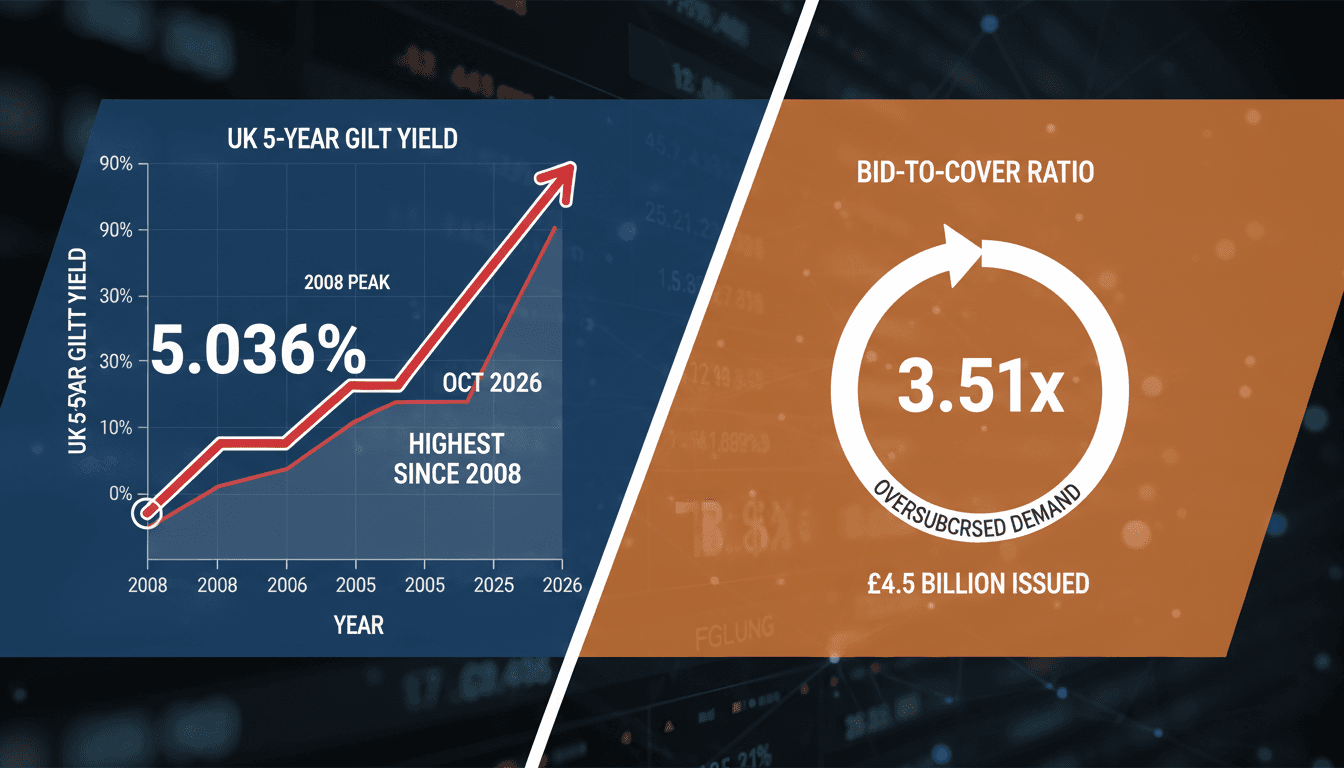
Sovereign borrowing costs are resetting baseline yields across international debt markets, tightening capital conditions for portfolios linked to sterling instruments and advanced-economy sovereign debt.
Why it matters
The cost of funding sovereign commitments has risen to levels unseen in eighteen years, establishing a restrictive hurdle rate that constrains national fiscal choices and sets higher financing expectations across global capital markets.
What happened (in 30 seconds)
- A multi-year yield peak: On 27 October 2026, the UK Debt Management Office sold £4.5 billion of 4.625% March 2032 gilts at an average yield of 5.036%, the highest rate secured at a five-year auction since 2008.
- Robust institutional demand: The auction drew significant buyer interest, finishing 3.51 times oversubscribed despite the elevated yield environment.
- Pre-Budget timing: The issuance occurred exactly one day before Chancellor John Healey's first fiscal Budget, which takes place amid intense pressure regarding annual debt servicing obligations.
The context you actually need
- Geopolitical inflation drivers: Advanced economy bond yields surged throughout October 2026 following the onset of the US-Iran conflict, which renewed supply-side inflation fears through elevated global energy pricing.
- Escalating debt service ratios: The UK Office for Budget Responsibility previously estimated that national debt servicing costs would rise to absorb 3.8% of gross domestic income by the end of the decade.
- An expensive debt baseline: Total UK annual debt interest costs currently run in excess of £115 billion, setting severe boundaries on any additional public expenditure commitments.
What's really happening
The mechanics behind the 5.036% clearing yield reflect an intersection of sovereign supply dynamics, geopolitical energy disruption, and fixed-income portfolio positioning.
When sovereign debt offices bring new issuance to market against a backdrop of geopolitical tension—such as the US-Iran conflict—institutional bond pricing must adjust to compensate for renewed upside inflation risks. Energy disruptions alter the projected paths of central bank interest rates. Because market participants expect consumer price indices to remain elevated, bond managers require a higher real rate of return before absorbing sovereign duration risk.
At the same time, the timing of this £4.5 billion sale creates a specific pricing friction. Entering an official budget presentation, investors face asymmetric downside if prospective government plans rely on excessive sovereign debt expansion. To purchase five-year maturities ahead of Chancellor John Healey’s statement, buyers demanded a tangible risk premium. This dynamic pushed the clearing yield above 5%, a threshold not recorded at a standard five-year gilt sale since the 2008 global financial crisis.
Crucially, the 3.51 times oversubscription ratio demonstrates that the dynamic is not an absence of liquidity, but rather a realignment of the price of balance sheet capacity. Institutional buyers possessed capital to deploy, yet strictly on terms that offset projected macroeconomic volatility. The government achieved full clearance of its £4.5 billion March 2032 issue, but locked in financing obligations that consume a growing proportion of future revenues.
This mechanism directly shapes macroeconomic policy headroom. With annual public debt interest already exceeding £115 billion, every issuance executed near or above 5% anchors structural government expenses higher. Analysts from ActivTrades and Morgan Stanley point out that the financial incentives facing the Treasury now heavily penalize spending shocks. Market structures demand fiscal discipline; departures from perceived fiscal restraint risk triggering secondary-market yield spikes. The sovereign borrower is operating within tight operational guardrails governed by bond investors demanding yields that track elevated energy-induced inflation paths.
Who feels it first (and how)
- Treasury budget planners: Face severe operational limits due to £115 billion in annual debt service obligations, directly reducing discretionary spending allocations.
- Fixed-income portfolio managers: Benefit from five-year sovereign returns above 5.036%, yet carry balance-sheet exposure to potential rate volatility around fiscal announcements.
- Corporate debt issuers: Confront higher baseline corporate borrowing benchmarks, as private credit facilities price at a margin above the sovereign gilt curve.
- Global cross-border investors: Monitor indirect spillovers into currency valuations, energy-related investments, and asset allocation strategies across European and Middle Eastern financial centers.
What to watch next
- The 2026 Budget delivery: Chancellor John Healey's fiscal stance will signal whether the Treasury prioritizes strict deficit controls or risks renewed bond market pushback via borrowing expansions.
- Global energy price stability: Developments in the US-Iran conflict will determine whether transport and energy components sustain cost-push inflation in core economies.
- Subsequent DMO debt auctions: Subscription cover ratios and yields on forthcoming gilt auctions will reveal whether investor demand remains durable above the 5% threshold.
The UK DMO allocated £4.5 billion in March 2032 five-year gilts at 5.036% with an oversubscription cover ratio of 3.51 on 27 October 2026.
The Chancellor's Budget will adopt a restrained, low-volatility posture to align with investor expectations for spending discipline.
The durability of current yields depends on how long geopolitical tensions in the US-Iran corridor sustain upward pressure on energy costs.
Frequently Asked Questions
- Why it matters?
- The cost of funding sovereign commitments has risen to levels unseen in eighteen years, establishing a restrictive hurdle rate that constrains national fiscal choices and sets higher financing expectations across global capital markets.
- What happened (in 30 seconds)?
- A multi-year yield peak: On 27 October 2026, the UK Debt Management Office sold £4.5 billion of 4.625% March 2032 gilts at an average yield of 5.036%, the highest rate secured at a five-year auction since 2008. Robust institutional demand: The auction drew significant buyer interest, finishing 3.51 times oversubscribed despite the elevated yield environment. Pre-Budget timing: The issuance occurred exactly one day before Chancellor John Healey's first fiscal Budget, which takes place amid intens
- What's really happening?
- The mechanics behind the 5.036% clearing yield reflect an intersection of sovereign supply dynamics, geopolitical energy disruption, and fixed-income portfolio positioning. When sovereign debt offices bring new issuance to market against a backdrop of geopolitical tension—such as the US-Iran conflict—institutional bond pricing must adjust to compensate for renewed upside inflation risks. Energy disruptions alter the projected paths of central bank interest rates. Because market participants exp
- Who feels it first (and how)?
- Treasury budget planners: Face severe operational limits due to £115 billion in annual debt service obligations, directly reducing discretionary spending allocations. Fixed-income portfolio managers: Benefit from five-year sovereign returns above 5.036%, yet carry balance-sheet exposure to potential rate volatility around fiscal announcements. Corporate debt issuers: Confront higher baseline corporate borrowing benchmarks, as private credit facilities price at a margin above the sovereign gilt c
- What to watch next?
- The 2026 Budget delivery: Chancellor John Healey's fiscal stance will signal whether the Treasury prioritizes strict deficit controls or risks renewed bond market pushback via borrowing expansions. Global energy price stability: Developments in the US-Iran conflict will determine whether transport and energy components sustain cost-push inflation in core economies. Subsequent DMO debt auctions: Subscription cover ratios and yields on forthcoming gilt auctions will reveal whether investor demand
UK and international business news, economics, and corporate coverage.
"The Guardian’s business section covers finance and markets with a progressive editorial tone."
— A47 Editor
Britain issues costliest five-year debt since 2008 in run-up to budget – business live
Britain issued its costliest five-year debt since 2008 in the run-up to the Chancellor John Healey's first budget, due on 28 October, as the FTSE 100 slipped about 1% and HSBC shares fell 6% after the bank's quarterly profit growth came in below mark...
UK and international business news, economics, and corporate coverage.
"The Guardian’s business section covers finance and markets with a progressive editorial tone."
— A47 Editor
HSBC says ‘no pressure’ to move HQ out of UK despite prospect of higher bank taxes
HSBC's chief financial officer, Pam Kaur, said there was "no pressure" from shareholders, particularly in its cornerstone Hong Kong market, to move the bank's headquarters out of London, despite speculation that tax increases expected in Chancellor J...
International coverage from The Guardian's global desks.
"The Guardian is known for its progressive editorial stance and in-depth analysis."
— A47 Editor
HSBC says ‘no pressure’ to move HQ out of UK despite prospect of higher bank taxes
HSBC's chief financial officer, Pam Kaur, has said there is "no pressure" to move the bank's headquarters out of the UK, seeking to quash speculation prompted by expected tax increases on banks in Wednesday's budget announced by Chancellor John Heale...
UK and global business, economy, and markets coverage.
"Sky News is often seen as a center-right outlet in the UK, known for rolling news and breaking business stories."
— A47 Editor
Another major lender's profits in billions as higher bank tax expected in budget
Another of the UK's biggest banks, HSBC, has reported billions of pounds in profits, partly driven by higher interest rates, as a higher bank tax is widely expected in the government's upcoming budget.
UK politics, business, and social stories.
"Sky News is a UK-based 24-hour channel known for fast-breaking news and political coverage."
— A47 Editor
Another major lender's profits in billions as higher bank tax expected in budget
Another of the UK's biggest banks, HSBC, has reported billions of pounds in profits, partly driven by higher interest rates, as a higher bank tax is widely expected in the government's upcoming budget.