
Apollo Chief Economist Reports Zero Financial Payoff from AI for Non-Tech S&P 493 Firms
Why it matters
The divergence between tech infrastructure providers and the rest of the corporate economy reveals that artificial intelligence adoption is currently compressing non-tech margins instead of driving top-line enterprise efficiency.
What happened (in 30 seconds)
- Apollo’s research reveals zero payoff: Torsten Slok, chief economist at Apollo Global Management, published an analysis on October 24, 2026, finding that AI has yielded zero financial payoff for S&P 500 corporations outside the technology sector.
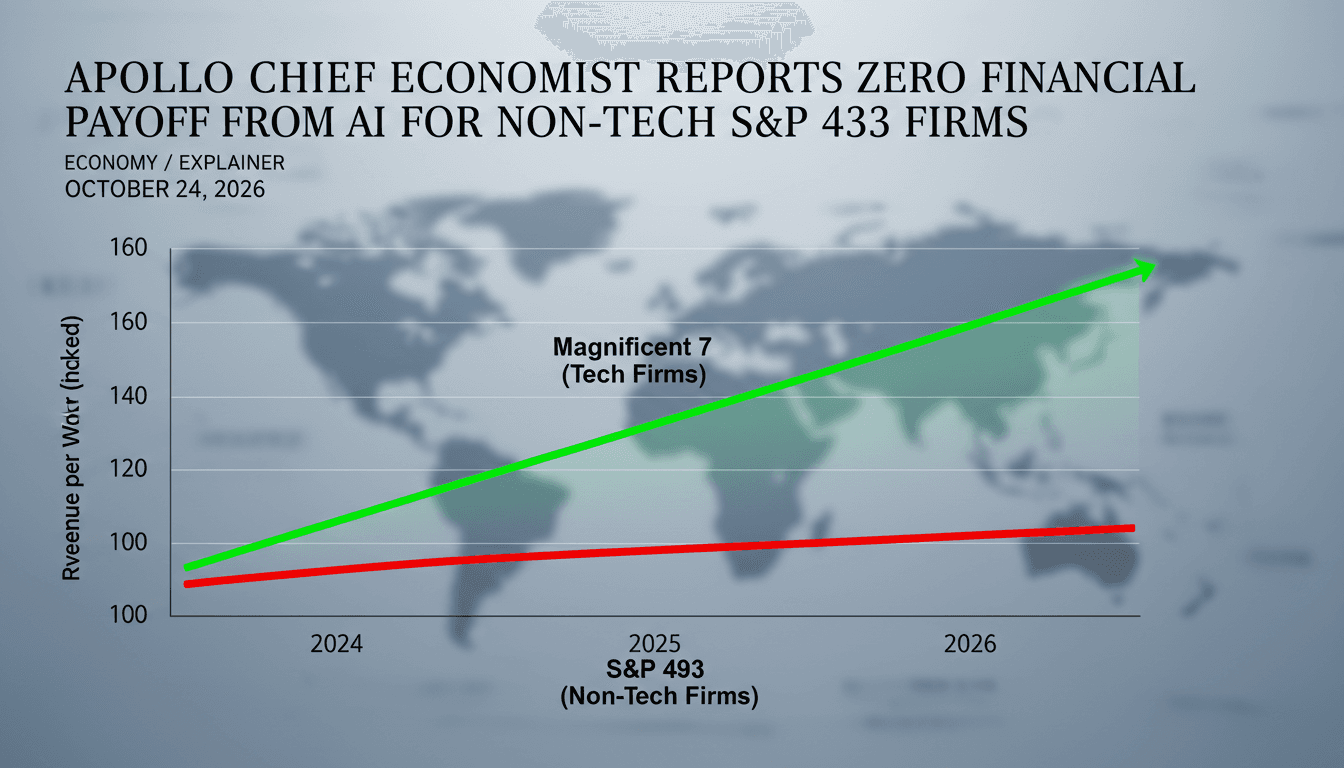
- The S&P 493 shows flatlined productivity: While the "Mag 7" tech leaders experienced rising revenue per worker and expanding profit margins, the remaining 493 firms recorded flat readings across both metrics.
- Corporate America is pulling back spending: Non-tech enterprises are increasingly classifying model access and token consumption as margin drags, triggering a spending pullback across mainstream corporate divisions.
The context you actually need
- Years of enterprise capex yielded scarce aggregate data: Between 2024 and 2026, capital expenditures in foundational hardware and software models surged, but macroeconomic proof of non-tech worker output improvements remained absent.
- Earnings call narratives masked core performance metrics: Corporate leaders routinely touted pilot deployments and internal efficiency tools across public disclosures without demonstrating measurable bottom-line gains outside dedicated software providers.
- The economic divide centered on infrastructure ownership: Financial gains have consolidated exclusively within hyperscalers and hardware designers (Alphabet, Amazon, Apple, Meta, Microsoft, Nvidia, Tesla), leaving non-tech enterprise users with ongoing software licensing costs.
What's really happening
The economic mechanics of generative artificial intelligence have run directly into enterprise accounting realities. For three years, corporate leadership operated under the thesis that integrating frontier models into legacy workflows would immediately elevate operational efficiency. The Apollo Global Management analysis authored by Torsten Slok indicates that this transmission mechanism has failed to materialize across the broader S&P 500.
To understand why, you have to follow the flow of capital versus the realization of value. The Magnificent 7 technology firms generate revenue by selling compute capacity, enterprise licenses, cloud storage, and specialized semiconductors. When an enterprise initiates an artificial intelligence deployment, that capital outlay registers immediately as high-margin revenue on the income statements of technology hyperscalers. Consequently, the Mag 7 show accelerating revenue per worker alongside expanding operating margins.
For the remaining 493 companies in the index—spanning retail, healthcare, manufacturing, transport, and consumer goods—the financial transaction is reversed. Model usage requires ongoing API calls, compute allocation, and recurring software subscriptions. In corporate ledger terms, token usage is not functioning as a multiplier for operational output; it is behaving as a variable utility expense. Because non-tech firms have not seen a corresponding acceleration in top-line revenue or a reduction in overall operating friction, these recurring token costs operate as a direct drag on operating margins.
The structural disconnect lies in worker output metrics. Measuring aggregate enterprise output requires tracking revenue generated relative to headcount. If generative tools were systematically reducing task completion times and automating white-collar workflows, revenue per worker across the S&P 493 would trace an upward slope. Instead, the data demonstrates that revenue per worker remains entirely flat across these 493 firms. Corporate America is absorbing recurring operational expenses for digital tools without achieving the volume or velocity needed to dilute overhead.
Because mainstream enterprises cannot validate return on investment through clear margin expansion, structural incentives are shifting. Chief financial officers are moving away from speculative pilot deployments, recognizing that enterprise software contracts must justify themselves on immediate operational savings rather than theoretical productivity promises.
Who feels it first (and how)
- Enterprise Chief Information Officers and IT Procurement Teams: Facing rigorous internal audits to justify multi-million-dollar software and token budgets that have not improved divisional operating leverage.
- Corporate Strategy and Operations Leaders: Forced to re-evaluate vendor contracts as board-level pressure mounts to convert generative tooling from experimental balance-sheet line items into demonstrable cost savings.
- Mid-Tier Non-Tech Corporate Workers: Experiencing scrutiny over workflow efficiency as internal tooling fails to produce the aggregate revenue per worker increases expected by senior leadership.
- Enterprise Software and AI Startup Vendors: Confronting longer sales cycles, reduced seat expansions, and tightened enterprise renewal budgets outside the core hyperscaler ecosystem.
What to watch next
- Non-Tech Corporate Capex Allocations: Enterprise earnings reports over subsequent quarters will indicate whether non-tech firms scale back software licensing commitments to protect operating margins.
- Enterprise Software Pricing Restructuring: Hyperscalers and software distributors may adjust enterprise pricing structures if corporate clients refuse to absorb unhedged token costs as utility expenses.
- Q4 2026 Corporate Labor Productivity Prints: Official output per hour readings will show whether aggregate productivity continues to stagnate across non-technology industrial and commercial classifications.
Torsten Slok's October 2026 data shows flat profit margins and flat revenue per worker across the S&P 493, contrasting with growth in both metrics across the Mag 7.
Mainstream non-tech enterprises will slow discretionary spending on generative software pilots, treating ongoing model integration strictly as an operational cost center.
Whether future architectural improvements in enterprise software will eventually convert recurring token expenses into measurable productivity gains for non-tech firms.
Frequently Asked Questions
- Why it matters?
- The divergence between tech infrastructure providers and the rest of the corporate economy reveals that artificial intelligence adoption is currently compressing non-tech margins instead of driving top-line enterprise efficiency.
- What happened (in 30 seconds)?
- Apollo’s research reveals zero payoff: Torsten Slok, chief economist at Apollo Global Management, published an analysis on October 24, 2026, finding that AI has yielded zero financial payoff for S&P 500 corporations outside the technology sector. The S&P 493 shows flatlined productivity: While the "Mag 7" tech leaders experienced rising revenue per worker and expanding profit margins, the remaining 493 firms recorded flat readings across both metrics. Corporate America is pulling back spending:
- What's really happening?
- The economic mechanics of generative artificial intelligence have run directly into enterprise accounting realities. For three years, corporate leadership operated under the thesis that integrating frontier models into legacy workflows would immediately elevate operational efficiency. The Apollo Global Management analysis authored by Torsten Slok indicates that this transmission mechanism has failed to materialize across the broader S&P 500. To understand why, you have to follow the flow of cap
- Who feels it first (and how)?
- Enterprise Chief Information Officers and IT Procurement Teams: Facing rigorous internal audits to justify multi-million-dollar software and token budgets that have not improved divisional operating leverage. Corporate Strategy and Operations Leaders: Forced to re-evaluate vendor contracts as board-level pressure mounts to convert generative tooling from experimental balance-sheet line items into demonstrable cost savings. Mid-Tier Non-Tech Corporate Workers: Experiencing scrutiny over workflow
- What to watch next?
- Non-Tech Corporate Capex Allocations: Enterprise earnings reports over subsequent quarters will indicate whether non-tech firms scale back software licensing commitments to protect operating margins. Enterprise Software Pricing Restructuring: Hyperscalers and software distributors may adjust enterprise pricing structures if corporate clients refuse to absorb unhedged token costs as utility expenses. Q4 2026 Corporate Labor Productivity Prints: Official output per hour readings will show whether
Consumer tech news, reviews, and buying guides for gadgets and electronics.
"TechRadar is known for comprehensive buying advice, hardware reviews, and consumer tech news targeted at mainstream audiences."
— A47 Editor
Top economist warns AI is giving ‘zero financial payoff’ to many firms - and warns 'mainstream corporate America is pulling back' on AI spending
A top economist, Apollo Global Management Chief Economist Torsten Slok, has said AI spending has provided "zero payoff" to many firms outside the tech sector, with mainstream corporate America reportedly pulling back on AI spending, according to Tech...
Technology business and AI-related headlines.
"Data-driven tech newsroom with global scope."
— A47 Editor
AI Funding Angst Stands in Way of Return to Highs: Taking Stock
Bloomberg Technology reports that a growing wall of worry, dominated by the financing costs of artificial intelligence, must be addressed before the market can make a run at fresh highs.
Technology business news, market impacts, and innovation trends.
"Bloomberg is a premier financial and tech news provider, respected for its in-depth reporting and analytical rigor."
— A47 Editor
AI Funding Angst Stands in Way of Return to Highs: Taking Stock
Bloomberg Technology reports that a growing wall of worry, dominated by the financing costs of artificial intelligence, must be addressed before the market can make a run at fresh highs.
Corporate leadership, finance, technology, and market trends.
"Fortune covers financial trends, leadership, and innovation with a pragmatic editorial approach."
— A47 Editor
Here’s the ‘core economic flaw’ in the AI bull case as stock and bond trades unravel, according to a top economist
Recent analysis highlights a significant economic flaw in the bullish narrative surrounding artificial intelligence (AI) investments, as firms are experiencing a slow realization of AI's potential benefits, leading to hesitance in spending on AI serv...