
UAE Banks Prepare Rules Restricting Loan Transfers From January 2027
Why it matters
The regulatory shift curbs aggressive debt-poaching incentives across the banking sector, anchoring liquidity profiles while removing short-term rate arbitrage for retail borrowers.
What happened (in 30 seconds)
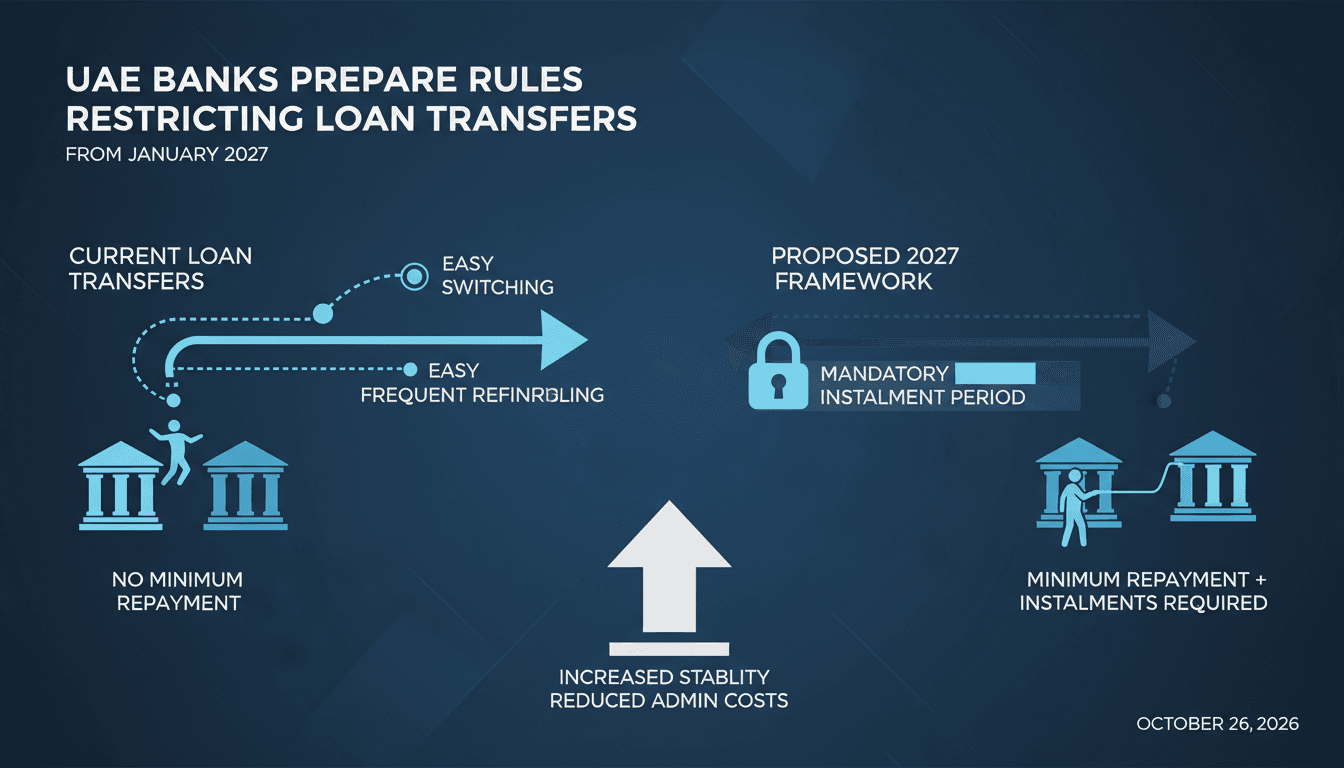
- New transfer restrictions emerge: UAE banking institutions are preparing regulatory controls effective January 1, 2027, requiring borrowers to clear a minimum term and a designated number of instalments before transferring a loan.
- Targeting debt churn: The incoming framework primarily covers personal loans, limiting a borrower’s ability to hop between institutions purely to capture competing introductory terms.
- Regulatory formalisation pending: Reported via banking sources on October 26, 2026, the specific thresholds for waiting durations and qualifying instalments await final technical circulars from the Central Bank of the UAE.
The context you actually need
- Lender acquisition battles: Intensifying rivalry across UAE retail banking has prompted lenders to offer aggressive balance-transfer packages, including reduced rates, loan restructuring, and payment grace periods extending between 6 and 12 months.
- Elevated administrative friction: Continuous debt transfers force originating banks to process early closures while recipient institutions absorb underwriting overhead, inflating transactional costs across the broader credit ecosystem.
- The Dubai exposure profile: Dubai residents represent a significant share of consumer leverage in the country; rapid-fire refinancing has served as an operational tool to compress monthly cash outflows rather than settle total principal.
What's really happening
The mechanics of retail lending in the UAE have reached an operational inflection point. Over recent quarters, commercial banks deployed aggressive retention and acquisition tactics to capture market share. The primary lever has been the balance transfer: incoming lenders offer prospective clients revised repayment timelines, reduced margin rates, and grace periods spanning 6 to 12 months where no instalments are collected.
For the borrower, this dynamic enabled systematic balance hopping. An individual could initiate a loan facility with Bank A, service the debt for several months, and promptly transfer the remaining principal to Bank B to secure an immediate payment pause or lower initial cash outflows. While rational at an individual balance-sheet level, this behaviour distorts portfolio forecasting for institutions. Originating lenders price long-term retail facilities based on multi-year interest accruals. When credit facilities are liquidated within months of origination, the initial underwriting, customer acquisition, and documentation costs fail to amortize.
Concurrently, the recipient bank absorbs legal, administrative, and processing overhead to book a loan that carries elevated flight risk. If the borrower repeats the transfer 12 months later, neither institution achieves durable net interest margins. The proposed policy directly targets this friction. By enforcing a statutory tenure and a verifiable quota of settled instalments with the original lender, the framework establishes an artificial lock-in window.
This lock-in changes institutional incentives. Lenders will no longer be able to rely on speculative, grace-period-led customer acquisition strategies to build volume. Instead, balance-sheet competition must pivot toward customer retention, long-term service stability, and holistic banking relationships. For borrowers, the trade-off is clear: the ability to execute rapid, opportunistic debt consolidation will disappear, forcing cash-flow planning to align with the complete lifecycle of a loan contract rather than short-term promotional windows.
Who feels it first (and how)
- Expatriate professionals in Dubai: Individuals utilizing debt consolidation to manage lifestyle and relocation overhead will face reduced flexibility, requiring deeper due diligence before signing primary credit agreements.
- Retail bank acquisition desks: Lending teams reliant on balance-transfer campaigns will see immediate disruption to outbound sales quotas, redirecting resources toward organic origination.
- Highly leveraged consumer segments: Borrowers dependent on sequential 6-to-12-month grace periods to navigate tight monthly cash flows will lose a critical liquidity release valve.
- Incumbent originating lenders: Financial institutions with large existing retail balance sheets gain statutory protection against immediate loan attrition, stabilizing their interest-earning asset portfolios.
What to watch next
- Central Bank technical guidelines: Watch for the official circular from the Central Bank of the UAE establishing the exact duration (months) and instalment count required before transfer eligibility activates.
- Scope definitions across asset classes: Monitor whether the framework remains isolated to unsecured personal loans or extends into auto financing, commercial credit lines, and home mortgages.
- Pre-2027 competitive surges: Observe whether banks intensify balance-transfer promotions during late 2026 as borrowers and lenders attempt to lock in flexible positions ahead of the January 1, 2027 enforcement deadline.
UAE banking institutions are preparing rules scheduled for January 1, 2027, that will mandate minimum servicing periods and instalment milestones prior to debt transfers.
The framework will reduce the volume of promotional grace periods (6–12 months) currently offered to solicit consumer debt transfers.
The exact length of the mandatory servicing period, exemptions for debt distress, and whether non-personal retail debt categories will fall under identical restrictions.
Frequently Asked Questions
- Why it matters?
- The regulatory shift curbs aggressive debt-poaching incentives across the banking sector, anchoring liquidity profiles while removing short-term rate arbitrage for retail borrowers.
- What happened (in 30 seconds)?
- New transfer restrictions emerge: UAE banking institutions are preparing regulatory controls effective January 1, 2027, requiring borrowers to clear a minimum term and a designated number of instalments before transferring a loan. Targeting debt churn: The incoming framework primarily covers personal loans, limiting a borrower’s ability to hop between institutions purely to capture competing introductory terms. Regulatory formalisation pending: Reported via banking sources on October 26, 2026, t
- What's really happening?
- The mechanics of retail lending in the UAE have reached an operational inflection point. Over recent quarters, commercial banks deployed aggressive retention and acquisition tactics to capture market share. The primary lever has been the balance transfer: incoming lenders offer prospective clients revised repayment timelines, reduced margin rates, and grace periods spanning 6 to 12 months where no instalments are collected. For the borrower, this dynamic enabled systematic balance hopping. An
- Who feels it first (and how)?
- Expatriate professionals in Dubai: Individuals utilizing debt consolidation to manage lifestyle and relocation overhead will face reduced flexibility, requiring deeper due diligence before signing primary credit agreements. Retail bank acquisition desks: Lending teams reliant on balance-transfer campaigns will see immediate disruption to outbound sales quotas, redirecting resources toward organic origination. Highly leveraged consumer segments: Borrowers dependent on sequential 6-to-12-month gra
- What to watch next?
- Central Bank technical guidelines: Watch for the official circular from the Central Bank of the UAE establishing the exact duration (months) and instalment count required before transfer eligibility activates. Scope definitions across asset classes: Monitor whether the framework remains isolated to unsecured personal loans or extends into auto financing, commercial credit lines, and home mortgages. Pre-2027 competitive surges: Observe whether banks intensify balance-transfer promotions during la
UAE-based newspaper covering Gulf politics, society, and international developments.
"Gulf News is one of the UAE’s most prominent English-language publications."
— A47 Editor
UAE banks set to introduce new rules on loan transfers from January 2027
The UAE's banks are set to introduce new rules governing loan transfers starting in January 2027, according to a Gulf News report. The base article focuses on the upcoming regulatory change and the timeline for implementation, with few additional det...
A curated Gulf News feed featuring major stories across news, business, opinion, and lifestyle.
"Gulf News is a major UAE newspaper whose featured stories feed reflects a broad editorial mix shaped for a Gulf audience."
— A47 Editor
UAE banks set to introduce new rules on loan transfers from January 2027
The UAE's banks are set to introduce new rules governing loan transfers starting in January 2027, according to a Gulf News report. The base article focuses on the upcoming regulatory change and the timeline for implementation, with few additional det...
Business, markets, economy, and corporate news with strong UAE and regional relevance.
"Emirates 24|7 business coverage tends to center UAE markets, property, regulation, and regional economic developments."
— A47 Editor
UAE banks prepare new debt transfer controls for borrowers from January 2027
UAE banks are preparing new controls that would regulate customer debt transfers between lenders, potentially taking effect from 1 January 2027. Under the anticipated measures, borrowers would need to stay with their original bank for a specified per...
Arabic-language economic and business reporting with strong UAE market relevance.
"Emarat Al Youm business coverage often centers UAE property, banking, consumer issues, and economic policy."
— A47 Editor
ضوابط جديدة مرتقبة لنقل المديونيات بين البنوك مطلع 2027 ضوابط جديدة مرتقبة لنقل المديونيات بين البنوك مطلع 2027
The UAE banking sector is preparing new regulations, expected to take effect from January 1, 2027, to govern the transfer of customer debts between banks. According to Emarat Al Youm, the rules would require borrowers to observe a waiting period and ...