
Federal Reserve Holds Benchmark Rate at 3.75%-4.00% as Two Members Dissent for Hike
Why it matters
The Federal Reserve’s pause signals that strong economic expansion and persistent inflation are forcing policymakers toward sustained monetary tightening, altering global capital costs and liquidity dynamics.
What happened (in 30 seconds)
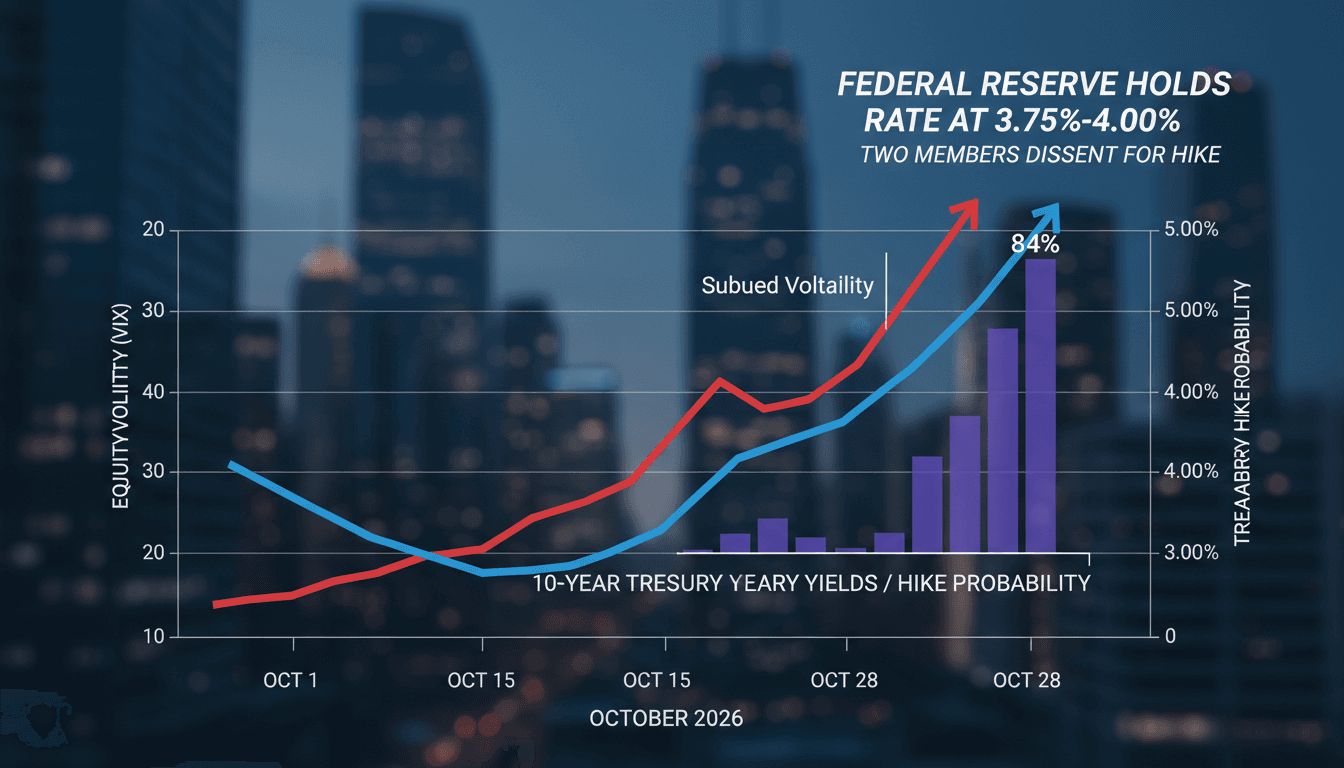
* The Fed held the benchmark rate steady at 3.75% to 4.00% on October 28, 2026, following a 10-2 vote by the Federal Open Market Committee (FOMC). * Two policymakers dissented against the hold, with Federal Reserve Governor Lisa Cook and Cleveland Fed President Beth Hammack voting for an immediate 25-basis-point increase. * Markets priced an 84% probability of a December hike, as Fed Chair Kevin Warsh cited robust economic momentum alongside stubbornly high consumer prices requiring additional data verification.
The context you actually need
* The decision follows a 25-basis-point rate hike in September 2026, confirming that the central bank’s broader monetary stance remains oriented toward curbing inflation rather than lowering borrowing costs. * Economic drivers are fueling persistent price pressure, specifically strong labor market returns, elevated energy prices, and continued capital spending in artificial intelligence infrastructure. * Underlying market metrics diverge from headline stability, with intraday U.S. Treasury yields testing 5.00% and inflation breakevens expanding even as standard equity volatility gauges remain subdued.
What's really happening
The Federal Reserve's choice to maintain the federal funds target range between 3.75% and 4.00% is a tactical intermission, not a policy pivot. Beneath the headline pause, the institutional incentive structure within the FOMC points toward continued monetary contraction. Chair Kevin Warsh and the committee majority opted to delay action to assess forthcoming economic indicators, but the two dissents from Lisa Cook and Beth Hammack reveal an active internal preference for immediate tightening. When multiple voting members break consensus to advocate for higher borrowing costs during an economic expansion, the internal policy momentum is moving upward.
The structural mechanics sustaining this posture stem from an economy expanding above historical trend despite prior interest rate increases. Heavy corporate expenditures, particularly capital flowing into artificial intelligence infrastructure and technological hardware, have generated sustained commercial demand. Simultaneously, elevated energy prices and resilient employment figures continue to prevent headline and core inflation from returning to the Fed’s targeted 2.00% annualized threshold. Lowering rates under these conditions risks accelerating capital expenditure and wage gains, which would entrench elevated price expectations across supply chains.
Financial asset pricing reveals a growing friction between equity market sentiment and interest rate reality. Federal funds futures markets price the likelihood of a 25-basis-point rate increase at the December FOMC meeting at approximately 84%. While equity indices maintained gains following the announcement and equity volatility indicators remained muted, fixed-income markets reflected underlying vulnerability. Intraday U.S. Treasury yields approached 5.00%, accompanied by widening inflation breakevens. This divergence indicates that bond markets are pricing higher real yields and extended capital costs, while equity valuations continue to reflect assumptions of financial stability.
For institutional allocators and international enterprises, the mechanism is straightforward: capital costs are not declining. As the Fed holds rates at restrictive levels and signals further tightening, the cost of corporate leverage rises, currency correlations adjust to dollar strength, and liquidity conditions tighten across international lending facilities.
Who feels it first (and how)
* Corporate treasurers and corporate borrowers: Companies facing near-term debt refinancing must absorb higher borrowing costs, with corporate bond yields pricing in elevated rates through 2027. * Dubai and GCC asset allocators: Sovereign funds, institutional offices, and private investors exposed to U.S. equities, dollar-denominated credit, and global commodities experience altered currency valuations and shifting asset correlations as the U.S. dollar maintains yield support. * Fixed-income portfolio managers: Asset managers holding long-duration securities face continuous capital depreciation as benchmark Treasury yields push toward the 5.00% threshold amid rising inflation breakevens. * Capital-intensive technology firms: Organizations funding ongoing artificial intelligence infrastructure projects must manage increased debt-financing expenses as capital markets price higher policy rates through year-end.
What to watch next
* Incoming U.S. inflation and labor data prints: Critical reads on consumer inflation and employment before the December FOMC meeting will determine whether the 84% market-implied rate hike materializes. * Treasury yield curve movements near the 5.00% level: Sustained closes near or above 5.00% will test equity market stability and force debt markets to reprice real borrowing costs globally. * Statements from non-dissenting Fed governors: Public commentary following the October meeting will show if the broader committee is aligning behind the hawkish stance established by Cook and Hammack.
The FOMC held the federal funds target range at 3.75% to 4.00% by a 10-2 margin on October 28, 2026, with Lisa Cook and Beth Hammack dissenting in favor of a 25-basis-point increase.
The Federal Reserve will implement an additional 25-basis-point interest rate increase at its December 2026 policy gathering, consistent with the 84% probability priced into futures contracts.
Whether equity valuations and compressed market volatility indices will withstand the transmission of 5.00% benchmark bond yields without a broader asset price correction.
Frequently Asked Questions
- Why it matters?
- The Federal Reserve’s pause signals that strong economic expansion and persistent inflation are forcing policymakers toward sustained monetary tightening, altering global capital costs and liquidity dynamics.
- What happened (in 30 seconds)?
- The Fed held the benchmark rate steady at 3.75% to 4.00% on October 28, 2026, following a 10-2 vote by the Federal Open Market Committee (FOMC). Two policymakers dissented against the hold, with Federal Reserve Governor Lisa Cook and Cleveland Fed President Beth Hammack voting for an immediate 25-basis-point increase. Markets priced an 84% probability of a December hike, as Fed Chair Kevin Warsh cited robust economic momentum alongside stubbornly high consumer prices requiring additional data ve
- What's really happening?
- The Federal Reserve's choice to maintain the federal funds target range between 3.75% and 4.00% is a tactical intermission, not a policy pivot. Beneath the headline pause, the institutional incentive structure within the FOMC points toward continued monetary contraction. Chair Kevin Warsh and the committee majority opted to delay action to assess forthcoming economic indicators, but the two dissents from Lisa Cook and Beth Hammack reveal an active internal preference for immediate tightening. Wh
- Who feels it first (and how)?
- Corporate treasurers and corporate borrowers: Companies facing near-term debt refinancing must absorb higher borrowing costs, with corporate bond yields pricing in elevated rates through 2027. Dubai and GCC asset allocators: Sovereign funds, institutional offices, and private investors exposed to U.S. equities, dollar-denominated credit, and global commodities experience altered currency valuations and shifting asset correlations as the U.S. dollar maintains yield support. Fixed-income portfolio
- What to watch next?
- Incoming U.S. inflation and labor data prints: Critical reads on consumer inflation and employment before the December FOMC meeting will determine whether the 84% market-implied rate hike materializes. Treasury yield curve movements near the 5.00% level: Sustained closes near or above 5.00% will test equity market stability and force debt markets to reprice real borrowing costs globally. Statements from non-dissenting Fed governors: Public commentary following the October meeting will show if th
Global business headlines with AI angles.
"General business outlet that frequently covers AI."
— A47 Editor
The Fed Held Rates Steady. But an Expert Warns Investors May be Underestimating Volatility Ahead.
The Federal Open Market Committee voted 10-2 to keep interest rates unchanged at its October meeting, with Fed Governor Lisa Cook and Cleveland Fed President Beth Hammack dissenting, and an expert has warned investors may be underestimating volatilit...
Capitol Hill news, legislation, and policy insight.
"The Hill specializes in U.S. politics and policy, with a focus on Capitol Hill developments and a reputation for insider reporting."
— A47 Editor
Fed hits pause on interest rates
The Federal Reserve voted 10-2 to hold its benchmark interest rate steady at 3.75% to 4% on Wednesday, its final decision before the midterm elections, despite persistent inflation that reached 3.7% in September, up from 3.4% in August. Governors Lis...
Global markets, investing, and macroeconomics from a premier financial newsroom.
"Bloomberg is respected for in-depth financial reporting and data-driven analysis."
— A47 Editor
Fed Officials Left Interest Rates Unchanged
The Federal Open Market Committee voted 10-2 to hold its benchmark federal funds rate in a range of 3.75% to 4%, leaving borrowing costs unchanged, with Governor Lisa Cook and Cleveland Fed President Beth Hammack dissenting. The decision was discusse...
Business and tech news excluding paywalled content.
"High-volume business/tech outlet with frequent AI coverage."
— A47 Editor
What smart people are saying after the Fed held rates steady
The Federal Reserve held interest rates steady, a move widely expected, as policymakers opted to buy time and gather more economic data before making further decisions. Many analysts still anticipate a possible rate hike in December.
Macro commentary, policy analysis, growth/inflation themes, and global outlooks.
"Contextual macro coverage that complements day-to-day market headlines."
— A47 Editor
Fed holds rates steady as expected, though two policymakers prefer 25 bps hike
The Federal Reserve left its benchmark federal funds rate unchanged in a range of 3.75% to 4% at its policy decision on Wednesday, October 28, 2026, a move widely expected by markets. The Federal Open Market Committee voted 10-2, with Governor Lisa C...
Corporate leadership, finance, technology, and market trends.
"Fortune covers financial trends, leadership, and innovation with a pragmatic editorial approach."
— A47 Editor
Fed holds rates steady days before the midterms, even as inflation runs hot
The Federal Reserve voted 10-2 to hold its benchmark federal funds rate in a range of 3.75% to 4%, leaving borrowing costs unchanged days before the midterm elections, even as inflation remains above 3 percent. Governor Lisa Cook and Cleveland Fed Pr...
Global business headlines with AI angles.
"General business outlet that frequently covers AI."
— A47 Editor
The Fed Kept Rates Unchanged in Line With Market Expectations But Warns That 'Uncertainty Remains Elevated'
The Federal Open Market Committee kept interest rates unchanged, in line with market expectations, while warning that 'uncertainty remains elevated.' The committee described domestic spending as 'resilient,' noted that productivity growth is strong a...