
DOL Finalizes Rule Requiring PBM Compensation Disclosure to Self-Insured Employers
Why it matters
The regulatory mandate strips back decades of pricing opacity in the prescription drug supply chain, projecting $22 billion in employer and enrollee savings over 10 years by altering the bargaining leverage between corporate plan sponsors and pharmacy middlemen.
What happened (in 30 seconds)
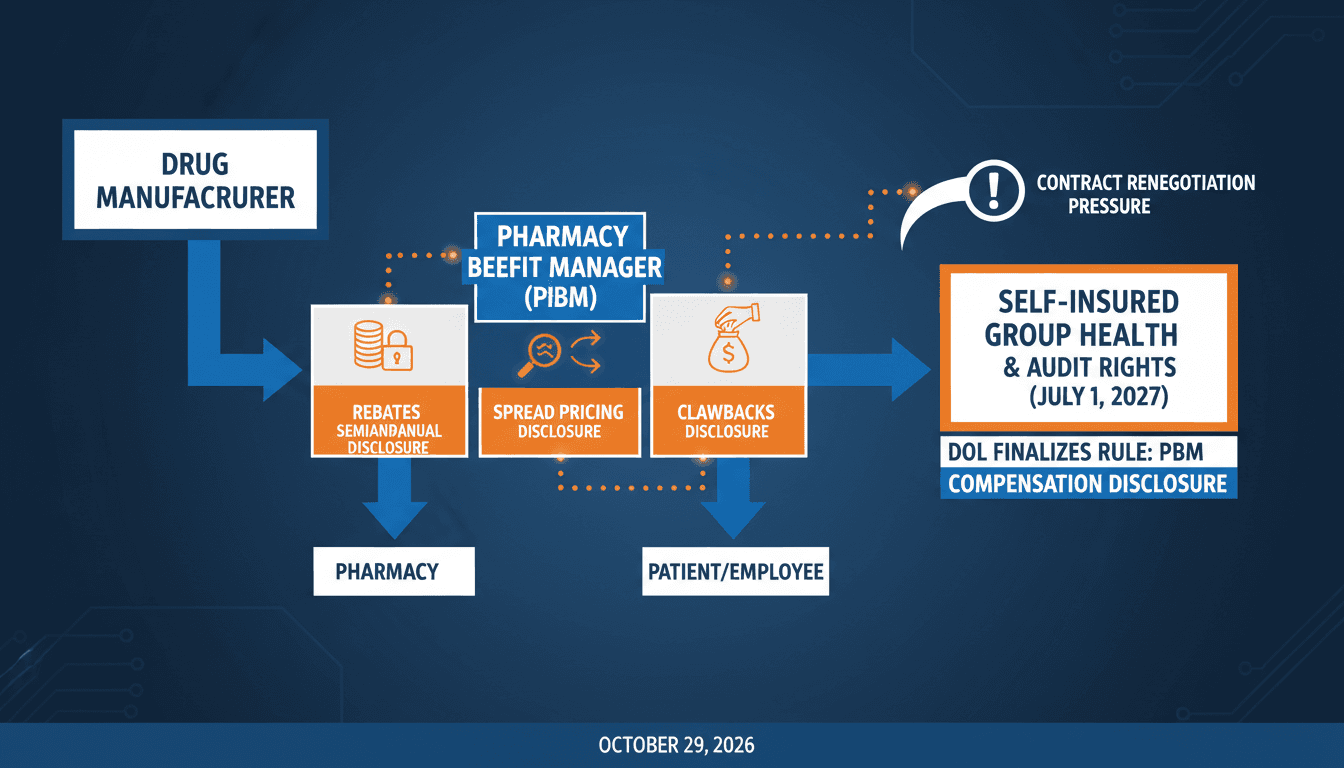
- Federal mandate finalized: On October 29, 2026, the U.S. Department of Labor issued a final administrative rule requiring pharmacy benefit managers (PBMs) to disclose detailed direct and indirect compensation arrangements.
- Coverage scope: The mandate applies to fiduciaries of self-insured group health plans governed by ERISA that cover more than 100 participants.
- Reporting and audit rights: PBMs must provide initial disclosures before contract execution or renewal, submit semiannual reports on rebates, spread pricing, and clawbacks, and grant plans formal annual audit rights, with noncompliance triggering penalties or contract invalidation.
The context you actually need
- Prior legislative momentum: The regulation implements and builds upon President Trump's April 2025 executive order, a January 2026 proposed rule by the Department of Labor, and statutory reforms within the February 2026 Consolidated Appropriations Act (CAA 2026).
- The opaque middleman mechanism: PBMs—dominated by entities including Optum Rx, Caremark, and Express Scripts—have historically faced scrutiny for monetizing formulary placement through manufacturer rebates, pharmacy clawbacks, and spread pricing, retaining margins that remained largely concealed from plan sponsors.
- The $22 billion stake: Official projections estimate $22 billion in net savings for health plans and participants across a 10-year horizon, driven by lowered net drug costs and enhanced employer oversight during contract procurement.
What's really happening
The economics of the U.S. corporate pharmacy benefit rest on structural information asymmetry. In a standard self-insured model, the employer assumes the financial risk of every prescription filled by covered workers, while the PBM acts as the purchasing intermediary. Historically, PBM contracts concealed the delta between what the PBM billed the plan sponsor and what it paid dispensing pharmacies (spread pricing), alongside the volume-based concessions captured from pharmaceutical manufacturers (rebates and administration fees).
Under ERISA, plan sponsors carry strict fiduciary obligations to ensure vendor fees are reasonable and plan assets are managed solely in the interest of participants. Until now, employers lacked the granular transactional accounting required to verify whether retained PBM revenue represented legitimate administration costs or disguised profit margins. The Department of Labor’s final rule changes this balance of power by legally requiring PBMs to report all revenue streams semiannually.
By opening these transactions to mandatory reporting and annual audits, the rule disrupts existing margin structures. When plan fiduciaries can clearly evaluate exact rebate capture rates, pharmacy reimbursement spreads, and clawback totals, PBMs can no longer rely on cross-subsidized, hidden fees to sustain margin expansion. Instead, they must compete on transparent administrative fees and verifiable clinical management.
For large self-insured employers, this data eliminates blind spots in vendor procurement. However, compliance shifts risk back to employer fiduciaries: once compensation structures are exposed by law, plan sponsors can no longer plead ignorance if they sign off on inflated middleman markups. For PBMs, particularly major players affiliated with UnitedHealth, CVS, and Cigna, the dynamic forces operational revamps to reporting systems, legal redrafting of client contracts, and renegotiations with pharmaceutical manufacturers. Meanwhile, smaller PBMs face acute compliance overhead, which market analysts anticipate could accelerate sector consolidation.
Who feels it first (and how)
- Corporate Benefit Fiduciaries and HR Executives: Gain full legal visibility into contract pricing, but face heightened fiduciary liability under ERISA to audit their PBMs and eliminate excessive vendor margins.
- Large Self-Insured Employers (100+ Participants): Experience direct improvements in purchasing leverage during contract renewals leading up to plan years starting July 1, 2027.
- Major Pharmacy Benefit Managers (Optum Rx, Caremark, Express Scripts): Must overhaul administrative reporting frameworks, absorb extensive compliance requirements, and replace spread-pricing revenues with transparent fee models.
- Mid-Sized and Independent PBMs: Confront high fixed compliance overheads to deliver semiannual disclosures and annual audit tracking, driving potential consolidation pressures.
- Enrollees and Employees: Benefit over time through reduced cost-sharing and suppressed premiums as estimated 10-year systemic savings of $22 billion begin materializing.
- Global and Dubai-Based Entities: No verified direct regulatory or economic impact applies to non-U.S. operations, as the jurisdiction applies strictly to U.S. domestic plans governed by ERISA.
What to watch next
- Contract renegotiation cycles ahead of July 2027: Track whether self-insured plans begin restructuring vendor agreements well before the July 1, 2027 effective date to integrate standard audit clauses.
- PBM pricing restructuring: Watch how major intermediaries adjust their fee schedules, monitoring whether transparent administrative fees increase to offset reductions in retained spread pricing and manufacturer rebates.
- Industry legal challenges: Monitor filings by trade organizations such as the Pharmaceutical Care Management Association (PCMA), which has publicly labeled the regulation as redundant administrative overreach.
The rule is finalized, applies to ERISA group plans with over 100 participants, takes effect for plan years starting July 1, 2027, and mandates semiannual reporting alongside annual plan audit rights.
The mandate will squeeze PBM margins derived from spread pricing and clawbacks, leading to altered contracting norms and accelerated M&A activity among smaller benefit administrators.
Whether drug manufacturers will recalibrate list prices versus gross rebates in response to transparent reporting, and the degree to which compliance disputes will lead to contract invalidations or federal enforcement actions.
Frequently Asked Questions
- Why it matters?
- The regulatory mandate strips back decades of pricing opacity in the prescription drug supply chain, projecting $22 billion in employer and enrollee savings over 10 years by altering the bargaining leverage between corporate plan sponsors and pharmacy middlemen.
- What happened (in 30 seconds)?
- Federal mandate finalized: On October 29, 2026, the U.S. Department of Labor issued a final administrative rule requiring pharmacy benefit managers (PBMs) to disclose detailed direct and indirect compensation arrangements. Coverage scope: The mandate applies to fiduciaries of self-insured group health plans governed by ERISA that cover more than 100 participants. Reporting and audit rights: PBMs must provide initial disclosures before contract execution or renewal, submit semiannual reports on r
- What's really happening?
- The economics of the U.S. corporate pharmacy benefit rest on structural information asymmetry. In a standard self-insured model, the employer assumes the financial risk of every prescription filled by covered workers, while the PBM acts as the purchasing intermediary. Historically, PBM contracts concealed the delta between what the PBM billed the plan sponsor and what it paid dispensing pharmacies (spread pricing), alongside the volume-based concessions captured from pharmaceutical manufacturers
- Who feels it first (and how)?
- Corporate Benefit Fiduciaries and HR Executives: Gain full legal visibility into contract pricing, but face heightened fiduciary liability under ERISA to audit their PBMs and eliminate excessive vendor margins. Large Self-Insured Employers (100+ Participants): Experience direct improvements in purchasing leverage during contract renewals leading up to plan years starting July 1, 2027. Major Pharmacy Benefit Managers (Optum Rx, Caremark, Express Scripts): Must overhaul administrative reporting fr
- What to watch next?
- Contract renegotiation cycles ahead of July 2027: Track whether self-insured plans begin restructuring vendor agreements well before the July 1, 2027 effective date to integrate standard audit clauses. PBM pricing restructuring: Watch how major intermediaries adjust their fee schedules, monitoring whether transparent administrative fees increase to offset reductions in retained spread pricing and manufacturer rebates. Industry legal challenges: Monitor filings by trade organizations such as the
Capitol Hill news, legislation, and policy insight.
"The Hill specializes in U.S. politics and policy, with a focus on Capitol Hill developments and a reputation for insider reporting."
— A47 Editor
New federal rule requires drug intermediaries to disclose how they're paid
A final rule released Thursday by the Trump administration, issued through the Department of Labor, will require pharmacy benefit managers (PBMs) to inform their clients about all the different ways they are paid. PBMs manage billions of dollars in p...
Public health, medical research, healthcare policy, and pharmaceutical developments.
"Dow Jones is a major financial news provider with a professional tone and broad coverage, including specialized health-sector reporting."
— A47 Editor
A new Labor Department regulation aims to pry open the business model of PBMs, powerful companies that oversee hundreds of billions of dollars’ worth of drug spending
The U.S. Labor Department has issued a new regulation requiring pharmacy-benefit managers, the powerful companies that oversee hundreds of billions of dollars in drug spending, to disclose information to employers that sponsor health plans. The rule ...
U.S. business news, corporate developments, and economy.
"The Wall Street Journal is respected for deep financial and economic reporting with a center-right editorial perspective."
— A47 Editor
Drug Middlemen Will Soon Have to Share Details on How They Are Paid
The U.S. Labor Department has issued a new regulation requiring pharmacy-benefit managers to disclose to employers details on how they are paid, according to a report from The Wall Street Journal. The rule addresses the intermediaries that manage pre...