
Brent Crude Extends Sell-Off to $91.56 as US-Iran Escalation Risk Recedes
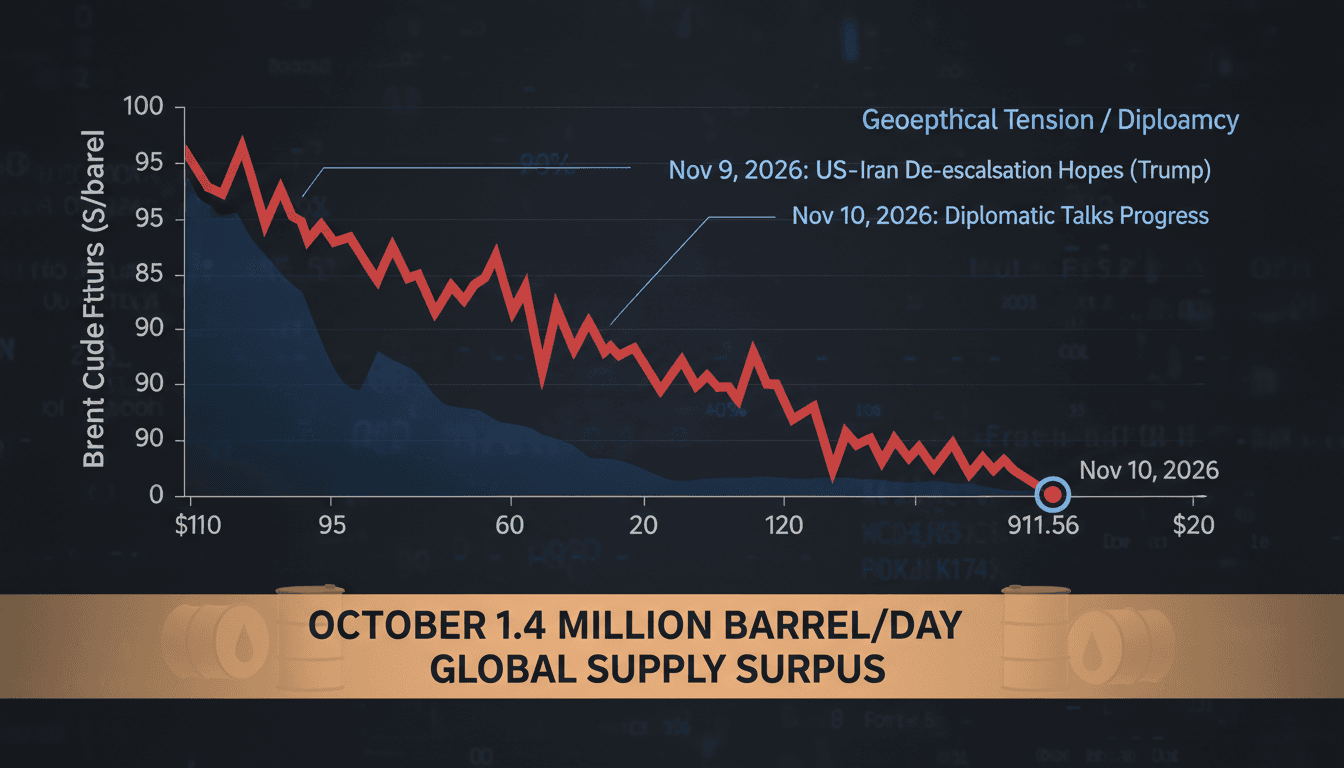
A swift contraction in energy benchmarks creates immediate downstream margin relief for logistics operators and corporate budgets, while recalibrating treasury projections across import-reliant economies.
Why it matters
The sudden removal of geopolitical risk premiums exposes fundamental physical surpluses, accelerating disinflationary pressures across global supply chains.
What happened (in 30 seconds)
- Brent crude dropped sharply, sliding by approximately one dollar to $91.56 per barrel in early Asian trading on November 10, 2026, building directly on a 5.85% settlement decline from the previous session.
- WTI followed the downward trajectory, falling to $85.79 per barrel as broader commodity markets mirrored the retreat from recent autumn peaks.
- Geopolitical premiums evaporated, triggered by public signals from US President Donald Trump indicating a low probability of renewed strikes if diplomatic discussions with Iran advance.
The context you actually need
- The decline marked a multi-month inflection, bringing Brent futures to their lowest settlement level since August 31, 2026, and generating the steepest single-week pullback recorded since early 2020.
- Physical balances were already softening, with market data revealing an estimated global oversupply of 1.4 million barrels per day in October alongside underlying weakness in physical crude deliveries.
- Regional shipping risks recalibrated, cooling trade tension that had previously inflated tanker rates following military posturing and maritime friction near the Strait of Hormuz.
What's really happening
The rapid descent in crude benchmarks illustrates what happens when speculative fear premiums disentangle from physical inventory realities. Over recent months, crude contracts carried an embedded surcharge linked to the US-Iran standoff. When traders calculate the probability of interdiction in maritime chokepoints like the Strait of Hormuz, capital pools bid up forward contracts to insure against supply shocks.
The sudden defusing of that scenario by diplomatic signalling produced an immediate structural unwinding. When US President Donald Trump indicated a low likelihood of military action provided diplomatic talks progress, the rationale for holding premium long positions dissolved. Traders liquidated contracts rapidly, leading to the 5.85% drop on November 9 that erased more than $5 per barrel in a single session, followed immediately by sub-$92 prints in Asian hours.
With the security cushion gone, the market was forced to price against raw balance sheets. Those fundamentals point to loose supply. Global production outpaced consumption by approximately 1.4 million barrels per day in October 2026, driven by sustained non-OPEC output and uneven demand across major manufacturing hubs. In an oversupplied environment, geopolitical friction serves as the primary support beam for elevated prices; remove that beam, and the market drops to its physical floor.
This mechanism fundamentally resets operational calculations. Producers face deteriorating margins on prompt deliveries, which discourages speculative storage plays and incentivizes commercial holders to release volumes into the spot market, reinforcing the downward cycle. Refiners, previously squeezed between costly feedstocks and disciplined end-user demand, suddenly capture improved crack spreads.
For state treasuries and corporate planners, this repricing shifts the macro focus from inflation containment to fiscal alignment. While lower input costs alleviate systemic pressure on consumer price indices, sustained settlement values around the $90 threshold alter sovereign revenue flows for net exporters while expanding fiscal room for energy-importing economies.
Who feels it first (and how)
- Aviation and Fleet Logistics Operators: Secure immediate cash flow stabilization through declining jet fuel and diesel wholesale pricing, easing fleet operating expenses within days.
- Energy Traders and Commodity Desks: Experience rapid margin calls and capital reallocations as long positions acquired during peak tension become loss-making.
- Dubai and Regional Gulf Households: Experience indirect cost moderation via stabilizing retail transportation expenses and reduced freight surcharges on imported consumer goods.
- Sovereign Fiscal Planners in Energy-Exporting States: Must adjust medium-term budget surplus expectations if prolonged price softness replaces the high-risk premiums seen earlier in the quarter.
What to watch next
- Diplomatic Milestones Between Washington and Tehran: Concrete negotiation schedules will clarify whether the geopolitical premium stays off the table or re-emerges on friction.
- Refinery Run Rates and Inventory Accumulation: Weekly inventory metrics will show whether the 1.4 million barrel-per-day October surplus expands, pushing physical storage to capacity.
- Producer Supply Responses: Any unified production adjustments from major global exporters will signal the minimum price floor participants are willing to defend.
Brent crude traded down to $91.56 per barrel and WTI to $85.79 following a 5.85% single-day decline, driven by diplomatic progress and a 1.4 million barrel-per-day October oversupply.
Energy-driven headline inflation across major importing jurisdictions will register downward adjustments over the following fiscal quarter as lower crude filters through transport networks.
Whether current diplomatic engagement will yield a formal long-term agreement or merely a temporary pause in Strait of Hormuz maritime tensions.
Frequently Asked Questions
- Why it matters?
- The sudden removal of geopolitical risk premiums exposes fundamental physical surpluses, accelerating disinflationary pressures across global supply chains.
- What happened (in 30 seconds)?
- Brent crude dropped sharply, sliding by approximately one dollar to $91.56 per barrel in early Asian trading on November 10, 2026, building directly on a 5.85% settlement decline from the previous session. WTI followed the downward trajectory, falling to $85.79 per barrel as broader commodity markets mirrored the retreat from recent autumn peaks. Geopolitical premiums evaporated, triggered by public signals from US President Donald Trump indicating a low probability of renewed strikes if diploma
- What's really happening?
- The rapid descent in crude benchmarks illustrates what happens when speculative fear premiums disentangle from physical inventory realities. Over recent months, crude contracts carried an embedded surcharge linked to the US-Iran standoff. When traders calculate the probability of interdiction in maritime chokepoints like the Strait of Hormuz, capital pools bid up forward contracts to insure against supply shocks. The sudden defusing of that scenario by diplomatic signalling produced an immediat
- Who feels it first (and how)?
- Aviation and Fleet Logistics Operators: Secure immediate cash flow stabilization through declining jet fuel and diesel wholesale pricing, easing fleet operating expenses within days. Energy Traders and Commodity Desks: Experience rapid margin calls and capital reallocations as long positions acquired during peak tension become loss-making. Dubai and Regional Gulf Households: Experience indirect cost moderation via stabilizing retail transportation expenses and reduced freight surcharges on impor
- What to watch next?
- Diplomatic Milestones Between Washington and Tehran: Concrete negotiation schedules will clarify whether the geopolitical premium stays off the table or re-emerges on friction. Refinery Run Rates and Inventory Accumulation: Weekly inventory metrics will show whether the 1.4 million barrel-per-day October surplus expands, pushing physical storage to capacity. Producer Supply Responses: Any unified production adjustments from major global exporters will signal the minimum price floor participants
Arabic-language economic and business reporting with strong UAE market relevance.
"Emarat Al Youm business coverage often centers UAE property, banking, consumer issues, and economic policy."
— A47 Editor
تراجع جديد لأسعار النفط.. و«برنت» يهبط إلى 91.56 دولار تراجع جديد لأسعار النفط.. و«برنت» يهبط إلى 91.56 دولار
Oil prices declined in early Asian trading, extending losses from the previous day, as Brent crude fell to $91.56 per barrel according to the base report from Emarat Al Youm. The report notes that futures contracts for crude oil dropped during the se...
Jordanian news and regional updates.
"Roya News is a Jordanian outlet focused on breaking news and local affairs."
— A47 Editor
أسعار النفط تواصل التراجع وخام برنت يهبط نحو 7% وسط آمال بالتوصل إلى اتفاق بين واشنطن وطهران
Oil prices continued to decline, with Brent crude falling nearly 7%, as markets reacted to hopes that Washington and Tehran could reach an agreement, which has eased concerns over potential supply disruptions in the energy market, according to a repo...
Arabic-language coverage of international news and geopolitics.
"RT Arabic is a Russian state-funded outlet often criticized for promoting Kremlin-aligned narratives."
— A47 Editor
برنت يتراجع دون 93 دولارا للمرة الأولى منذ سبتمبر
Brent crude futures for January 2027 delivery fell to $92.8 per barrel, a decline of 5.61%, marking the first time the benchmark has dropped below $93 since September 1, according to trading data reported by RT Arabic.
Sports reporting with a focus on Saudi and regional competitions.
"Okaz sports coverage is broad and audience-friendly, with strong attention to Saudi teams and leagues."
— A47 Editor
أسعار برنت إلى 97 دولاراً.. «غرب تكساس» قرب 90 دولاراً
Brent crude futures for the nearest month fell toward $97 per barrel after losing more than 16% last week, their largest weekly decline since April 2020, while West Texas Intermediate traded near $90. Prices eased from six-month highs reached at the ...
Jordanian news and regional updates.
"Roya News is a Jordanian outlet focused on breaking news and local affairs."
— A47 Editor
تراجع أسعار النفط رغم توترات الملاحة.. كيف أثرت إشارات واشنطن الدبلوماسية في السوق؟
Brent crude futures fell by 64 cents, or about 1%, as oil prices declined despite navigational tensions, according to the Arabic-language report published by Royanews, with the decline attributed in the coverage to diplomatic signals from Washington ...