
Democratic Midterm Win Triggers Sector-Wide Repricing of U.S. Equities as AI and Defense Stocks Fall and Healthcare and Consumer Names Rise
Why it matters
A shift to unified Democratic legislative control triggers an immediate reallocation of capital out of elevated tech and defense assets and into tariff-relief, healthcare, and consumer sectors.
What happened (in 30 seconds)
- Democrats gained full control of Congress on November 3, 2026, creating immediate shifts across equity markets ahead of the January 2027 legislative transition.
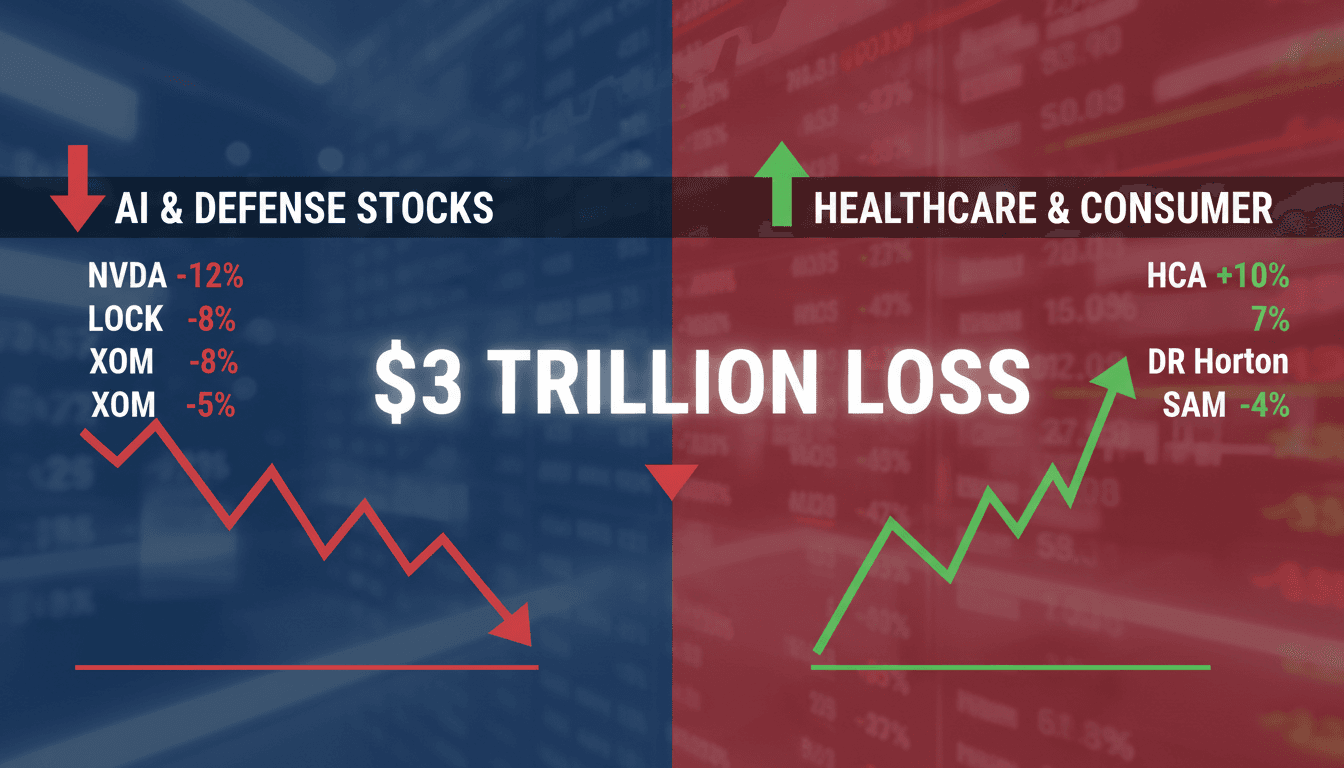
- Over $3 trillion in market value vanished in a single post-election session as benchmark indexes retreated, with the S&P 500 falling 4.4% and the Nasdaq 100 dropping 6.4%.
- Capital rotated sharply across major sectors, prompting declines in AI hardware, defense contractors, and oil producers, while healthcare providers, homebuilders, and tariff-sensitive import brands surged.
The context you actually need
- Unified legislative control followed two years of split government, shifting market assumptions established during President Donald Trump's term under prior Republican congressional control since 2025.
- Elevated commodity and defense baselines had persisted since the U.S.-Iran conflict began in February 2026, creating structural profit premiums for defense contractors and fossil fuel extractors that face potential de-escalation pressures.
- AI data center infrastructure was already facing capacity scrutiny, leaving chipmakers and hardware suppliers vulnerable to shifts in federal oversight and regional regulatory scrutiny across states like Texas.
What's really happening
The market reaction between November 4 and November 7 reflects an abrupt repricing of federal policy incentives rather than a generalized macro contraction. Investors are recalibrating cash-flow expectations based on the reality of Democratic committee leadership, regulatory priorities, and budgetary allocations taking effect in January 2027.
Capital fled artificial intelligence infrastructure names on expectations of heightened operational friction. Shares of Nvidia and Lam Research retreated sharply as institutional managers weighed potential regulatory hurdles and slowed data center buildouts, particularly where utility and land-use rules face political scrutiny. This sector bore the brunt of the immediate post-election contraction, contributing to the loss of more than $3 trillion in aggregate equity value in one session. The sell-off also extended to politically adjacent enterprises: Elon Musk-linked entities Tesla and SpaceX fell between 5% and 10.1%, while Trump Media & Technology Group dropped 33%.
Simultaneously, traditional geopolitical hedges unwound. Defense contractors including Northrop Grumman, Lockheed Martin, RTX, and General Dynamics saw share prices decline between 4% and 12%. This drop reflects market bets on reduced defense spending growth and potential diplomatic de-escalation surrounding the U.S.-Iran conflict that began in February 2026. Lower risk premiums similarly pressured upstream energy assets, pulling down oil and gas giants such as Exxon Mobil and Phillips 66 as traders anticipated softening crude prices.
Conversely, domestic policy beneficiaries experienced an inflow of capital. Hospital systems advanced on projections of restored or expanded funding for the Affordable Care Act and Medicaid under Democratic legislative oversight, with Universal Health Services gaining 10.4%, HCA Healthcare rising 6.9%, and Tenet Healthcare adding 6.2%. Consumer goods producers and importers positioned for margin recovery gained on expectations of lowered tariff friction. Alcohol producers Constellation Brands and Brown-Forman rallied on tariff-relief hopes, while domestic builders D.R. Horton (+4.9%) and PulteGroup (+4.4%) gained alongside consumer staples Costco (+3.4%) and Procter & Gamble (+2.1%). Renewable energy operators also gained ground, benefiting from anticipated legislative protection of clean energy incentives.
Who feels it first (and how)
- Tech and semiconductor portfolio managers, who absorb valuation compressions across high-multiple AI hardware and data center component holdings.
- Global defense and energy investors, who face margin compression as risk premiums tied to the U.S.-Iran conflict and federal procurement contracts unwind.
- Healthcare and hospital equity operators, who gain sudden balance sheet clarity from anticipated increases in Medicaid and ACA federal allocations.
- Consumer goods and beverage importers, who gain immediate margin relief on expectations of reduced tariffs and easing trade disputes.
- Dubai and GCC-based family offices, who hold passive dollar-denominated exposure to U.S. indexes, absorbing equity volatility while monitoring stabilized global crude pricing.
What to watch next
- Data center zoning and environmental reviews, which indicate whether congressional oversight will materially restrict tech utility buildouts in energy-heavy hubs like Texas.
- Crude pricing stability and Middle East diplomatic posture, which determine whether the 4% to 12% valuation cuts to defense and oil contractors are temporary adjustments or structural shifts.
- Tariff schedule adjustments and healthcare appropriations bills, which validate whether margin expansions for alcohol producers, consumer staples, and hospital operators will materialize in corporate earnings.
Democrats won control of both chambers of Congress on November 3, 2026, triggering single-session losses exceeding $3 trillion across U.S. equities, marked by S&P 500 declines of 4.4% and Nasdaq 100 declines of 6.4%.
Legislative gridlock with the executive branch will stall direct executive trade initiatives, favoring defensive consumer stocks, homebuilders, and healthcare providers over high-valuation tech.
The degree to which Congress can enforce data center restrictions or alter the diplomatic trajectory of the U.S.-Iran conflict ahead of official committee assignments in January 2027.
Frequently Asked Questions
- Why it matters?
- A shift to unified Democratic legislative control triggers an immediate reallocation of capital out of elevated tech and defense assets and into tariff-relief, healthcare, and consumer sectors.
- What happened (in 30 seconds)?
- Democrats gained full control of Congress on November 3, 2026, creating immediate shifts across equity markets ahead of the January 2027 legislative transition. Over $3 trillion in market value vanished in a single post-election session as benchmark indexes retreated, with the S&P 500 falling 4.4% and the Nasdaq 100 dropping 6.4%. Capital rotated sharply across major sectors, prompting declines in AI hardware, defense contractors, and oil producers, while healthcare providers, homebuilders, and
- What's really happening?
- The market reaction between November 4 and November 7 reflects an abrupt repricing of federal policy incentives rather than a generalized macro contraction. Investors are recalibrating cash-flow expectations based on the reality of Democratic committee leadership, regulatory priorities, and budgetary allocations taking effect in January 2027. Capital fled artificial intelligence infrastructure names on expectations of heightened operational friction. Shares of Nvidia and Lam Research retreated
- Who feels it first (and how)?
- Tech and semiconductor portfolio managers, who absorb valuation compressions across high-multiple AI hardware and data center component holdings. Global defense and energy investors, who face margin compression as risk premiums tied to the U.S.-Iran conflict and federal procurement contracts unwind. Healthcare and hospital equity operators, who gain sudden balance sheet clarity from anticipated increases in Medicaid and ACA federal allocations. Consumer goods and beverage importers, who gain imm
- What to watch next?
- Data center zoning and environmental reviews, which indicate whether congressional oversight will materially restrict tech utility buildouts in energy-heavy hubs like Texas. Crude pricing stability and Middle East diplomatic posture, which determine whether the 4% to 12% valuation cuts to defense and oil contractors are temporary adjustments or structural shifts. Tariff schedule adjustments and healthcare appropriations bills, which validate whether margin expansions for alcohol producers, consu
Conservative-leaning political and national coverage.
"The Washington Times is a conservative-leaning newspaper known for its political coverage and advocacy of right-of-center viewpoints."
— A47 Editor
From high-flying AI stocks to tariff-hit alcohol companies, the midterms shook up Wall Street
The Washington Times reported that the decisive Democratic victories in the 2026 midterm elections shook Wall Street, with high-flying AI stocks and tariff-hit alcohol companies among the sectors that moved sharply as investors reassessed the economi...
Markets desk coverage, trading insights, and investor updates.
"WSJ’s markets reporting provides in-depth analysis and context for investors."
— A47 Editor
What the Midterm Shake-Up Means for Markets and Investors
The Wall Street Journal's markets coverage examines how the Democratic sweep of the November 3, 2026 US midterm elections is reshaping market expectations, with investors weighing a more divided Washington against uncertainty tied to Iran and Israel....
News across North, Central, and South America including politics and economics.
"France 24 is viewed as a globally focused outlet with balanced coverage and a European perspective."
— A47 Editor
European stocks plunge after US midterm election results shock markets
European shares tumbled on Friday as global investors grappled with uncertainty over artificial intelligence stocks following the Democrats' sweeping victory in the US midterm elections, with fears that a Democratic-led Congress could curb the develo...
Insights and news on social issues, policy, and political movements across the United States.
"The Wall Street Journal is known for its deep political coverage, especially at the intersection of policy, regulation, and social dynamics."
— A47 Editor
An unusual force helped fuel this week’s historic Blue midterm wave: Democratic candidates with serious business credentials
An unusual force helped fuel the historic Democratic midterm wave, as a number of Democratic candidates with serious business credentials and M.B.A.s flipped key seats, according to The Wall Street Journal. The development bucks a mixed record for ex...
Insights and news on social issues, policy, and political movements across the United States.
"The Wall Street Journal is known for its deep political coverage, especially at the intersection of policy, regulation, and social dynamics."
— A47 Editor
The Democrats strolled to victory in the midterms after pummeling Republicans over high energy prices. Now they face tough decisions about what to do about it.
The Democrats won the 2026 midterm elections after campaigning heavily against Republicans over high energy prices, and now face difficult decisions about how to respond to the pressure that brought them to power, according to The Wall Street Journal...
Global business headlines with AI angles.
"General business outlet that frequently covers AI."
— A47 Editor
These Were the Stocks That Won and Lost the Most as Dow Jumped More Than 3% after the Midterms
The Dow Jones jumped more than 3% after Democrats won both chambers of Congress in the midterm elections, with investors expecting a divided government to limit major policy changes. The rally followed an early selloff in futures as results came in, ...
Editor-curated FT homepage stories spanning markets, business, world, and opinion.
"The Financial Times is a globally respected business publication with a centrist/center-left tone and strong markets focus."
— A47 Editor
Wall Street bets Democratic sweep will empower moderates in Washington
Investors on Wall Street are positioning for a Democratic sweep in the US midterm elections, according to the Financial Times, with expectations that a Democratic-controlled Congress will restrain the political extremes that have shaped American poli...