
Brent and WTI Fall About 13% Weekly as US-Iran Diplomacy Hopes Reduce Strait of Hormuz Risk Premium
Why it matters
The rapid unwinding of geopolitical premiums signals that commodity trading desks are recalibrating supply-side disruption models, directly shifting cross-border shipping rates and broader corporate input costs.
What happened (in 30 seconds)
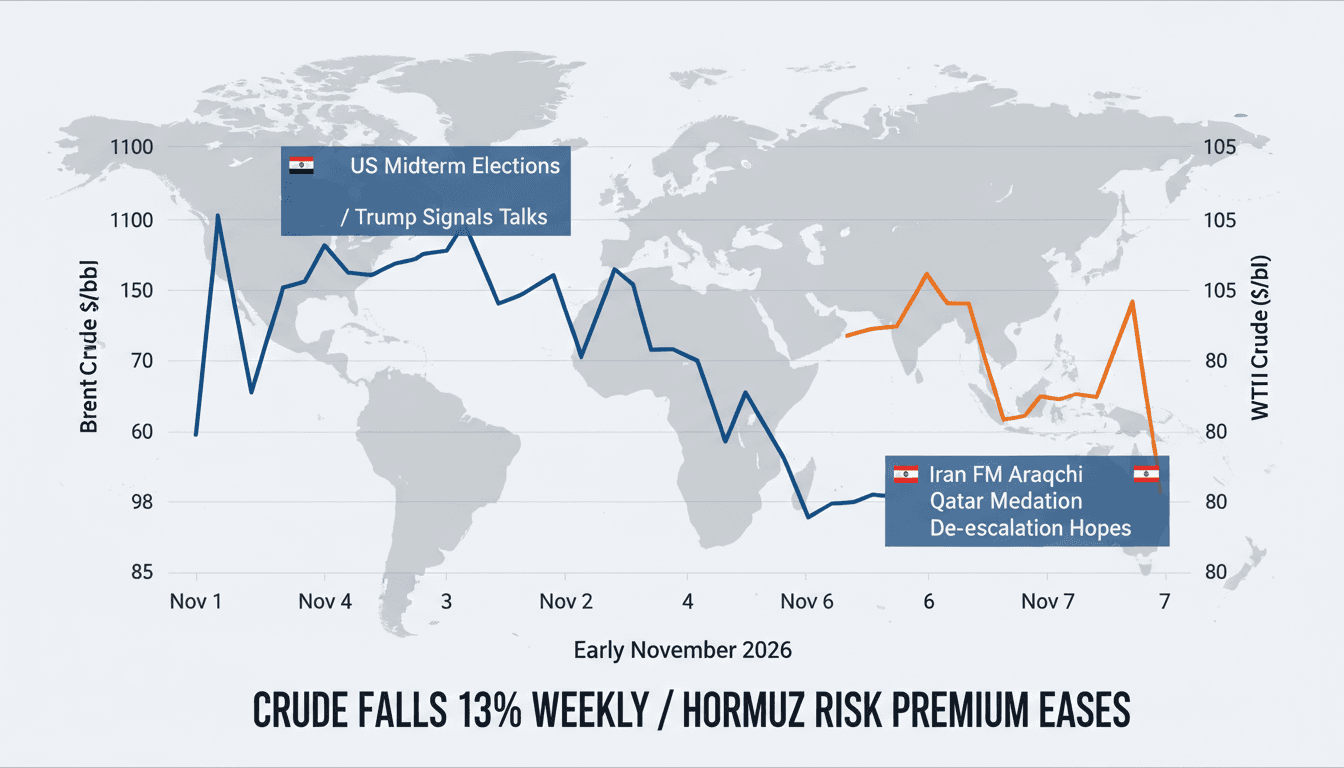
- Crude benchmarks dropped in tandem: Brent crude for January delivery settled at $98.32 per barrel, while West Texas Intermediate closed at $90.83 on November 7, 2026, marking an identical 13% weekly reduction.
- Midterm results shifted geopolitical projections: Following significant losses for the Republican Party in the November 2026 US midterm elections, markets altered their expectations away from ongoing conflict escalation toward negotiated settlements.
- Mediation opened communication channels: Facilitated by Qatari intermediaries, public remarks from the Trump administration alongside Iranian Foreign Minister Abbas Araqchi signaled a shared willingness to de-escalate tensions around the Strait of Hormuz.
The context you actually need
- Pre-election pricing was heavily defensive: Throughout October 2026, crude benchmarks rallied into triple digits as traders factored in localized tanker disruptions and election-related foreign policy uncertainty.
- The Strait of Hormuz remains the core choke point: Prior disruptions along this critical transit lane forced logistics operators to carry inflated risk premiums on physical delivery contracts.
- Technical selling accelerated the drop: Once diplomatic signaling punctured the baseline assumption of military escalation, automated stop-losses and position liquidations multiplied the speed of the 13% weekly slide.
What's really happening
The price movement across international energy exchanges on November 7 was less about immediate physical volume changes and more about the swift liquidation of a systemic risk premium. When commodity markets price crude oil during geopolitical friction, the final tick on the screen reflects two distinct components: the marginal cost of physical extraction and refining, and an added surcharge that covers the probability of an interdiction along major maritime arteries. Throughout late October 2026, that surcharge stayed elevated as traders hedged against an expanding dispute surrounding the Strait of Hormuz.
The outcome of the US midterm elections altered the structural incentives for the key state actors involved. Facing altered legislative realities domestically, the Trump administration signaled an operational pivot toward conflict resolution. Simultaneously, Iranian authorities, represented in public statements by Foreign Minister Abbas Araqchi, signaled their own openness to formal negotiations. These mutual signals provided Qatari mediators with an actionable basis to coordinate de-escalation frameworks.
Because capital allocations in energy derivatives operate on forward-looking scenarios rather than trailing headlines, trading desks acted immediately. When both leadership groups publicly favored negotiation over expanded enforcement, the fundamental rationale for holding deep out-of-the-money call options and long risk hedges vanished. Brent crude settling at $98.32 and WTI at $90.83 reflects institutional desks unwinding those defensive positions. The velocity of the slide—erasing 13% of benchmark value in five trading days—demonstrates how much of the prior price rally was sustained by headline sensitivity rather than real deficits in current consumption.
This reduction reverberates through the operational chain. Energy costs function as a foundational variable for global trade: transport fleets, civil aviation, plastics production, and agricultural logistics all take their base pricing cues from Brent and WTI curves. A double-digit decline in prompt-month contracts lowers the spot expenditure for bulk petroleum products, reducing working capital requirements for industrial supply chains. While physical tanker security incidents created intermittent daily rebounds, the structural direction indicates that trading desks now treat a continuous closure of regional trade channels as a low-probability scenario.
Who feels it first (and how)
- Global logistics and freight operators: Container lines and air-cargo carriers experience an immediate softening in bunker and jet fuel surcharges, freeing up operational cash flow.
- Energy-intensive manufacturing enterprises: Facilities reliant on petroleum derivatives and heavy transport see forward contract pricing ease, reducing procurement risks for early 2027.
- Dubai and Gulf consumers: UAE household budgets and local fleet operators benefit from downward adjustments at retail fuel pumps, reducing daily living and distribution costs in an import-oriented regional economy.
- Commodity-focused portfolio managers: Trading funds positioned for sustained supply disruptions face immediate margin compression as war premiums evaporate from futures contracts.
What to watch next
- Direct verification from Qatari mediation: Formal joint communiqués regarding the status of maritime passage rules will determine whether Brent stabilizes below the $100 threshold.
- Commercial tanker insurance rates: Watch whether maritime underwriters lower war-risk premiums for vessels entering the Strait of Hormuz, which would serve as real-world confirmation of lower geopolitical tension.
- US legislative rhetoric on foreign policy: Statements from incoming congressional leadership will show whether the post-midterm pivot toward regional stability retains domestic institutional support.
Brent crude and WTI dropped 13% across the first week of November 2026, settling at $98.32 and $90.83 per barrel respectively, driven by post-midterm diplomatic initiatives involving US, Iranian, and Qatari officials.
Corporate logistics managers and aviation operators will see secondary transportation indices ease over the next two inventory cycles if current benchmark prices hold.
Whether minor tanker incidents in the Gulf will trigger localized supply pinches that temporarily counter the broader downward trend in spot market pricing.
Frequently Asked Questions
- Why it matters?
- The rapid unwinding of geopolitical premiums signals that commodity trading desks are recalibrating supply-side disruption models, directly shifting cross-border shipping rates and broader corporate input costs.
- What happened (in 30 seconds)?
- Crude benchmarks dropped in tandem: Brent crude for January delivery settled at $98.32 per barrel, while West Texas Intermediate closed at $90.83 on November 7, 2026, marking an identical 13% weekly reduction. Midterm results shifted geopolitical projections: Following significant losses for the Republican Party in the November 2026 US midterm elections, markets altered their expectations away from ongoing conflict escalation toward negotiated settlements. Mediation opened communication channels
- What's really happening?
- The price movement across international energy exchanges on November 7 was less about immediate physical volume changes and more about the swift liquidation of a systemic risk premium. When commodity markets price crude oil during geopolitical friction, the final tick on the screen reflects two distinct components: the marginal cost of physical extraction and refining, and an added surcharge that covers the probability of an interdiction along major maritime arteries. Throughout late October 202
- Who feels it first (and how)?
- Global logistics and freight operators: Container lines and air-cargo carriers experience an immediate softening in bunker and jet fuel surcharges, freeing up operational cash flow. Energy-intensive manufacturing enterprises: Facilities reliant on petroleum derivatives and heavy transport see forward contract pricing ease, reducing procurement risks for early 2027. Dubai and Gulf consumers: UAE household budgets and local fleet operators benefit from downward adjustments at retail fuel pumps, re
- What to watch next?
- Direct verification from Qatari mediation: Formal joint communiqués regarding the status of maritime passage rules will determine whether Brent stabilizes below the $100 threshold. Commercial tanker insurance rates: Watch whether maritime underwriters lower war-risk premiums for vessels entering the Strait of Hormuz, which would serve as real-world confirmation of lower geopolitical tension. US legislative rhetoric on foreign policy: Statements from incoming congressional leadership will show wh
U.S. business news, corporate developments, and economy.
"The Wall Street Journal is respected for deep financial and economic reporting with a center-right editorial perspective."
— A47 Editor
Oil Futures Slide As Market Holds Out Hopes for Middle East Diplomacy
Oil futures posted double-digit losses in the week following the Republican Party's major setbacks in the U.S. midterm elections, as expectations grew that President Trump's administration would pursue a diplomatic path to resolve the conflict with I...
Global political, business, and cultural coverage from WSJ international desks.
"The Wall Street Journal offers extensive international reporting with a reputation for financial insight and a center-right editorial stance."
— A47 Editor
Brent Crude Climbs Above $100 as Middle East Oil Supply Risks Persist
Brent crude rose above $100 a barrel on Friday as traders weighed renewed security threats to Middle Eastern oil shipments, according to The Wall Street Journal, which reported the move amid persisting supply concerns in the region.
English-language digital publication covering business, politics, technology, and current affairs.
"The Arabian Post mixes original and syndicated-style coverage with a broad regional and global business-news orientation."
— A47 Editor
Oil advances towards $100 as tanker attacks persist
Brent crude futures rose 1.31% to $99.58 a barrel in early trading on Friday, briefly crossing $100, as attacks on commercial vessels in the Middle East revived supply concerns and oil prices climbed for a second consecutive session despite expectati...
Arabic-language coverage of Saudi, regional, and international affairs.
"Al Bilad offers mainstream Saudi newspaper coverage across domestic and broader Arab topics."
— A47 Editor
النفط يعود للارتفاع بأكثر من 3%
Brent crude futures rose $3.67, or 3.88%, to settle at $98.29 a barrel, while West Texas Intermediate gained $2.40, or 2.72%, to $90.52, as geopolitical developments lifted oil prices at the close of trading, according to Al Bilad.
Arabic-language economic and business reporting with strong UAE market relevance.
"Emarat Al Youm business coverage often centers UAE property, banking, consumer issues, and economic policy."
— A47 Editor
رغم مكاسبه اليوم.. النفط يتجه لانخفاض أسبوعي حاد رغم مكاسبه اليوم.. النفط يتجه لانخفاض أسبوعي حاد
Oil prices were on track for a sharp weekly decline despite a gain on the day, with January Brent crude futures rising $1.57, or 1.6%, according to Emarat Al Youm. The base report frames the move as part of a broader weekly fall in crude markets.