
US Equity Markets Suffer Steepest Sell-Off Since April 2025 on Post-Midterm AI Data Center Restriction Fears
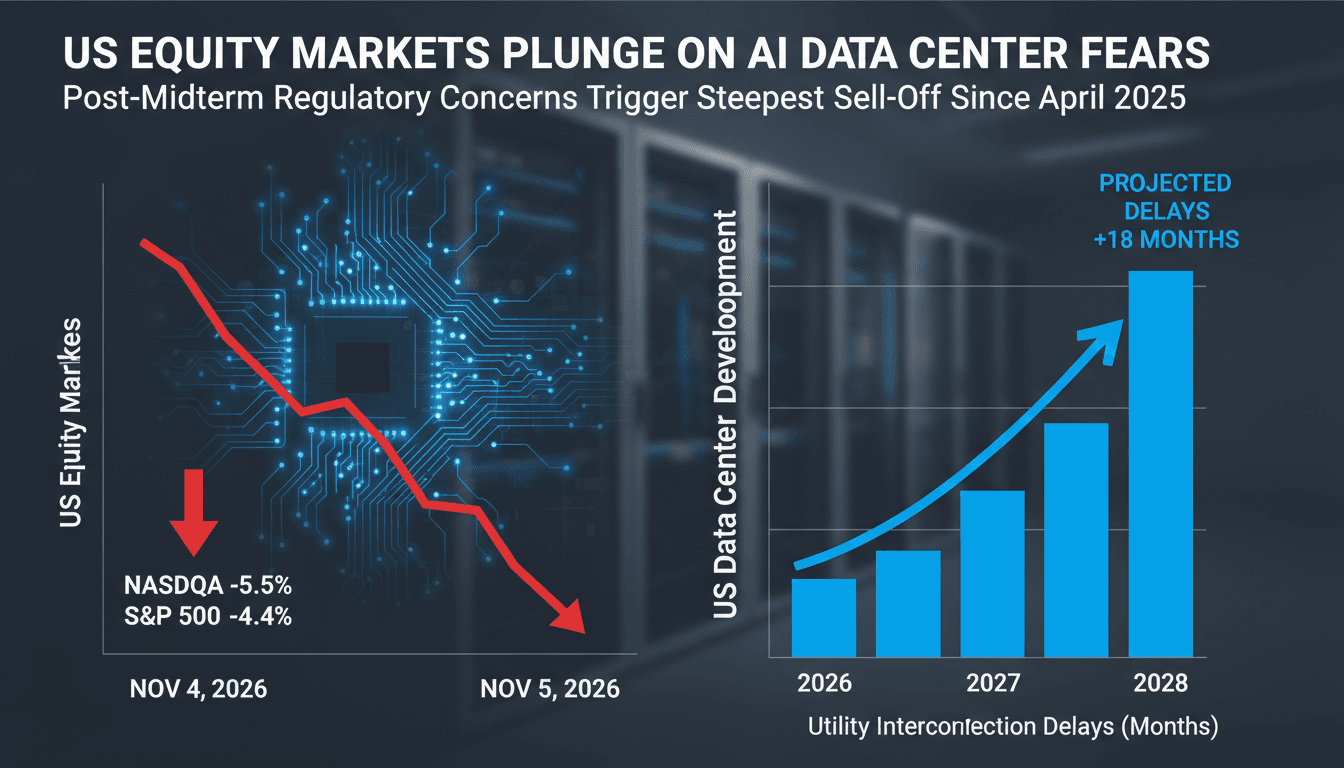
Heightened regulatory scrutiny over physical infrastructure assets means global tech valuations, semiconductor supply allocations, and institutional portfolios face sharp reassessments of long-term deployment timelines.
Why it matters
The convergence of political realignment and resource constraints has triggered an estimated $2.5 trillion to $3.2 trillion market contraction, exposing how heavily modern equity valuations rely on frictionless physical buildouts of power and water infrastructure.
What happened (in 30 seconds)
- Equity markets experienced a sharp downturn: On November 5, 2026, the Nasdaq Composite dropped 5.5 percent and the S&P 500 fell 4.4 percent, recording their steepest single-day declines since April 2025.
- Hardware manufacturers absorbed the heaviest losses: Semiconductor leaders led the decline, with Nvidia falling over 9 percent, AMD dropping more than 17 percent, and the Philadelphia Semiconductor Index retreating approximately 12 percent.
- Global indices recorded immediate spillover: Selling pressure moved through European and Asian exchanges on November 6, alongside a 6.4 percent decline in the Nasdaq 100 relative to pre-election levels, before a modest 1 percent rebound emerged later that day.
The context you actually need
- Federal policy had driven fast-track development: Following the 2024 presidential election, the administration of President Donald Trump established pro-AI policies structured to expedite physical infrastructure expansion and cut administrative delays.
- Midterm outcomes altered legislative control: The November 3, 2026 midterm elections delivered Democratic majorities in both chambers of the US Congress alongside key state governorships, reshaping the federal regulatory outlook.
- Local resistance focused on utilities and municipal resources: Campaign rhetoric and state-level ballot measures targeted data center expansion, citing sharp increases in commercial electricity demand, municipal water consumption, environmental impacts, and local property tax abatements.
What's really happening
The market contraction on November 5–6, 2026, was not driven by a sudden collapse in software demand or algorithmic performance. It was a structural repricing of the physical inputs required to run high-density compute clusters.
For nearly two years, institutional capital operated on the premise that semiconductor design, capital expenditure pipelines, and utility connections would scale in a straight line. Valuations across hardware, foundries, and peripheral equipment suppliers were priced against continuous capacity additions. That financial architecture assumed federal and state authorities would prioritize rapid infrastructure buildouts over municipal resource limits.
The midterm election results altered that incentive calculation. When legislative control shifts, the administrative framework governing energy grids and environmental permitting faces direct revision. Data centers require uninterrupted megawatts of baseload power and millions of gallons of cooling water daily. Municipalities and state-level leaders face growing political incentives to shield residential rate payers from grid strain and preserve local aquifers.
When regional ballots began featuring zoning limits and tax-incentive rollbacks, investors immediately recognized that the constraint on artificial intelligence is no longer chip architecture; it is the physical grid connection. Proposing moratoria in major computing corridors—such as key zones in Texas—forces operators into extended review cycles.
A project delay of 18 to 24 months fundamentally alters the internal rate of return on multi-billion-dollar capital expenditure budgets. If hyperscalers cannot secure utility interconnections, their purchase orders for graphic processing units and advanced packaging inevitably slow down. The market reacted by recalculating cash-flow projections for semiconductor firms whose current earnings multiples depended on uninterrupted hardware delivery schedules.
While the executive branch reiterated its commitment to supporting computational infrastructure, state governors and municipal councils retain statutory jurisdiction over land use, water permits, and local utility contracts. This split in authority introduces operational friction into asset development. When long-term regulatory costs enter an ecosystem previously characterized by rapid deregulation, institutional investors reduce risk by discounting high-multiple tech equities across the board.
Who feels it first (and how)
- Institutional Portfolio Managers and Tech Equity Funds: Experience immediate net-asset-value compression following multi-trillion-dollar drawdowns across core semiconductor and enterprise tech allocations.
- Semiconductor and Hardware Manufacturers: Face inventory and revenue-recognition uncertainties as hyperscalers re-evaluate their delivery schedules against state permitting timelines.
- Municipal Grid Operators and Regional Utilities: Encounter conflicting mandates between federal infrastructure priorities and local political directives aimed at capping high-voltage commercial tie-ins.
- Global and Regional Cross-Border Investors: Absorb broader equity volatility and a surging VIX index, prompting defensive realignments even in jurisdictions without direct domestic regulatory shifts.
What to watch next
- State-level moratorium votes in Texas and key tech hubs: State legislative sessions and county zoning boards will signal whether proposed construction freezes gain statutory backing or dissolve into standard administrative delays.
- Hyperscaler capital expenditure revisions: Upcoming quarterly earnings calls will clarify whether major cloud providers adjust their stated 2027 infrastructure spending targets downward in response to utility grid bottlenecks.
- Federal administrative interventions: Watch for executive directives or federal agency rules attempting to assert national-security preemption over municipal-level utility and water restrictions.
The Nasdaq Composite declined 5.5 percent and the S&P 500 dropped 4.4 percent on November 5, 2026, erasing $2.5 trillion to $3.2 trillion in equity value as chipmakers like AMD and Nvidia saw double-digit and near-double-digit drops.
Heightened regulatory review across key states will extend project lead times for new high-density data centers, forcing cloud providers to reassess immediate hardware deployment schedules.
The extent to which federal executive authority can override state-level water and electricity zoning ordinances remains legally untested, leaving long-term infrastructure timelines unresolved.
Frequently Asked Questions
- Why it matters?
- The convergence of political realignment and resource constraints has triggered an estimated $2.5 trillion to $3.2 trillion market contraction, exposing how heavily modern equity valuations rely on frictionless physical buildouts of power and water infrastructure.
- What happened (in 30 seconds)?
- Equity markets experienced a sharp downturn: On November 5, 2026, the Nasdaq Composite dropped 5.5 percent and the S&P 500 fell 4.4 percent, recording their steepest single-day declines since April 2025. Hardware manufacturers absorbed the heaviest losses: Semiconductor leaders led the decline, with Nvidia falling over 9 percent, AMD dropping more than 17 percent, and the Philadelphia Semiconductor Index retreating approximately 12 percent. Global indices recorded immediate spillover: Selling pr
- What's really happening?
- The market contraction on November 5–6, 2026, was not driven by a sudden collapse in software demand or algorithmic performance. It was a structural repricing of the physical inputs required to run high-density compute clusters. For nearly two years, institutional capital operated on the premise that semiconductor design, capital expenditure pipelines, and utility connections would scale in a straight line. Valuations across hardware, foundries, and peripheral equipment suppliers were priced a
- Who feels it first (and how)?
- Institutional Portfolio Managers and Tech Equity Funds: Experience immediate net-asset-value compression following multi-trillion-dollar drawdowns across core semiconductor and enterprise tech allocations. Semiconductor and Hardware Manufacturers: Face inventory and revenue-recognition uncertainties as hyperscalers re-evaluate their delivery schedules against state permitting timelines. Municipal Grid Operators and Regional Utilities: Encounter conflicting mandates between federal infrastructure
- What to watch next?
- State-level moratorium votes in Texas and key tech hubs: State legislative sessions and county zoning boards will signal whether proposed construction freezes gain statutory backing or dissolve into standard administrative delays. Hyperscaler capital expenditure revisions: Upcoming quarterly earnings calls will clarify whether major cloud providers adjust their stated 2027 infrastructure spending targets downward in response to utility grid bottlenecks. Federal administrative interventions: Watc
National headlines across the United States including breaking stories and societal issues.
"NBC News is a mainstream media outlet known for comprehensive national and international news coverage with a centrist to slightly left-leaning editorial tone."
— A47 Editor
Stocks Plunge Amid AI Fears and Political Uncertainty
U.S. stocks suffered their worst day since April 2025 on Thursday, with the S&P 500 and the Nasdaq falling sharply and technology and AI-linked companies among the biggest losers. Investors attributed the sell-off largely to uncertainty over how a De...
Stock market news, investing ideas, and trading analysis.
"TheStreet provides market news and retail-investor-focused analysis."
— A47 Editor
Stock Market Today (Nov. 6, 2026): Nasdaq, S&P 500 rise after midterms AI rout
Nasdaq and S&P 500 rose on November 6, 2026, recovering from a sharp AI-related sell-off that followed Democratic gains in the US midterm elections, according to TheStreet. Investors had been dumping tech shares partly over concerns that a Democratic...
Markets, economy, and company analysis from NYT’s business desk.
"The New York Times is a globally recognized newspaper offering authoritative reporting with a center-left editorial stance."
— A47 Editor
Stocks Erase Post-Midterm Elections Rally, Dragged Down by Tech
Stocks reversed a post-midterm rally as the S&P 500 posted its worst daily decline since April 2025 and the tech-heavy Nasdaq entered correction territory, with investors voicing doubts about the durability of the A.I. infrastructure build-out.
Editor-curated FT homepage stories spanning markets, business, world, and opinion.
"The Financial Times is a globally respected business publication with a centrist/center-left tone and strong markets focus."
— A47 Editor
Nasdaq drops the most since pandemic as Democratic ‘blue wave’ upends AI bets
The Nasdaq suffered its steepest drop since the pandemic as investors reacted to a Democratic 'blue wave' in the US midterm elections, with fears that newly elected politicians could slow data centre development and disrupt bets on artificial intelli...